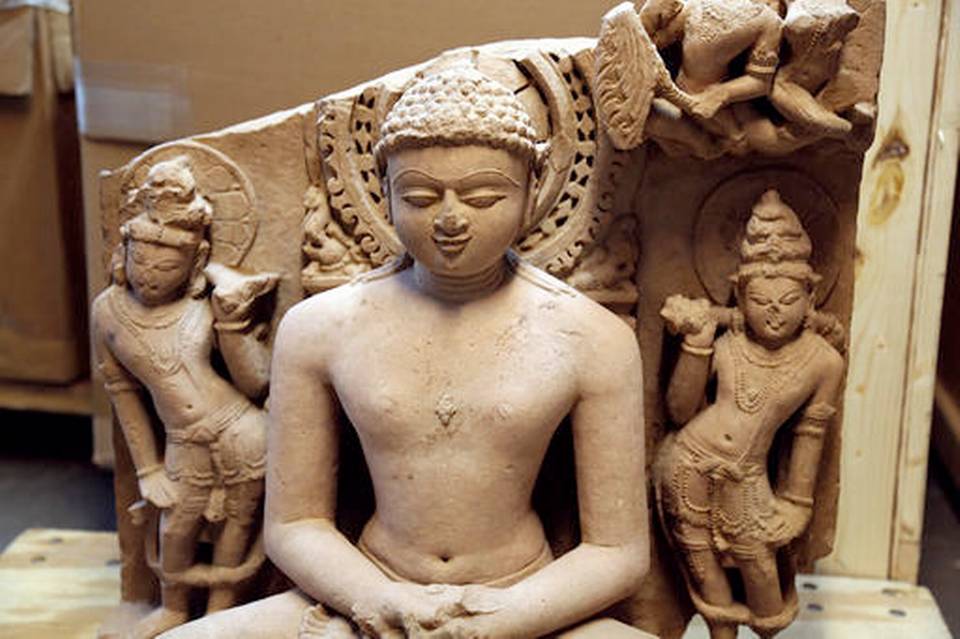
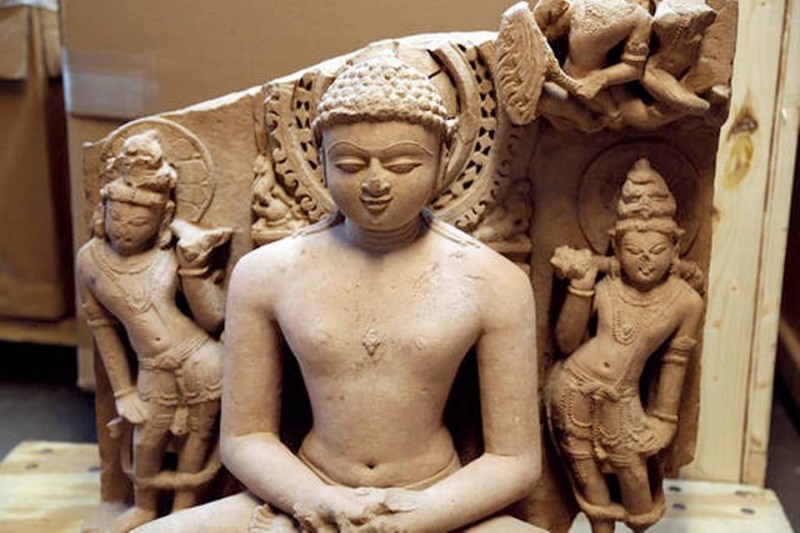
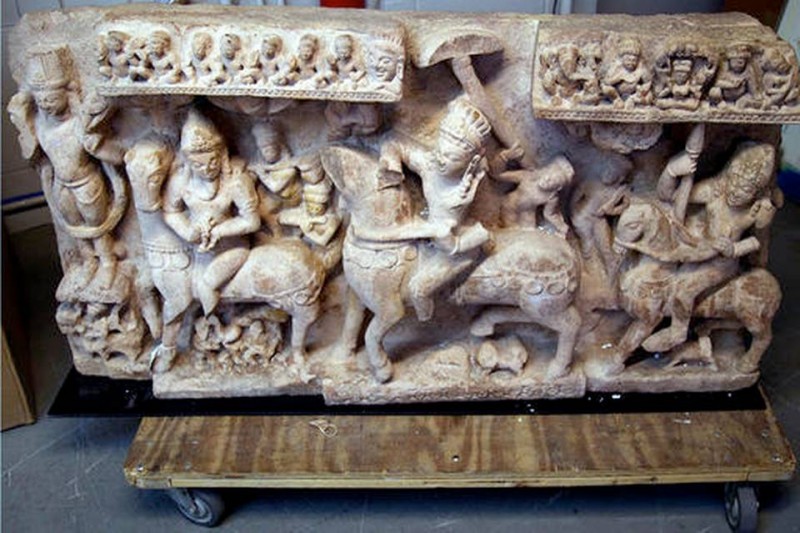
The two sandstone statues—Stele of Rishabhanata and Revanta—are valued at about $150,000 and $300,000 respectively.
Two Indian statues that are more than 1,000 years old were seized from Christie’s auction house after investigators discovered they had been smuggled out of the country, eventually landing in New York.
The artifacts made from sandstone were recovered from the auction house following an international investigation with assistance from the Indian government and the Interpol.
The seizure occurred on Friday. The antiquities were to be part of an auction next week called “The Lahiri Collection: Indian and Himalayan Art, Ancient and Modern.”
One statue called “Stele of Rishabhanata” depicts a stele carved with the first Jain Tirthankara and is valued at approximately USD 1,50,000. It is believed to be from Rajasthan or Madhya Pradesh belonging to the 10th century AD.
A sandstone statue of Rishabhanata, from Rajasthan or Madhya Pradesh, India, in the 10th century A.D., flanked by a pair of attendants. It is valued at approximately $150,000 [Credit: U.S. Immigration and Customs Enforcement]The second artifact is a Buff Sandstone Panel depicting Revanta and His Entourage from India in the 8th Century AD, in a very rare representation of the equestrian deity and valued at approximately USD 300,000.
A sandstone panel depicting a very rare representation of the equestrian deity, Revanta, and his entourage, from India, in the 8th Century A.D. It is valued at approximately $300,000 [Credit: U.S. Immigration and Customs Enforcement]Christie’s said in a statement that it would never knowingly offer a stolen work of art and it was cooperating with authorities.
“Christie’s devotes considerable resources to investigating the provenance of all objects we offer for sale. This is one of the difficulties the art market faces in vetting antiquities, which is why Christie’s very much values building strong relationships with and between countries of origin, law enforcement, archeologists, and the collecting community,” the statement read.
According to a yearslong, ongoing investigation by federal agents and the Manhattan district attorney’s office, the Rishabhanata statue was sold in 2006 or 2007. The Revanta panel contained a piece that had been perfectly broken off to be sold by smugglers after the sale of the main sculpture.
The seizure sends an important message, said Angel M. Melendez, special agent in charge of the New York office of U.S. Immigration and Customs Enforcement’s Homeland Security Investigations.
“First and foremost, it demonstrates that we are committed to protecting cultural heritage around the world, and second, it demonstrates that we are monitoring the market to protect prospective buyers as well,” Melendez said.
Investigators believe both came from a smuggler in India who’s awaiting trial on charges he looted rare antiquities worth tens of millions of dollars from seven countries. Federal officials said four museums and a collector have surrendered looted artifacts within the past year. Four others have been arrested in the scheme.
The consul general of India praised authorities for their work in tracking down the statues.
“I would like to convey my deep sense of appreciation to HSI for the exceptional work done in locating and retrieving the sculptures brought into the United States by organized crime syndicates,” said Ambassador Riva Ganguly Das.
Most Indians today are well aware of the two famous ancient universities of India which also are one of the oldest universities in the world – Takshashila University (Taxila) and Nalanda. But are these the only knowledge centers that existed in ancient India?
Education has always been given great prominence in Indian society since the times of the vedic civilization, with gurukul and ashrams being the centers of learning. And with evolving times, a large number of centers of learning were established across ancient India of which Takshashila and Nalanda are the most famous ones known today.
Below is a list of major ancient universities that flourished across ancient India.
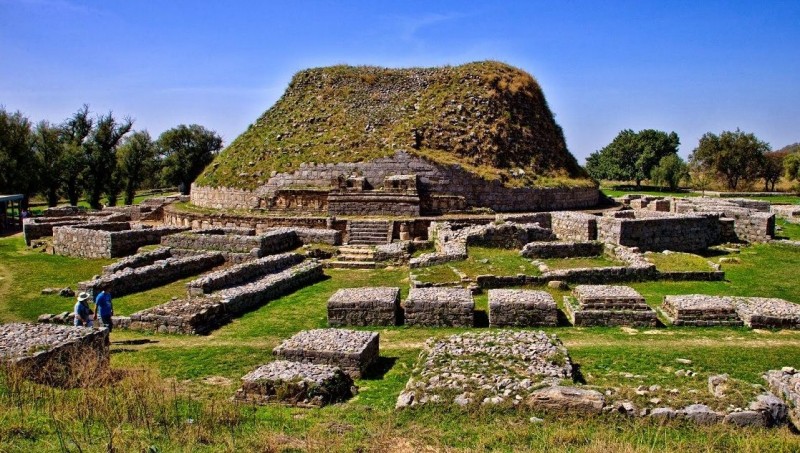
Takshashila University
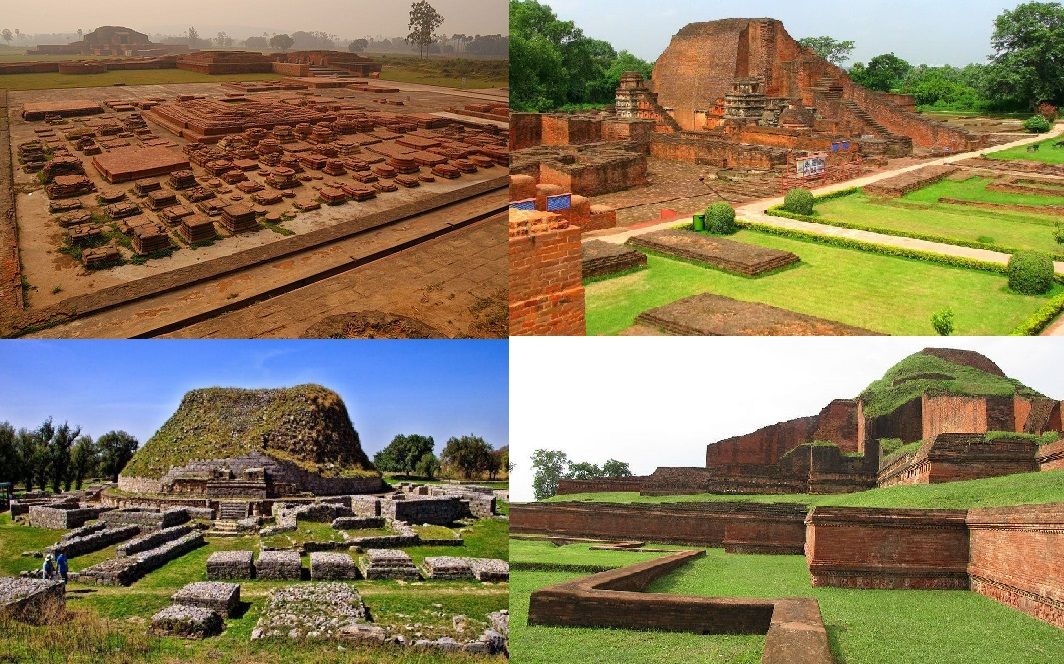
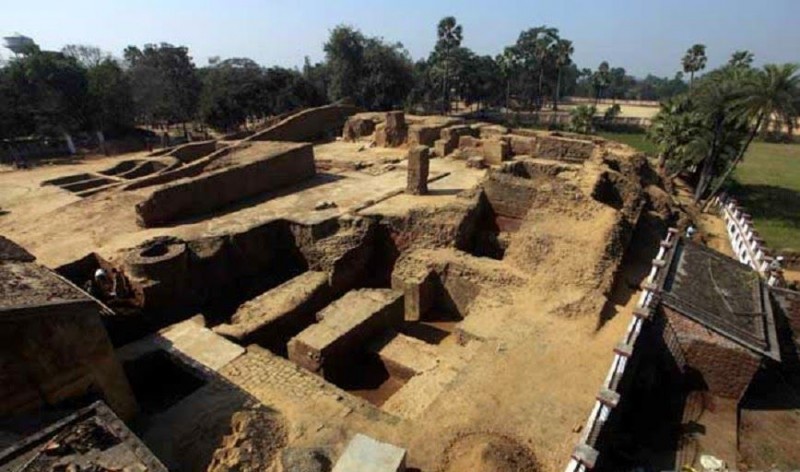
Ruins of Takshasila University in present day Pakistan. –img source
Taxila as it is called today, Takshashila University established around 2700 years ago was home to over 10500 students where the students from all across the world used to come to attain specialization in over 64 different fields of study like vedas, grammar, philosophy, ayurveda, agriculture, surgery, politics, archery, warfare, astronomy, commerce, futurology, music, dance, etc.
Taxila is also described in some detail in the Buddhist Jātaka tales, written in Sri Lanka around the 5th century. In this text, Taxila has been mentioned as the capital of the kingdom of Gandhara and a great learning center. Chinese travellers like Fa Hian (Faxain) and Huien Tsang (XuanZang) also speak of Takshashila in their writings.
Famous graduates of this University include the ones like Chanakya, Panini, Charaka, Vishnu Sharma, Jivaka etc. This is the world’s oldest university.
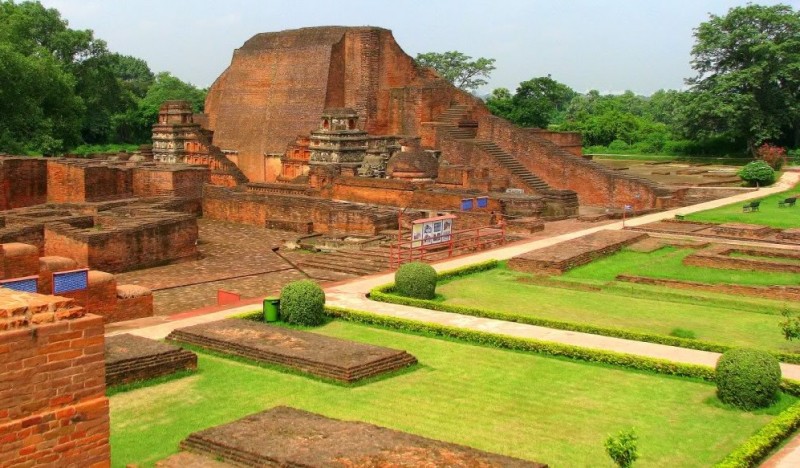
Nalanda University was established by Shakraditya of Gupta dynasty in modern Bihar during early 5th century and flourished for 600 years till 12th century. Nalanda was the world’s first university to have residential quarters for both students and teachers. It also had large public lecture halls. Students from countries like Korea, Japan, China, Tibet, Indonesia, Persia and Turkey came to study in this university. Nalanda University was set on fire by Turkish Muslim army under Bakhtiyar Khilji in 1193.
The great library of Nalanda University was destroyed, ransacked and burnt by the soldiers of Khilji’s army and it is said that it was so vast that the manuscripts kept burning for three months. In-numerous number of ancient Indian manuscripts carefully preserved for thousands of years were destroyed in this fire. Thousands of monks in the University were burnt alive and beheaded by Khilji’s army.
In 2010, the parliament of India passed a bill approving the plans to restore the ancient Nalanda University as a modern Nalanda International University dedicated for post-graduate research. Many east asian countries including China, Singapore and Japan have come forward to fund the construction of this revived Nalanda University.
Pushpagiri University
Pushpagiri University was established in ancient Kalinga kingdom (modern day Odisha) and was spread across Cuttack and Jajpur districts. It was established in 3rd century and flourished for the next 800 years till 11th century. The university campus was spread across three adjoining hills – Lalitgiri, Ratnagiri and Udayagiri. This was one of the most prominent centers of higher education in ancient India along with the universities of Takshashila, Nalanda and Vikramashila.
The Chinese traveler Xuanzang (Huien Tsang) visited this university in 639 CE. Lalitgiri is said to have been commissioned by early 2nd century BCE itself and is the oldest Buddhist establishments in the world. Recently a few images of Emperor Ashoka have been discovered here, and it has been suggested that the Pushpagiri University was established by Emperor Ashoka himself.
Valabhi University
Valabhi University was established in Saurashtra of modern Gujarat at around 6th century and it flourished for 600 years till 12th century. Chinese traveler Itsing who visited this university during the 7th century describes it as a great center of learning. Gunamati and Sthiramati, the two famous Buddhist scholars are said to have graduated from this University.
This University was popular for its training in secular subjects and students from all over the country came to study in this University. Because of its high quality of education, graduates of this University were given higher executive posts.
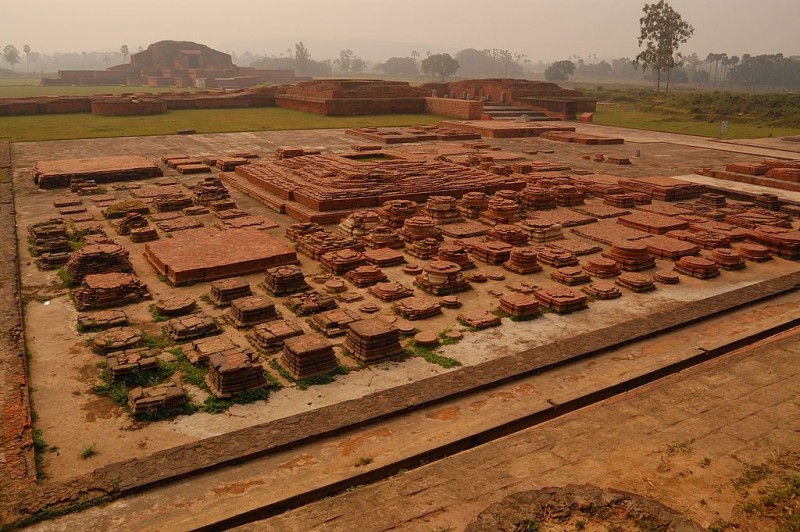
Vikramashila University was established by Dharmapala of Pala dynasty during late 8th century and flourished for 400 years till 12th century. It was located in the Bhagalpur district of modern day Bihar. It gave direct competition to Nalanda University with over 100 teachers and over 1000 students listed in this University. This university was well known for its specialized training on the subject of Tantra (Tantrism).
One of the most popular graduates from this University was Atiśa Dipankara, a founder of the Sharma traditions of Tibetan Buddhism who also revived the Buddhism in Tibet.
Odantapuri University
Odantapuri University was established by Dharmapala of Pala dynasty during late 8th century in Magadha (which is in modern day Bihar) and flourished for 400 years till 12th century. The famous Acharya Sri Ganga who was a professor at the Vikramashila University was a graduate of this Odantapuri University.
According to the ancient Tibetan records there were about 12,000 students studying at this University. Ancient Tibetan texts mention this as one among the five great Universities of its time, the other four being Vikramashila, Nalanda, Somapura and Jagaddala Universities – all located in ancient India.
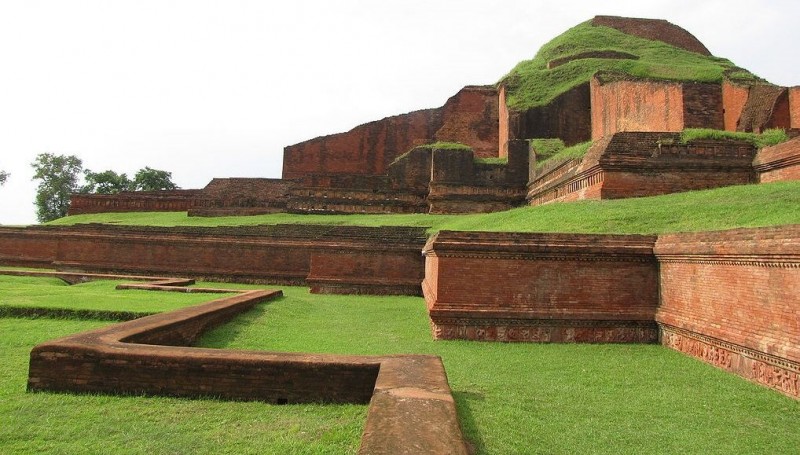
Somapura Mahavihara was established by Dharmapala of Pala dynasty during late 8th century in Bengal and flourished for 400 years till 12th century. The University spread over 27 acres of land of which the main complex was 21 acres was one of the largest of its kind.
It was a major center of learning for Bauddha Dharma (Buddhism), Jina Dharma (Jainism) and Sanatana Dharma (Hinduism). Even today one can find ornamental terracotta on its outer walls depicting the influence of these three traditions.
Ruins of Telhara University were found in January 2014 during excavation of a 45-foot high mound. Based on findings archaeologists placed the Telhara University back to first century AD to Kushan Empire. It is said the university was built by one of the descendents of Magadha ruler Bimbisara.
Nalanda University was set on fire by Turkish Muslim army under Bakhtiyar Khilji in 1193. During the excavation work, the team members stumbled upon a 1.5-foot-thick layer of ash, suggesting that Telhara University was also burnt by Khilji on his way.
Other Ancient Universities
The above mentioned list is not a complete list of ancient Indian universities either. Dharmapala of Pala dynasty alone is said to have established 50 mega learning centers across his kingdom, and they have been as huge and as popular as the ones mentioned above. For instance, the Munshiganj Vihara discovered as recently as March 23, 2013 in Bengal is said to have been established in 9th century and was home to 8000 students who came from faraway places like China, Tibet, Nepal and Thailand.
Further centers include Jagaddala, in Bengal (from the Pala period to the Muslim conquest), Nagarjunakonda, in Andhra Pradesh, Sharada Peeth, in modern day Pakistan Administered Kashmir, Varanasi in Uttar Pradesh (8th century to modern times), Kanchipuram, in Tamil Nadu, Manyakheta, in Karnataka.
Destruction of Ancient Indian Universities
As you can see, many of the universities mentioned above came to an end around 12th century. The universities like Nalanda, Vikramashila etc were destroyed around this period during the Muslim invasion of India by the fanatic Bakhtiyar Khilji from Turkey in 1193 CE.
The destruction of these centres of learning at Nalanda and other places across northern India was responsible for the demise of ancient Indian scientific thought in mathematics, astronomy, alchemy, and anatomy.
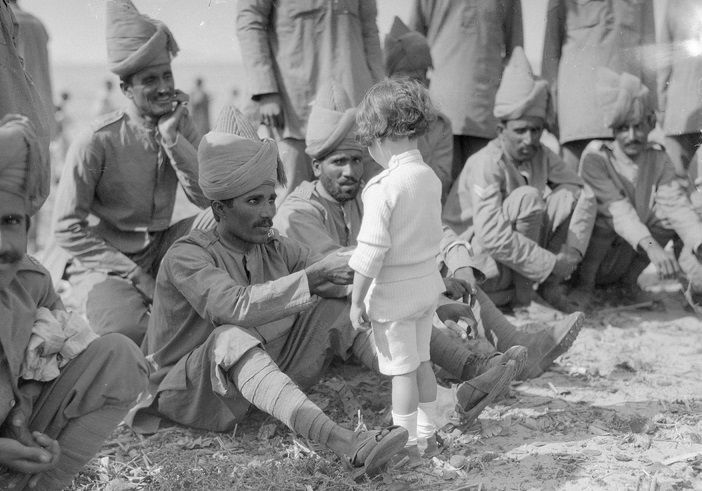
Britain’s World War-I army included Indian children as young as 10-years-old fighting against the Germans on the western front, according to a new book on the role of Indian soldiers in the Great War.
The account by writer and historian Shrabani Basu is based on official papers at the National Archives and British Library. Some of the Indian children, including a 10-year-old “bellows blower”, and two grooms, both 12, provided support to cavalry regiments, a ‘Sunday Times’ report said.
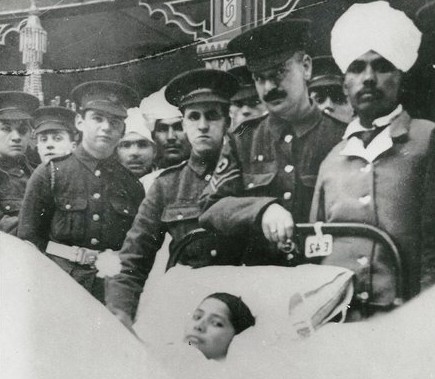
Pim, a Gurkha boy, was given an award for bravery in combat
One of the youngest boys involved in direct combat was a “brave little Gurkha” called Pim, 16, who was given an award for valour by Queen Mary while he was recuperating in hospital in Brighton. Basu believes many of the children came from poor families and that they would have lied about their age at recruitment offices in India, where they were encouraged to sign up for a monthly salary of 11 rupees.
“In the case of a 10-year-old, it should have been pretty obvious that they were underage,” she told the newspaper.
This embarrassment was shared by some British officials.
In one dispatch to Lord Kitchener, secretary of state for war, Sir Walter Lawrence, a civil servant tasked with overseeing injured Indian troops, wrote: “It seems a great pity that children should have been allowed to come to Europe.” About 1.5 million Indian soldiers fought for Britain in the First World War, with a handful being awarded the Victoria Cross bravery medal.
Basu’s book also reveals that British nurses were barred from treating Indian soldiers in war hospitals and were allowed only to supervise orderlies, leading to claims of discrimination.
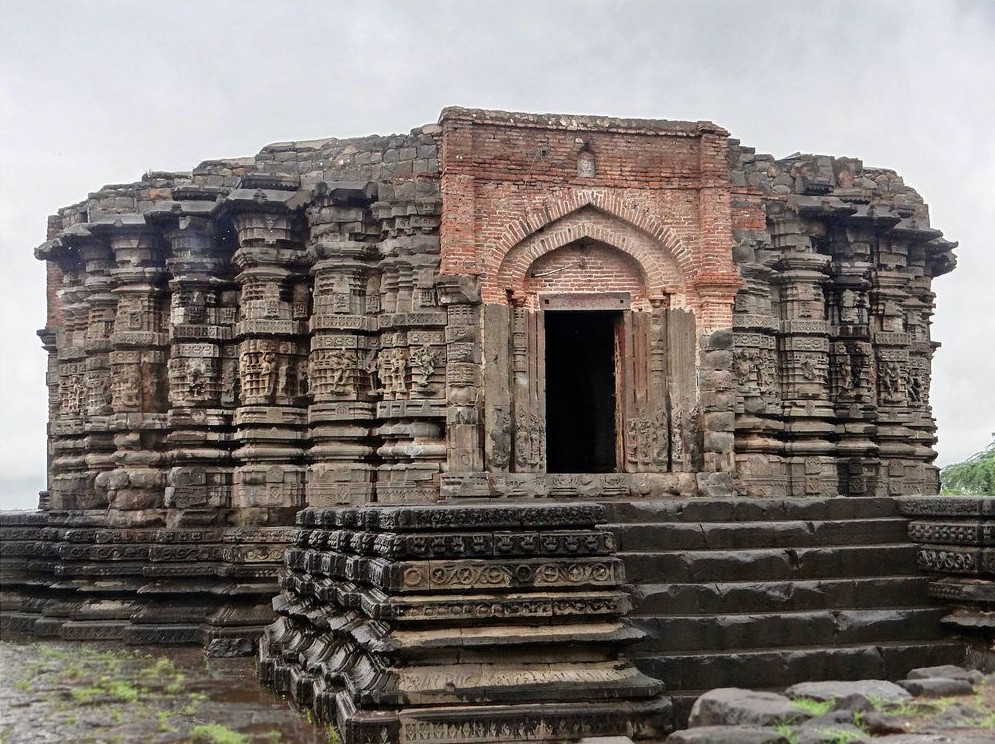
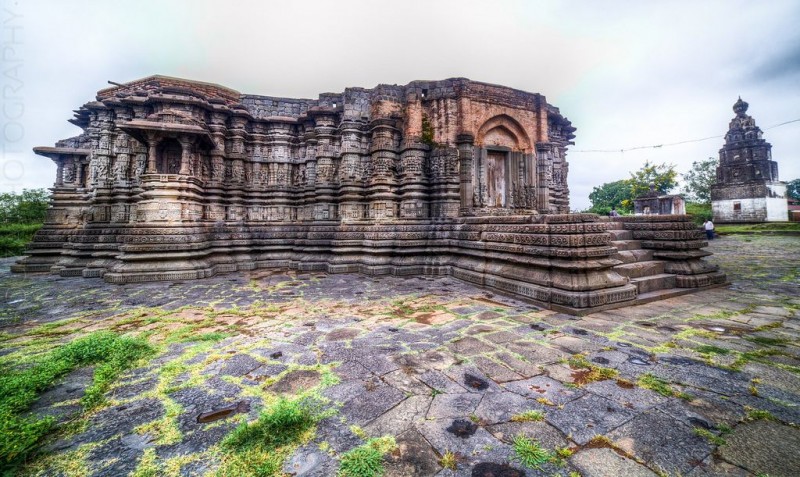
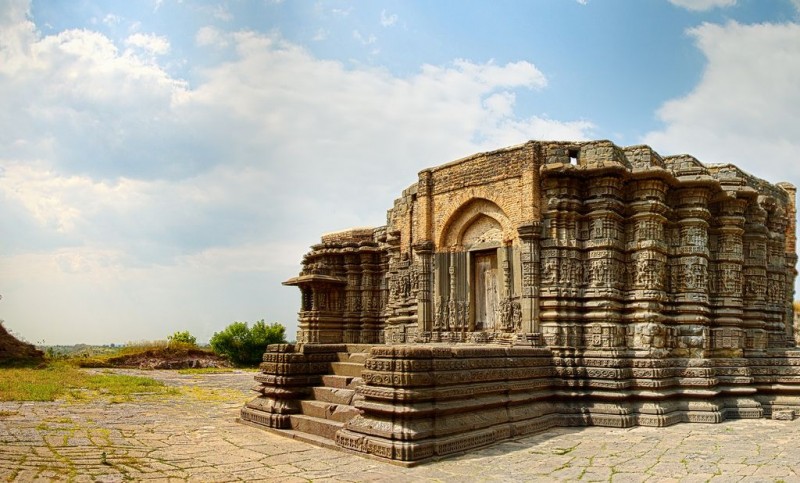
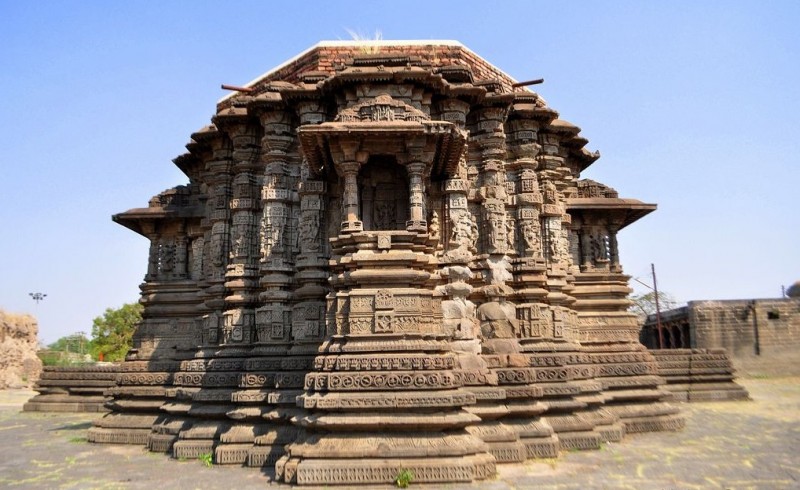
Daitya Sudan Temple is a Vishnu temple dated to the Chalukya Dynasty which ruled Central and Southern India between the 6th and 12th centuries.
This temple is an example showing how a temple gets converted to mosque. There are clear visible evidences of invading Muslim forces who tried to convert this historic Hindu temple into a mosque. Attempts have been made to layer the main gateway of the temple with red bricks in Islamic style.
The deity of this temple is made of an ore with high metal content and looks like stone. The present day idol was made by bholse rulers of Nagpur after the original went missing. Area out-side the sanctum is dark and the ceiling reveals beautiful carvings under a torch light. The plinth of the temple is about 1.5 m in height and the unfinished roof suggests an intended pyramidal form for the tower
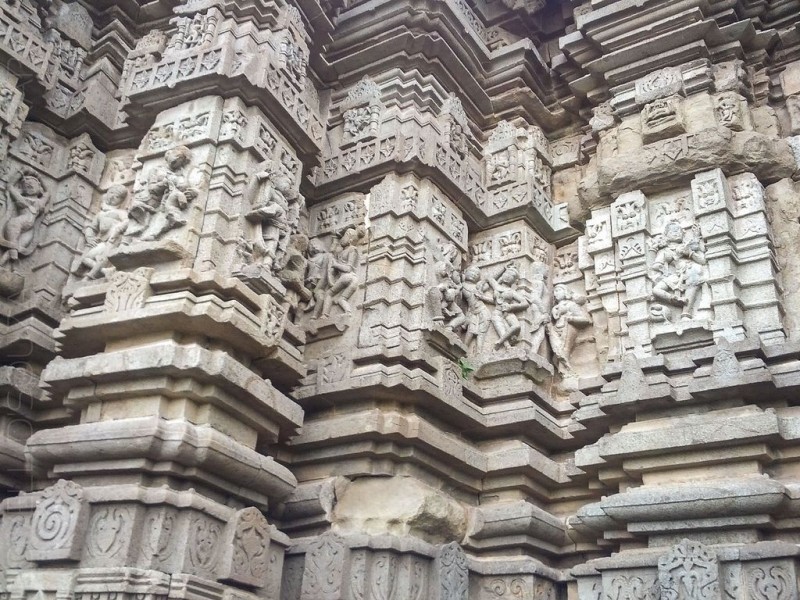
One of the best examples of Hemadpanti style of construction, the temple is built in the form of an asymmetrical star. Wonderful erotic carvings of the temple resembles to the popular Khajuraho temples and definitely reminds you about the exquisitely rich elaborated carvings of Badami or Pattadakkal, built by the mighty Chalukyas only.
Detailed carvings which covered the entire surface of the temple, elaborates stories from the Puranas, great epics like Ramayana & Mahabharata, incarnations of various gods & goddesses, Apsaras, Yakshas, Kinnaras and Kamasutras.
Erotic carvings on the Daitya Sudan Temple, Lonar. img source
From the standing image of Surya in the principal niche on the back of the temple it is conjectured that the temple was originally dedicated to the Sun god. However, in the present form its vaishnav temple of god vishnu in its daityasudan avatar.
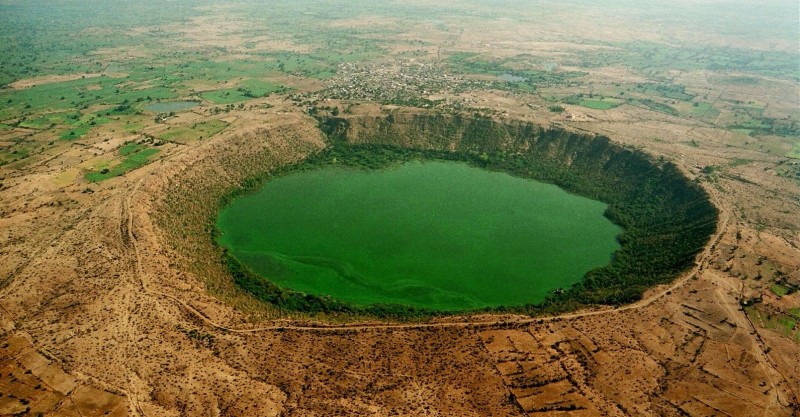
Daitya Sudan Temple is located near the Lonar crater – the world’s only salt water lake in basaltic rock, believed to have been caused by a meteorite hitting Earth around 52, 000 years ago. It is surrounded by forests with a large variety of birds, particularly peacocks, owls, red-wattled Lapwings and ducks. A number of temples surround the lake, most of which stand in ruins today.
According to local belief, Lonar derives its name from the mythical demon Lonasura (also called Lavansura). This demon used to harass and trouble the local people so much that Lord Vishnu descended to earth to vanquish him. The crater, and the lake that now fills it, was formed when Lonasura was pushed back into the netherworld with tremendous force by Vishnu!
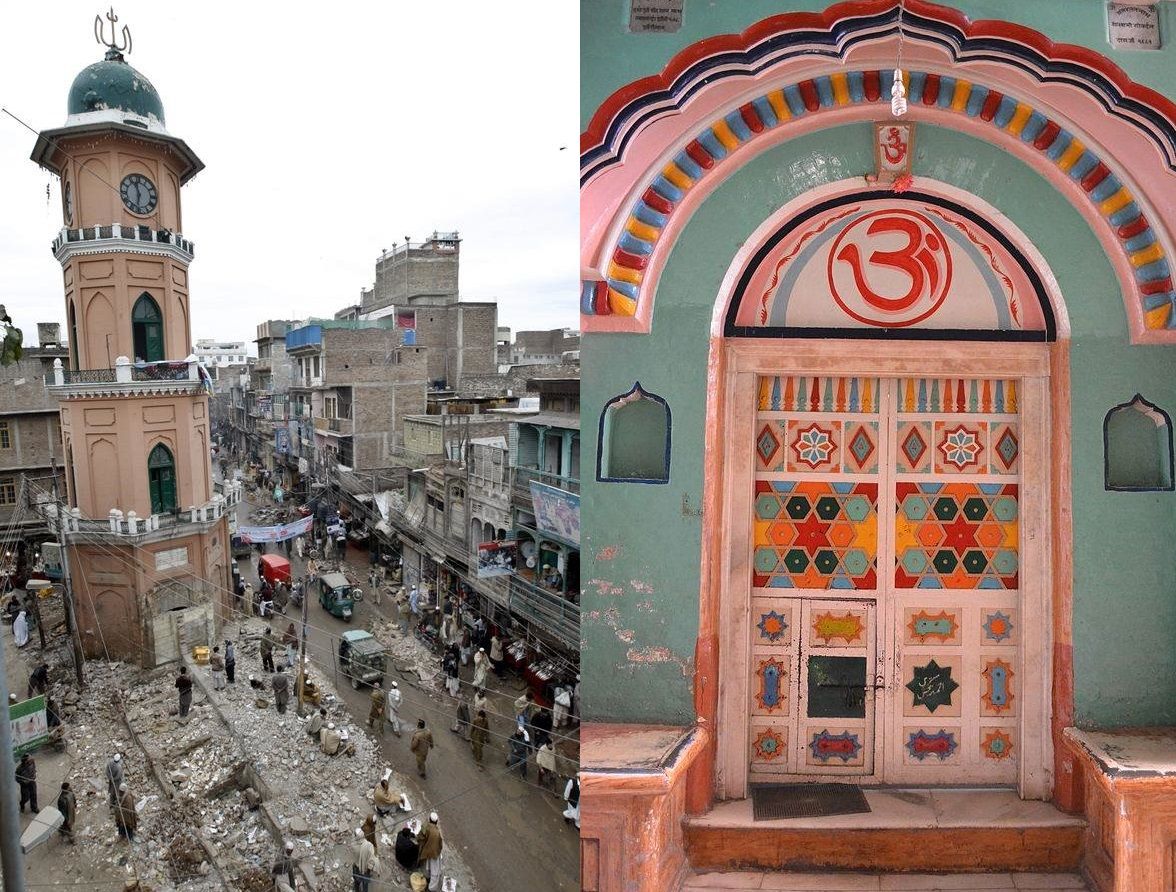
An ancient Hindu temple in this northwestern Pakistani city is being demolished secretly in the name of repair with a commercial plaza set to come up on its land. The process began 10 days ago and is going on without any hindrance.
It is a pity that a criminal act of pulling down a heritage structure has been launched. The building is being knocked down clandestinely to erect a commercial plaza on the site. There is no action from any of the government departments which are supposed to protect such buildings.
A local resident
Another resident said it was a double-criminal act. “On the one hand an ancient building is being demolished while on the other a commercial plaza is set to be constructed on its land in a purely residential area,” he told The News.
Residents questioned the silence of government departments on the episode. They also deplored the inaction of authorities. There has been no action by the Evacuee Trust Property Board and Auqaf Department, which deal with non-Muslim properties, and the Archaeology Department.
“Either these departments are a partner in the crime or they are negligent,” a resident said. Demanding an immediate halt to the demolition process, the residents asked ETPB Chairman Saddique-ul-Farooq to order a probe into the issue to bring to justice the government officials whose negligence or tacit approval had put in danger the ancient Hindu temple.
The Civil Society members, in a statement, said this is a painful story in all major cities of Pakistan where speculative land mafia in collusion with lower-tier government officials and police get away with destroying Pakistan’s precious heritage. The government is reduced to being a silent spectator in this demolition, they said.
India is home to some of the most magnificent structures in the world. Places like Taj Mahal, Chittorgarh, Jaisalmer Fort, The Golden Temple, mesmerizes one with its splendour. However, in its basket of historical treasures,there are many stunning and awe-inspiring structures that even their state of ruins, stand proudly bearing testimony to the golden era of Kings and dynasties.
The ruins and abandoned places in India were once full-fledged colonies inhabited by a whole civilisations. These abandoned historical ruins have mysterious stories behind them. While some of these towns were known as ‘ghost towns’ some others were destroyed by war.
Presenting to you a list of Lesser known but architectural marvels of India, currently in the form of ruins
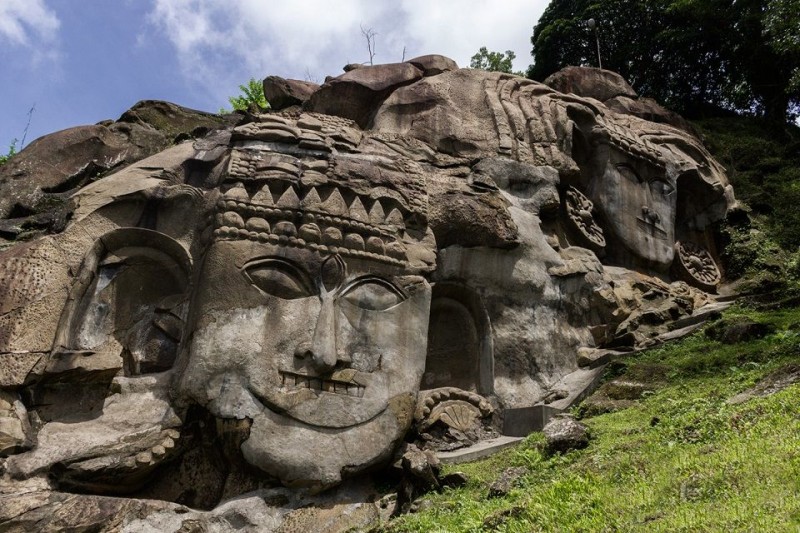
Uninhabited, unexplored and largely unknown to tourists, Unakoti in Tripura is like a treasure hunt. There are hundreds of massive rock-cut sculptures and those made out of sandstone, besides scattered ruins of ancient temples make Unakoti a unique place. It lies in the middle of lush green forest and the largest part of the sculptures has buried beneath the earth and those were never excavated. It is believed, according to local legend, that the place was cursed by Shiva.
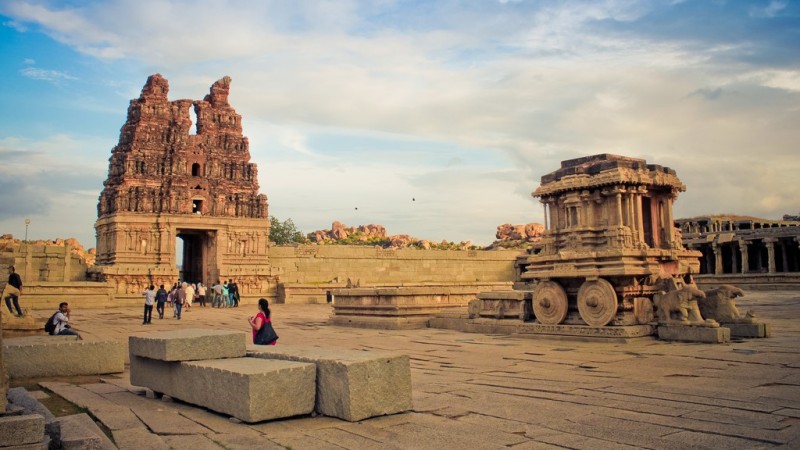
Spread across 25 kms, once the capital of the prosperous kingdom of Vijaynagar, the ruins of Hampi are now the listed under the UNESCO World Heritage sites. In around 1500 A.D. Vijaynagar had 500,000 inhabitants, probably making it the second largest city in the world after Peking-Beijing and twice the size of Paris back then! It was later captured and destroyed by Muslim armies and abandoned ever since.
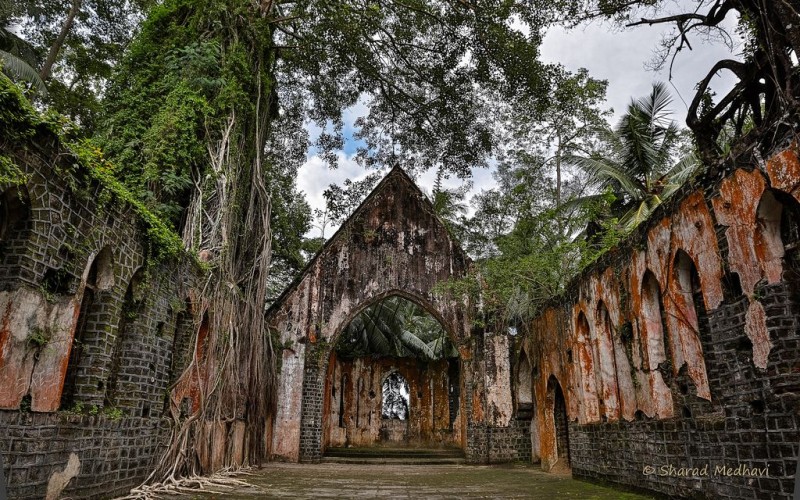
Ross Island was the Administrative Headquarters for the Andaman and Nicobar islands before an earthquake rocked it in 1941. All that remains are the beautiful ruins of once what was a flourishing city that boasted of every modern amenity possible. The island has remnants of an opulent past in the ruins of the church, swimming pool and the chief commissioner’s residence with its huge gardens and grand ballrooms. There is also a cemetery and a small museum managed by the Indian Navy.
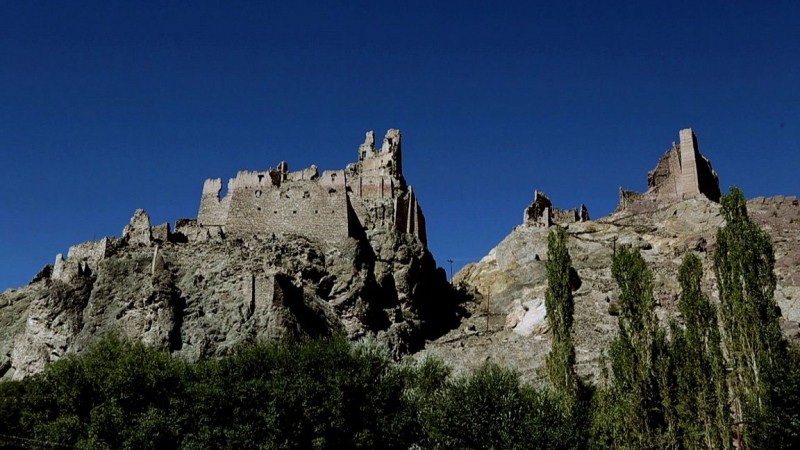
The Chiktan fort, a desolate, abandoned structure that lies atop a hill, is the Indian version of the castle of Count Dracula. The fort was built in the 16th century and was 9 storeys high. Unfortunately, today it stands in ruins as just walls and rubble. It gives the image of a castle with the backdrop of snow capped mountains. The view from the fort is equally spectacular.
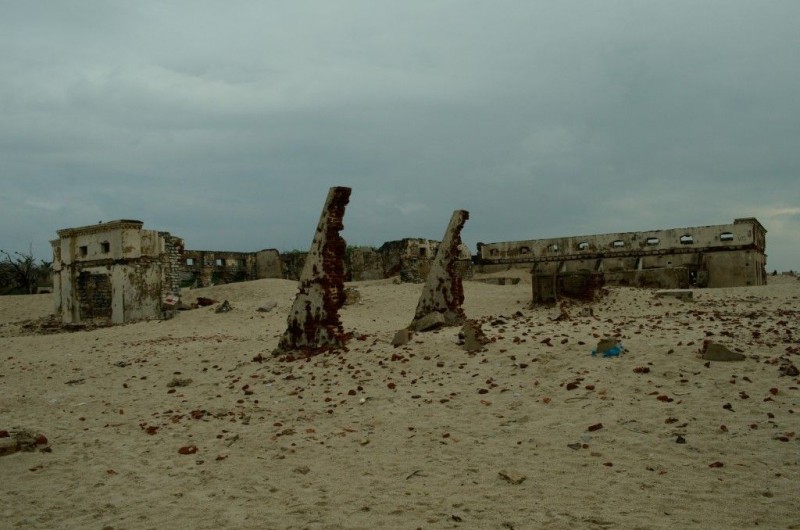
Located at the south-eastern tip of Pamban Island, the town was once a thriving tourist spot. This place was completely washed away in 1964 by a gigantic cyclone, killing as many as 1800 people submerging under a big wave. From temples to churches, houses, dharmashalas, roads and railway station, all were destroyed leaving no signs of life. It has religious significance as the Ram Setu, which connected India and Sri Lanka earlier.
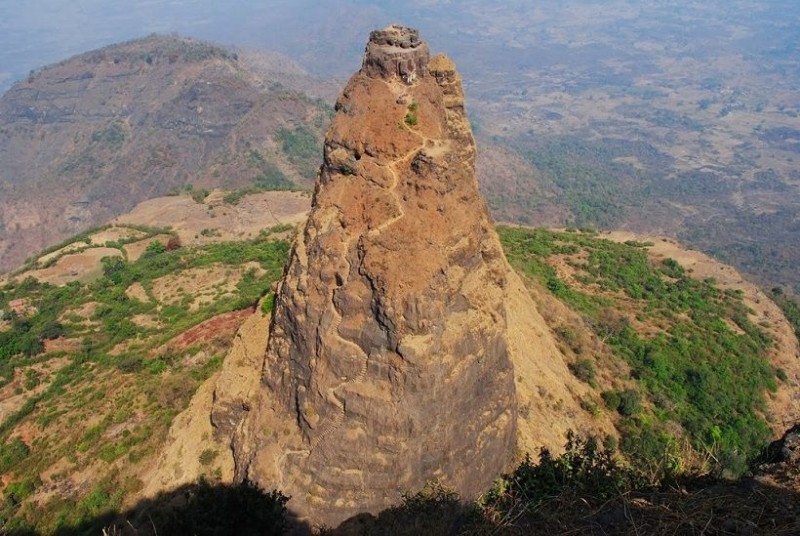
The fort of Kalavantin Durg lies near the city of Mumbai, in the Western Ghats. The origins of Prabalgad Fort are unknown but it is believed to have been built during the time of Buddha or in or around 500 BC for a queen named Kalavantin. Reputedly the most dangerous fortress in the world, Kalavantin Durg is at an elevation of over 2300 feet. Steps leading up to the fort have been cut into the rock face of the hill.
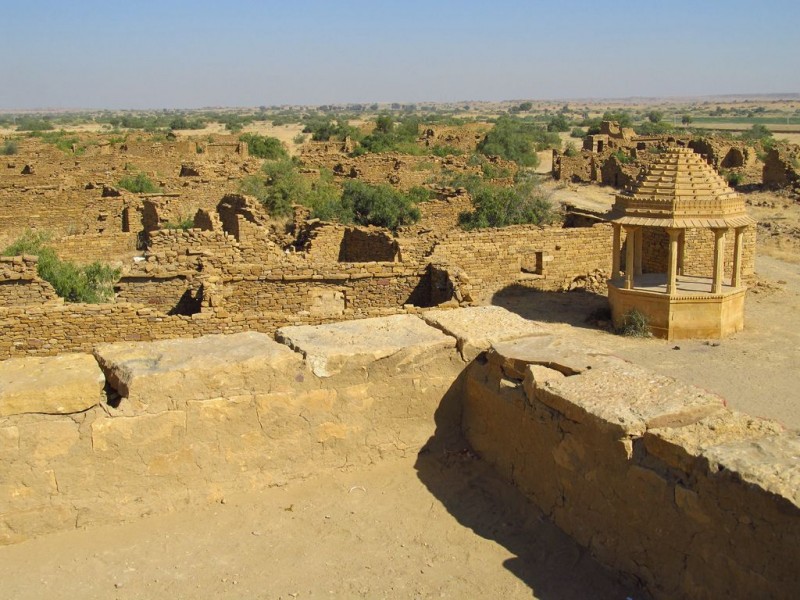
Kuldhara is a famous ghost town who’s bizarre history still hasn’t been solved. The people of the town mysteriously disappeared collectively around 300 years ago and were never seen since. It’s believed they left behind a curse bringing death to anyone who tried to inhabit it. It now stands as a strange testament to the weirdness of our towns.
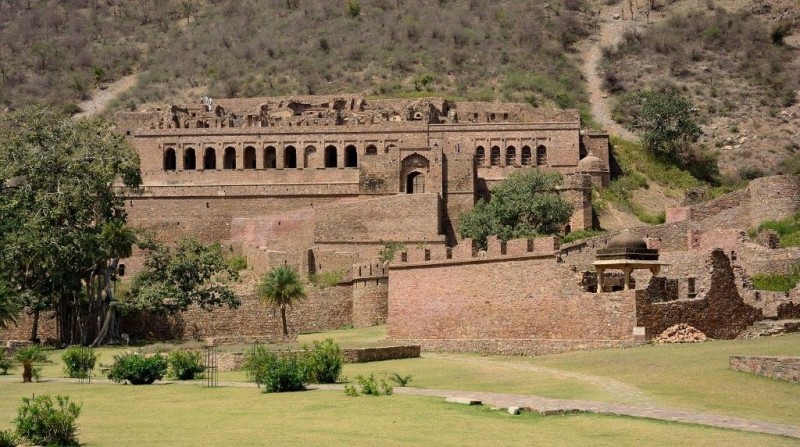
Bhangarh, a deserted town in Rajasthan, was established in 1613 by King Madho Singh, son of great Mughal general, Man Singh of Amber. Bhangarh was abandoned soon after being built and supposedly after it was cursed by a magician. Local villagers say that whenever a house is built there its roof collapses. People say that nobody returned who stayed there after dark.
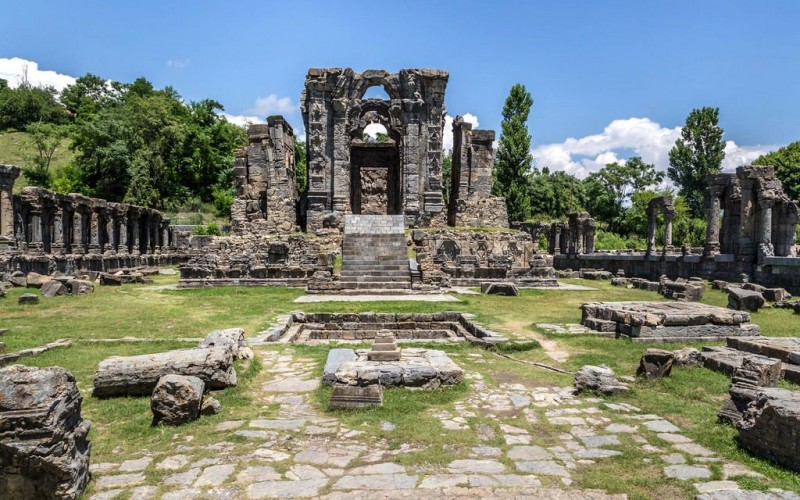
Located on a plateau in Anantnag, Jammu & Kashmir, Martand Sun Temple is dedicated to the Sun god built by the King of Karkota Dynasty in the early 8th century AD. The temple was destroyed by Islamic ruler Sikandar Butshikan in the early 15th century, and it has stood in ruins ever since. The placement of the Temple enables a panoramic view of the beautiful Kashmir Valley. The Shrine is situated in the centre while the remains of the other structures are scattered around the premise. The Martand Sun Temple is one of the important archaeological sites in India.
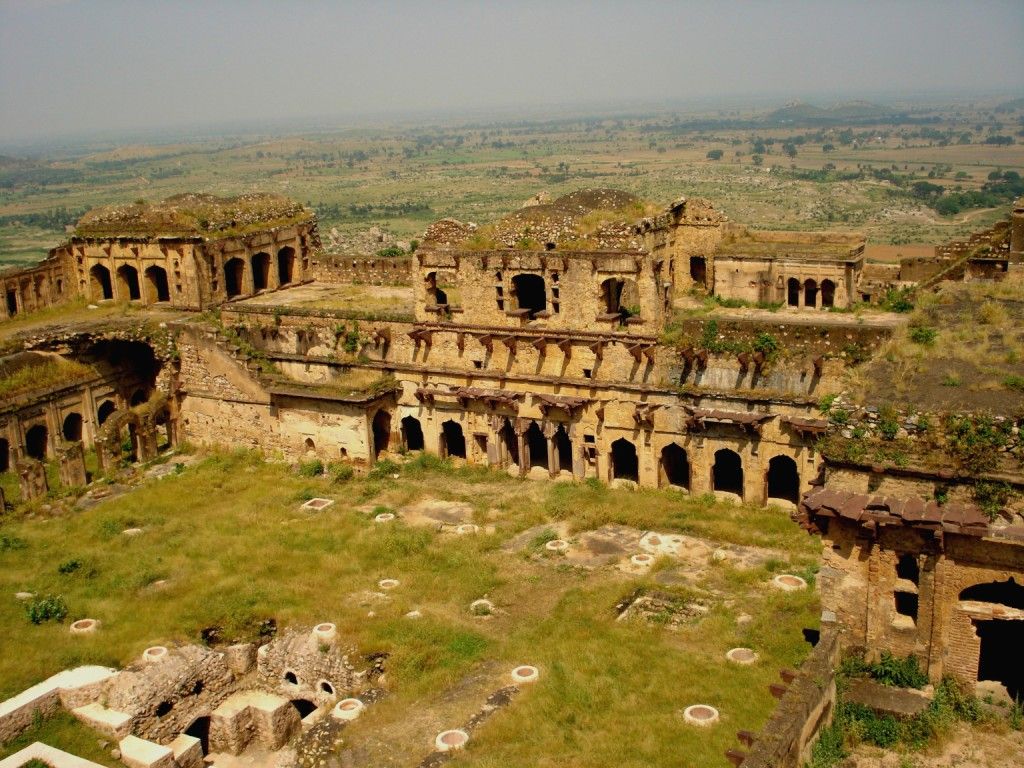
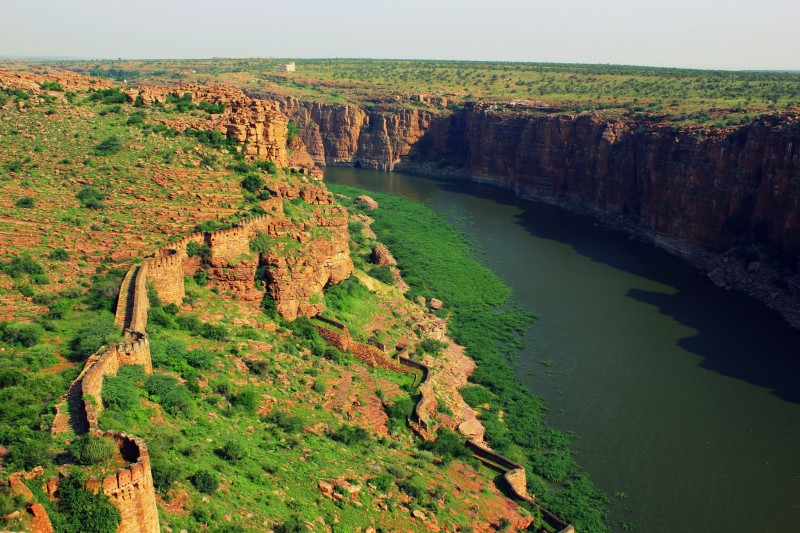
This quaint little village situated on the banks of the Pennar River, in Andhra Pradesh, is home to some major historical structures. The Gandikota fort premises include small fortresses, a granary, two beautiful temples and a splendid mosque. All of these ruins speak of their prime even as the structures seem to be on the verge of crumbling. The two temples Raghunatha and Madhavaray of the 15th and 16th century respectively stand as a testimony to the Kakatiya and Vijaynagara architecture. This village is now only a tourist attraction.
By continuing to use the site, you agree to the use of cookies. more information
The cookie settings on this website are set to "allow cookies" to give you the best browsing experience possible. If you continue to use this website without changing your cookie settings or you click "Accept" below then you are consenting to this.