

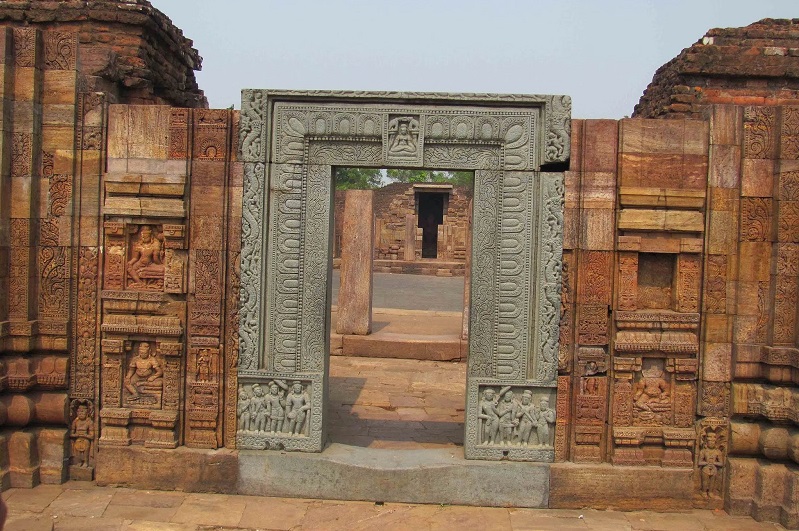
You could be forgiven for not knowing about the sacred Buddhist sites in Orissa (Odisha). After all, they’ve only been excavated relatively recently and are largely unexplored. Yet, more than 200 Buddhist sites, scattered across the length and breadth of the state, were revealed by these archeological excavations. They show the prominence of Buddhism in Odisha from the 6th century BC to at least the 15th-16th centuries AD, with the 8th-10th centuries being the period when it really prospered.
Ship Building & Navigation in Ancient India

India has a rich maritime history dating back 5,000 years. The world’s first tidal dock is believed to have been built at Lothal around 2300 BCE during the Indus Valley Civilization, near the present day Mangrol harbour on the Gujarat coast. A compass, Matsya yantra, was used for navigation in the 4th and 5th century AD.
Haryana’s Bhirrana is oldest Harappan site
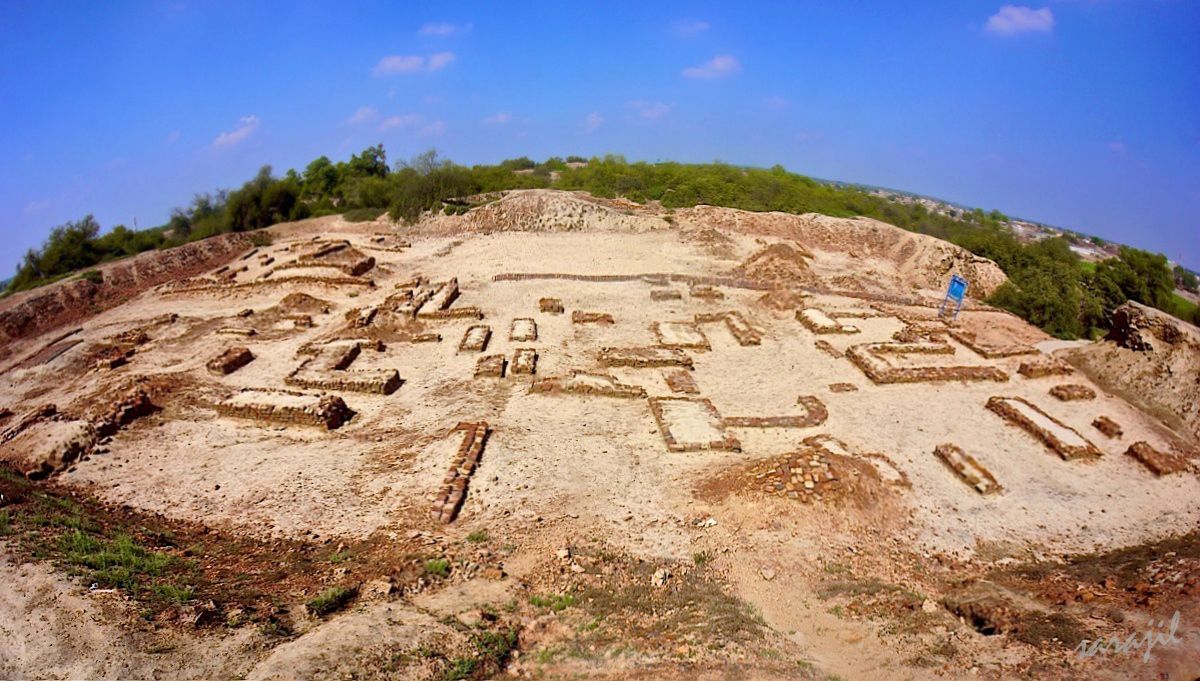
The oldest archaeologically attested civilization in South Asia, roughly on par chronologically with ancient Egypt and Sumer, the Indus Valley Civilization is considered the fount of ancient Indian civilization and its heritage is claimed by both Pakistan and India.
The Indus Valley Civilization was discovered in the early 20th century by the Archeological Survey of India. At that time, the two largest Indus Valley Civilization sites were Harappa and Mohenjo-Daro. Since then, subsequent discoveries have upended assumptions about the Indus Valley Civilization’s chronology, geographical range, linguistic characteristics, and demise.
Initially, the Indus Valley Civilization was assumed to have lasted at most about a thousand years, with a mature period dating from around 2600 B.C.E. to 1900 B.C.E. Furthermore, the range of the civilization has steadily expanded with new discoveries.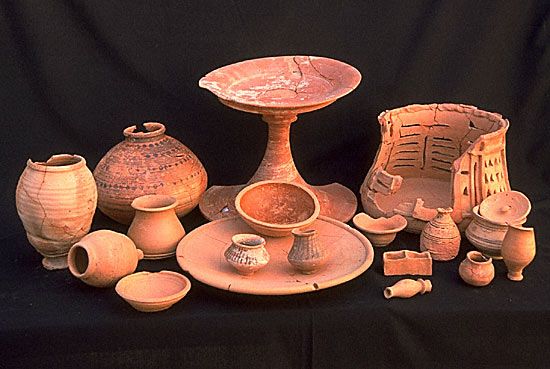
New discoveries in the Indian state of Haryana, underscore many of these trends. Bhirrana is now considered the oldest discovered Indus Valley Civilization site, with some of the oldest mounds dating back to 7500 B.C.E.
According to a report published in Times Of India, the recent study has debunked the early research that the Indus Valley civilization’s Harappan phase originated in Sind, in present-day Pakistan.
The report states that while the c 14 radio-dating of the excavations at the Mehrgarh site in Pakistan puts it in the 6400-7000 BC bracket while the latest study has revealed that the cultural remains at the Bhirrana village go back to the time bracket of 7300 BC. It is situated on the banks of Ghaggar river, in Fatehabad district of Haryana.
Last year, Rakhigarhi, in Haryana, India, has been determined to be the largest-ever Indus Valley Civilization site. This has led to speculation that the Indus Valley Civilization reached its mature phase farther east than previously thought.
Bhirrana and Rakhigarhi show continuous occupation from 8th millenium BC. Bhirrana was occupied from the earliest to the last dates of the Harappan era and Rakhigarhi is home to the largest and one of the oldest sites of the ancient Indus Valley Civilization.
Related Articles
Countless Rock Carved Shiva Lingas of Sahasralinga
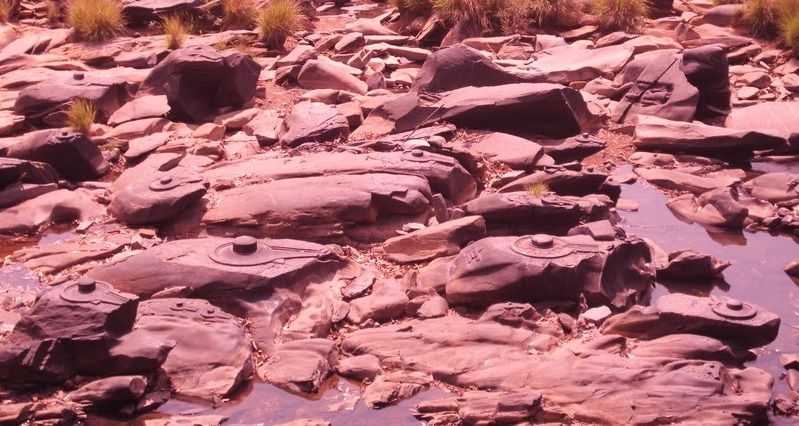
Sahasralinga is a pilgrimage place in the Sirsi Taluk in Karnataka state of India. It is in the river Shalmala and is famous for being the location where small-sized Shiva Lingas carved out of stones embedded on the river bed lay scattered all over. Most of the lingas are clearly visible when the water level in the river is not very high.
Linga is a symbol of worship of the Hindu God, Shiva. The place derived its name Sahasralinga (thousand lingas) because of the existence of these uncountable lingas on the river bed.
5,000 Years Old skeletons Found at Harappan Site
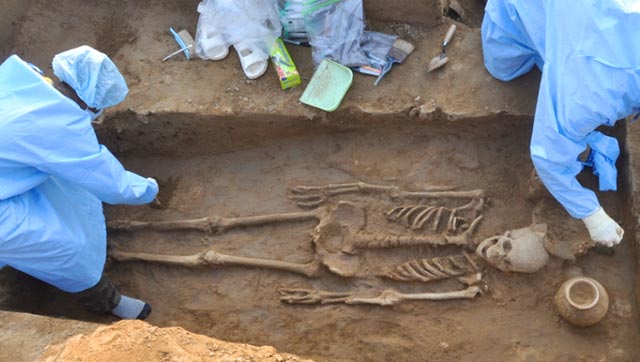
Archaeologists in India have found a group of skeletons from one of the world’s most ancient civilisations, in a discovery which could provide clues to the origins of the first human settlements. Four human skeletons, believed to be 5,000 years old, have been found in a cemetery at Rakhigarhi village in Hisar, a large Indus Valley (also known as Harappan) site. Archaeologists and scientists from India and South Korea have been carrying out excavations at the cemetery at Rakhigarhi village since 2013.
These skeletons are of two men, one woman and a child. The height of the skeletons of the men is five feet and six inches and both were aged about 50 years while the height of the skeleton of the woman is five feet and four inches and was aged around 30 years. The child’s age was believed to be around 10 years.
Enthused at the recovery of well-preserved skeletons, archaeologists hope forensic scientists will reconstruct the DNA extracted from bones to help decipher the history and origin of the human settlement, which is part of the Indus Valley civilisation. Using a novel software developed in South Korea, archaeologists are confident of projecting, in a few months, how the Harappans looked like 4,500 years ago — their build, the colour of their skin or hair, their facial features and so on.
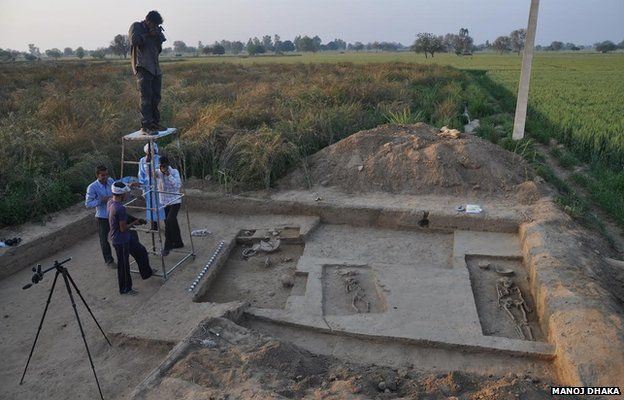
Besides pottery with grains of food, bangles, toys, mini wheels and sling balls of different sizes have also been recovered from the excavation site. The archaeologists have also found certain things that reveal that the settlers believed in reincarnation.
During the excavation, it has also come to the fore that toy culture must have been in the vogue among the Harappans. Researcher Malavika Chatterjee said toys were found during the excavation including “figurines of animals and mythical characters”. She told the Hindustan Times: “A figurine of dog with a leash points towards their domestication aspect. Then we also found figurines of unicorns too, giving us impression about their mythical state of mind.”
Besides, the toys include mini wheels, miniature lids and sling balls of different sizes. The stuff is mostly made up of terracotta.
The jewellery and the stamps found during the excavation give the impression that the settlers used to go out for their trade and also used to get some of their jewellery from outside the state.

Archaeologists also recovered a seal which has some tiger-like figure inscribed on it. They believe that it was used in trade or for some other purposes. Tools which could have been used for fishing and hunting purposes have also been recovered.
The excavation work was spread over an area of 50 acres and the archaeologists are still working on three mounds numbering 4, 6 and 7. According to archaeologists, the excavations at the different mounds have different significance.
The excavation at mound number 4 will help them to figure out how and when did the Harappans settled here while the mound 6 reveals how were they living. Likewise, the mound number 7 has been established as the burial place, the archaeologist said.
The Indus Valley Civilisation is one of the three oldest urban civilisations, along with Egypt and Mesopotamia. Ancient India during the Harappan era had one of the largest populations in the ancient world, far greater than the Middle East or Europe.
More:
Rock Cut Mountain Statue of Lord Narasimha
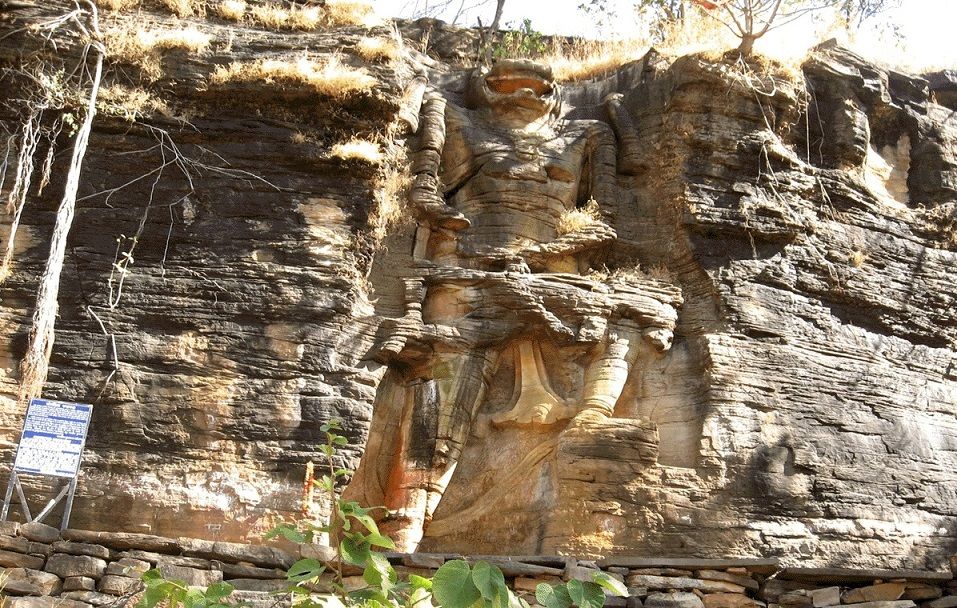
In the Lalitpur district of Uttar Pradesh is the ancient village of Dudhai, which is home to an astounding Statue of Lord Narasimha . Cut into the rock face of a hillside way off the beaten track, relatively few pilgrims search out this hidden treasure. Although it is listed as a sacred site by the Archaeological Survey of India, little documentation is available about the sculpture.
Destruction of The Indian System of Education by British
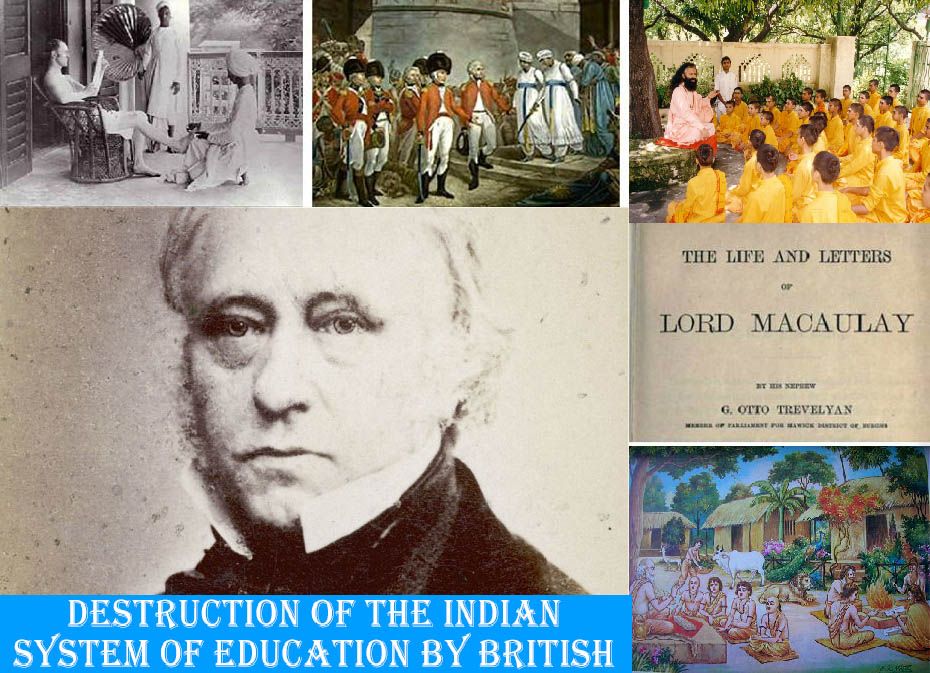
During the time of the East India Company and later, in the British rule, there seem to have been two motives working in the minds of the rulers: plundering the wealth of this land and the ‘white man’s burden’ of civilizing the natives (the term used by them to refer to all Indians). We shall see, how in order to achieve these ends, the British so cleverly played their cards that even after 60+ years of independence we still continue to exist in a state of stupor, unable (and even unwilling!) to extricate ourselves from one of the greatest hypnoses woven over a whole nation.
Perhaps many of us do not know that India was the richest land till the British came here. Whereas Britain’s share in world exports before was only 9% as against India’s share of 19% today our share is only 0.5%. Most of the foreigners came to India in search of her fabulous wealth. Ernest Wood, in the book ‘A Foreigner defends Mother India’ states, “In the middle of the eighteenth century, Phillimore wrote that ‘the droppings of her soil fed distant regions“. No traveller found India poor until the nineteenth century, but foreign merchants and adventurers sought her shores for the almost fabulous wealth, which they could there obtain. ‘To shake the pagoda tree’ became a phrase, somewhat similar to our modern expression ‘to strike oil’.”
In India 35% to 50% of village lands were revenue free and that revenue was utilized for running schools, conducting temple festivals, producing medicines, feeding pilgrims, improving irrigation etc. The British in their greed brought down the revenue free lands down to 5%. When there was a protest they assured Indians that the government would create an irrigation department to take care of irrigation, an educational board to take care of education. etc. The initiative of the people was destroyed. But the rulers found to their chagrin, that though they had conquered this nation, it was still strongly rooted in its own culture. They found that as long as the nation was aware and even proud of its traditions, their ‘white man’s burden’ remained as ‘heavy and cumbersome as ever’! India had, at that time, a very well spread system of education and that system had to be made ineffective for their purposes. Now, most of us are taught to believe that the education was in the hands of the Brahmins and in Sanskrit medium and that the other castes had no education. But here are the facts about how the British destroyed the Indian educational system and made one of the most literate nations illiterate.
In the Round- table conference in 1931, Mahatma Gandhi in one of his speeches said, “The beautiful tree of education was cut down by you British. Therefore today India is far more illiterate than it was 100 years ago.” Immediately, Philip Hartog, who was a parliamentarian stood up and said, “Mr.Gandhi, it is we who have educated the masses of India. And therefore you must take back your statement and apologise or prove it.” Gandhi said he would prove it. But the debate did not continue for lack of time.
Later one of his followers, Shri Dharampal, went to the British museum and examined the reports and archives. He published a book “The Beautiful Tree” where this matter has been discussed in great detail. By 1820, the British had already destroyed the financial resources that supported our educational system- a destruction that they had been carrying out for nearly twenty years. But still the Indians persisted in continuing with their system of education. So, the British decided to find out the intricacies of this system. Therefore a survey was ordered in 1822 and was conducted by the British district collectors. In the survey it was found that the Bengal presidency had 1 lakh village schools, in Madras there was not a single village without a school, in Bombay, if the village population was near 100, the village had a school. Teachers as well as students of all castes were in these schools. The Brahmins accounted 7% to 48% of the teachers, and the rest of the teachers in any district, came from other castes. Further all children had their education in their mother tongue.
The equivalent of the present day primary education lasted 4 to 5 years. We all know that it is universal primary education that is important for taking the nation ahead, not just a few getting higher education. The British administrators admired the dedication and capacity of the Indian teachers. By the time the students came out of the schools they had acquired the capacity to be competitive, and to understand and have proper insight into their own culture. One Mr.Bell, a Christian missionary in Madras took the Indian system of education back to England, and introduced it there. Until then, only the children of the nobles were given education there and he started education for the masses in England. So, we gather that it is from India that the British adopted the system for educating the masses.
The Cause of Degradation: The Downward Filtration Method.
But what happened in India? Foreign Christian missionaries even resented the nominal amount of one lakh rupees kept aside for the education of Indians. The British cut down the financial resources and brought in several regulations one after the other- regulations like “there has to be a ‘pucca’ building etc. That was not the end. They invited T.B. Macaulay to decide how to divert the money, what should be the medium of instruction and the mode of educating the Indian. He made English the medium of instruction and diverted the money for English education. G.D.Trevelyan writes in “Life of Lord Macaulay”(vol 1 pg164) “A new India was born in 1835″.
What Alexander, Ashoka and the western missionaries had failed to do was accomplished by Macualay’s educational minutes, decreeing that India was to receive through English education, the language of the West. “The very foundations of her ancient civilization began to rock and sway. Pillar after pillar in the edifice came crashing down.” But Macaulay did a more harmful thing, which is not generally known. He adopted the “downward filtration method” for educating the Indians. What is this method? The problem facing Macaulay was that Indians were numerous and The British were a handful. How were they going to educate the Indians? How could this nation be weakened so that in self-forgetfulness it would support the British Raj?
Kashiraj Divodas Dhanvantari – Father of Surgery in Ayurveda
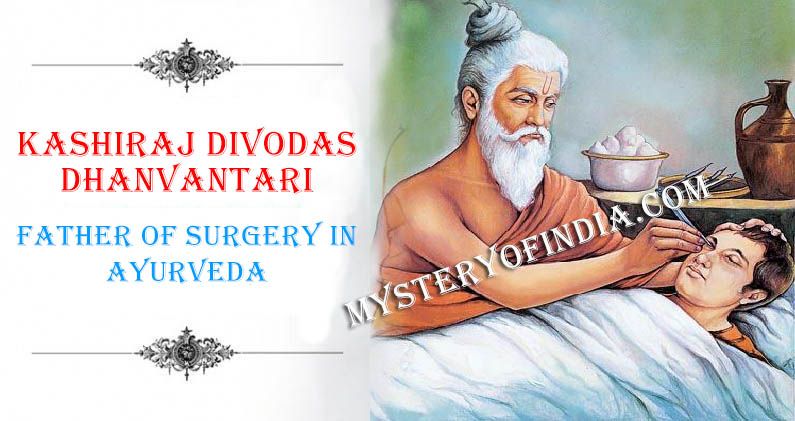
Born in 1000 BCE, Kashiraj Divodas Dhanvantari is hailed as the Father of Surgery in Ayurveda, the oldest and the most holistic medical science in the world. It forms a part of the Atharva Veda, one of the four Vedas.
Somapura Mahavihara – Ruins of the Buddhist Vihara at Paharpur
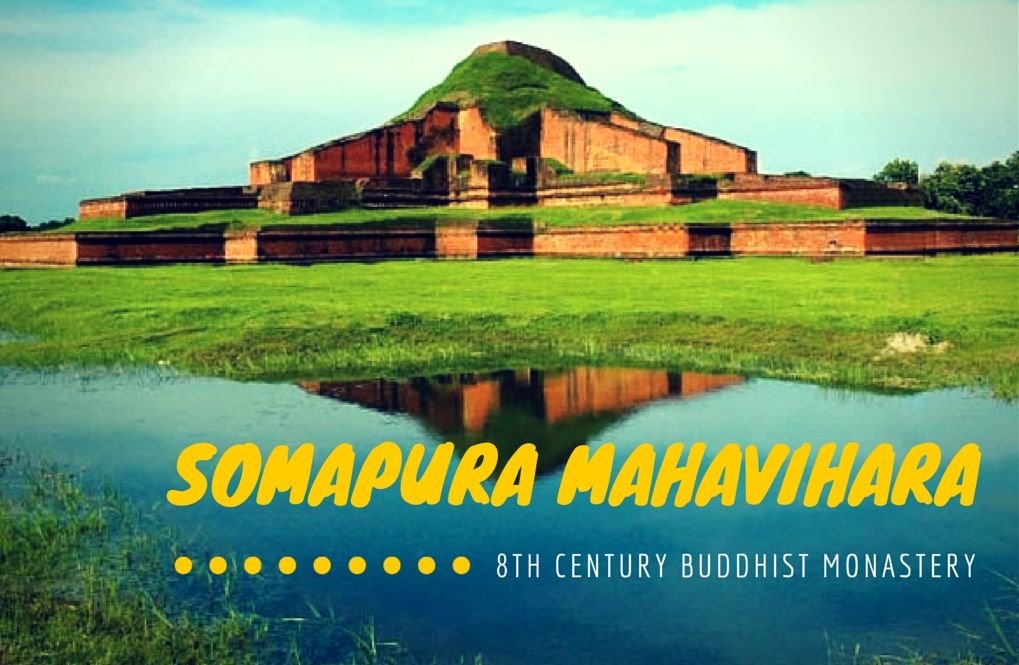
Somapura Mahavihara is an 8th century Buddhist monastery and an important archaeological site located in Paharpur, Naogaon District, Bangladesh. It is one of the largest and best known Buddhist monasteries in Indian subcontinent with the complex itself covering more than 20 acres, almost a million square feet (85,000 sq. meters). With its simple, harmonious lines and its profusion of carved decoration, it influenced Buddhist architecture as far away as Cambodia.
Concept of Earthquakes in Ancient India

Ancient Indians invented zero. Sanskrit is the world’s most ‘scientific’ language. Ayurveda experts claim they have cures for many diseases allopathy is still struggling to find answers for. Here is another one that should make people sit up and take notice of the wisdom of an old civilisation: predicting earthquakes.