
Acharya Kanad – The Father of Atomic theory

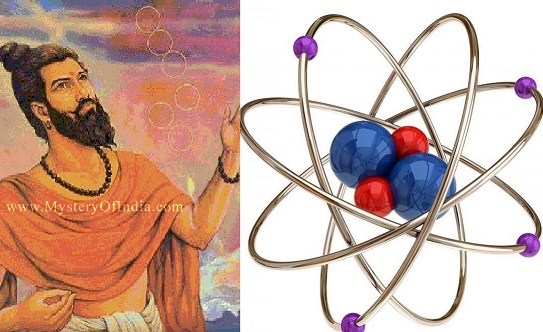
John Dalton (1766 – 1844) is the man credited today with the development of atomic theory. However, It would be surprising for many people today to know that the theory of atoms was actually formulated 2,600 years ago by an Indian sage and philosopher. The first Indian philosopher who formulated ideas about the atom in a systematic manner was Sage Kanad who lived in the 6th century B.C.

Kanad was born in 600 B.C. in Dwarka, Gujrat. His real name was Kashyap. He was the son of a philosopher named Ulka. From his child days Kashyapa displayed a keen sense of service. Minute things attracted his attention. 

Once he went on a pilgrimage, he saw thousands of pilgrims littered the town roads & the banks of river Ganga with flowers and rice grains which they offered at the temple. He started collecting the grains of rice. Everybody thought he was insane as he was from a good family. Crowd gathered around him & one person asked him why was he collecting the grains even beggars wouldn’t like to touch these. He told them that individual grains in themselves may seem worthless, but a collection of some hundred grains make up a person’s meal, the collection many meals would feed an entire family and ultimately the entire mankind was made of many families, thus even a single grain of rice was as important as all the valuable riches in this world. Since then people started calling him Kanad, as “Kan” in Sanskrit means “Smallest particle“.

Kanad was the first person in the world to discuss atoms and molecules. It was Kanad who first propounded that the Parmanu (Atoms) was an indestructible particle of matter. According to the material universe is made up of Parmanu (Atoms). When matter is divided and subdivided, we reach a stage beyond which no division is possible, the indivisible element of matter is Parmanu (Atom). Kanad explained that this indivisible, indestructible atom cannot be sensed through any human organ.

This theory occurred to him while Kanad was walking with food in his hand, breaking it into small pieces when he realised that he was unable to divide the food into any further parts, it was too small. From this moment, Kanad conceptualized the idea of a particle that could not be divided any further. He called that indivisible matter Parmanu (atom).

Kanad further held that atoms of same substance combined with each other to produce dvyanuka (biatomic molecules) and tryanuka (triatomic molecules). Kanad also put forward the idea that atoms could be combined in various ways to produce chemical changes in presence of other factors such as heat. 

Kanad founded the Vaisheshika school of philosophy where he taught his ideas about the atom and the nature of the universe. He wrote a book on his research “Vaisheshik Darshan“. People started calling him “Acharya” – mean Teacher and became known as “The Father of Atomic theory.”

Reference to matter consisting of atoms appear also in Jainism School and Buddhist School. Three different schools of thought Vaisesika, Jainist, and Buddhist came to similar but slightly different conclusions.

Another Indian philosopher, Pakudha Katyayana who lived around the 5th or 4th century B.C. and was a contemporary of Gautama Buddha, had also propounded ideas about the atomic constitution of the material world.

Between the 5th and 3rd centuries BC, the atom is mentioned in the Bhagavad Gita (Chapter 8, Verse 9)

This Indian concept of the atom was developed independently and prior to the development of the idea in the Greco-Roman world. These Indian ideas about atom and atomic physics could have been transmitted to the west during the contacts created between India and the west by the invasion of Alexander. Greeks came into India only in the 4th century B.C. Thus it is quite possible that the Greeks borrowed the ideas about atom from Indian philosophers in the 4th century B.C.

It remains a fact that Indian ideas about atom are the oldest. But the credit of developing these ideas further, goes to the Greeks and other western philosophers as Indian theories about the atom are greatly abstract and enmeshed in philosophy as they were based on logic and not on personal experience or experimentation. 

Source: UnitedIndia and WikiPedia
Tamil-Brahmi Script Found in Arab Countries

Brahmi is the earliest Indian alphabetical script. The origin of the script is still much debated, but according to most scholars it is connected to the much older and as-yet undeciphered Indus script. As per its regional variations, it is identified as Tamil-Brahmi, Asokan-Brahmi, Northern-Brahmi, Southern-Brahmi and Sinhala-Brahmi. All modern Indian scripts are the evolved forms of Brahmi.

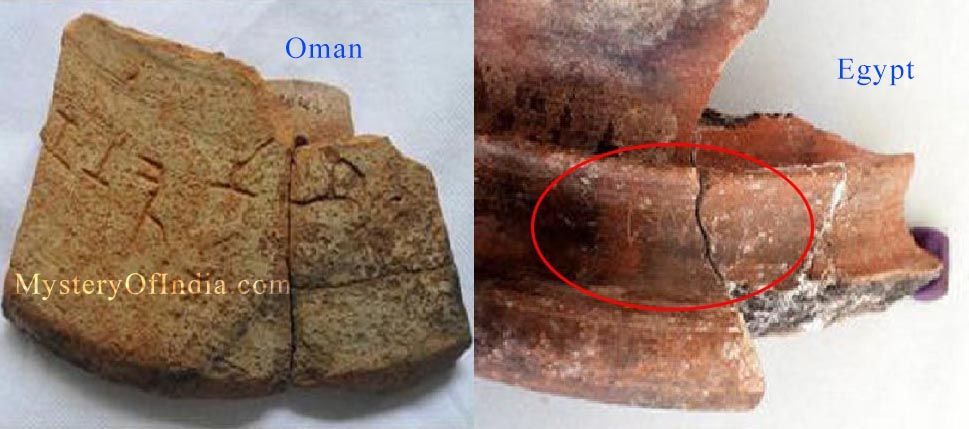
Inscriptions have been found on cave beds, pot sherds, Jar burials, coins, seals, and rings. Due to overseas trade, few pottery pieces and a touchstone bearing personal names in Tamil-Brahmi script are recently noticed in Arab countires Egypt and Oman.

Tamil-Brahmi Script Found in Egypt

A few years ago, a broken storage jar with inscriptions in Tamil Brahmi script has been excavated at Quseir-al-Qadim, an ancient port with a Roman settlement on the Red Sea coast of Egypt. This Tamil Brahmi script has been dated to first century B.C. The same inscription is incised twice on the opposite sides of the jar. The inscriped text is “பானை ஒறி” (paanai oRi) which means ‘pot suspended in a rope net’.

Tamil brahmi script Egypt
Potsherd with Tamil Brahmi inscription, circa first century B.C., found in Egypt.

A pottery specialist at the British Museum, London, identified the fragmentary vessel as a storage jar made in India.

Iravatham Mahadevan, a specialist in Tamil epigraphy, has confirmed that the inscription on the jar is in Tamil written in the Tamil Brahmi script of about first century B.C.

According to Mr. Mahadevan, the inscription is quite legible and reads: paanai oRi, that is, ‘pot (suspended in) a rope net.

Earlier excavations at this site about 30 years ago yielded two pottery inscriptions in Tamil Brahmi from the same era. Another Tamil Brahmi pottery inscription of the same period was found in 1995 at Berenike, also a Roman settlement, on the Red Sea coast of Egypt.

Tamil-Brahmi Script Found in Oman

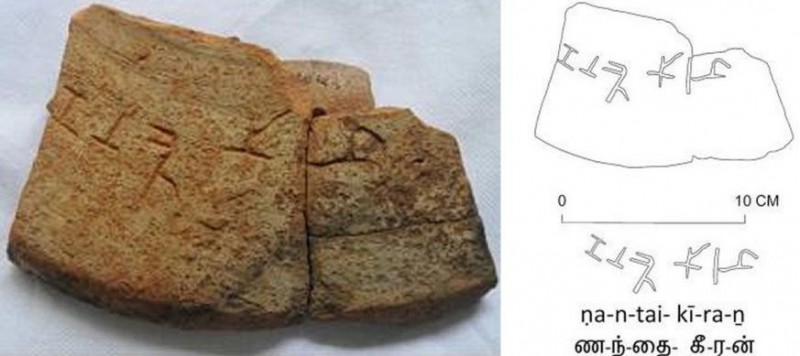
Yet another 1900 years Tamil-Brahmi script inscribed on a potsherd was found at the Khor Rori area in Oman. The script reads “nantai kiran” and it can be dated to the 1st century CE.

Found by The Italian Mission to Oman during its second archaeological excavation in 2006 in the Khor Rori area, this potsherd was deciphered when the piece came for a pottery exhibition in Kerala in September 2012.

The potsherd was found in a residential area of Sumhuram city in a layer mixed with a few pottery pieces and animal bones.

The potsherd found in Oman in 2006.
The potsherd found in Oman in 2006. –Image Source

“Potsherd could be dated to first century CE or a little earlier. There was so much of Indian material, including beads, coins and pottery, discovered during the excavation that it was important to show the relationship between India and the southern coast of Oman,” said Alexia Pavan, an Italian archaeologist, who found this potsherd.

The text nantai kiran is a fragment or a complete personal name in two words. The last word that could be read as Kiran, is a popular personal name in Tamil, since very early times. There were many poets of the Changkam corpus who had that name. According to archaelogists, the broken piece of the pot carries the personal name of an important trader who commanded a high regard in the trading community.

The port of Sumhuram could be dated to circa third century BCE to fourth century ACE.  The discovery in the ancient city of Sumhuram has opened a new chapter in understanding the maritime trade of the Indian Ocean countries, according to specialists in history.

It was generally believed that India’s contact with the Mediterranean world began with the Roman trade and much of the studies were concentrated on the Red Sea ports such as Quseir al-Qadim and Berenike, both in Egypt. The latest discovery in Oman was significant as it opened a new avenue in understanding the impact of the Indian Ocean trade, particularly on the west coast of the peninsular India.

These discoveries provided material evidence to corroborate the literary accounts by classical Western authors and the Tamil Sangam poets about the flourishing trade between the south India and Rome (via the Red Sea ports) in the early centuries A.D.

Tamil Brahmi script is also noticed in other countries like China, Sri Lanka, Myanmar and Thailand.

Source:

Potsherd with Tamil-Brahmi script found in Oman –  The Hindu

Tamil Brahmi script in Egypt – The Hindu

Tamil Brahmi – Wikipedia

Bridge of Rama: Traces of an Ancient Advanced Civilization

© Enrico Baccarini – We have often spoken about the mysteries of the ancient India. By studying and analyzing its secrets we tried to lift ‘Maya’s veil’, which sometimes seems to overshadow it but outshine many of its ancient remains.
Each piece found seems to open new horizons, every discovery reveals an incredible truth! Many things regarding the country of India are still today an unsolved challenge to earth’s history.

Often, overall among the skeptics, there is a point of view that tends to diminuish the value and importance of the ancient remains of the Indian continent. It’s a fact that along the coasts of the Gulf of Cambay, in Tamil Nadu, at Mahabalipuram or Dwarka, ancient underwater urban settlements are existing – traces of a forgotten civilization that after the last Ice Age and the rise of the coastal sea levels had to leave their holy cities.

A proof? The legendary Dwarka – the city of Lord Krishna, which is among the seven holiest places in India – has been recently rediscovered: submerged by the waves. Shipments of marine archeologists have been able to recover ancient artifacts in the site that show the plan of a giant urban settlement which today lies under 40 feet of water and sediments.

Underwater Ruins of Dwarka

But let’s move to the South of India, to Tamil Nadu, to see the legacy that these lands are still showing today. A testimony above all expectations is the beyond doubt presence of an ancient highly developed civilization, able not only to fly in the skies with flying machines named Vimana, but also creating wonderful works of environmental engineering – comparable, if not superior, to modern ones.

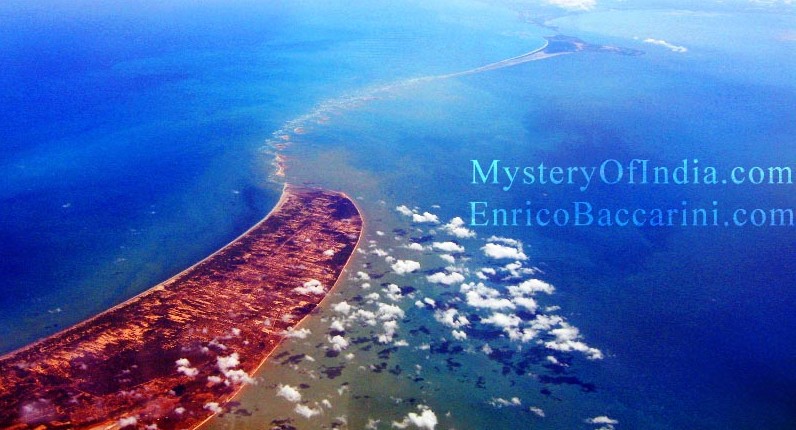
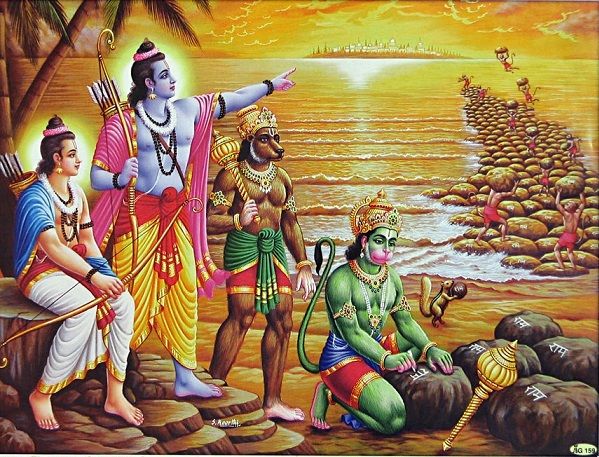
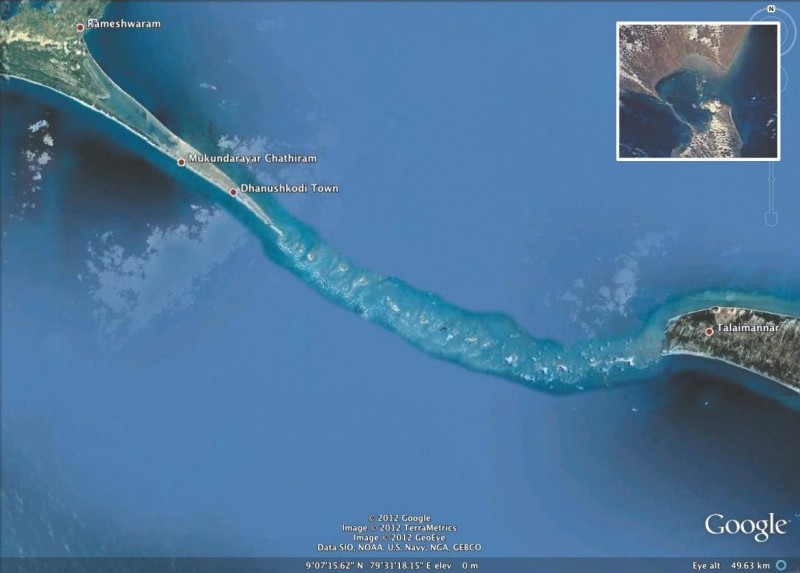
A chain of “rocks” is connecting India to Sri Lanka. This is the commonly accepted version by geologists for this strange strip of rocks. For the Hindus these formations are remainings of the Bridge of Rama (called Rama Setu and Setubandhnella in the local language). It is a structure that, as told in the ancient epic poem Ramayana, was built by the god Hanuman and his army of ape-men, to allow Lord Rama to find his wife Sita, hold in captivity by the demon King Ravana on the island.

The Indian state of Tamil Nadu is separated by the Palk Strait from Sri Lanka connecting the Bay of Bengal to the northeast – with the Gulf of Mannar in the south. 

On its last track, the Strait is dotted with a chain of low islands and rocky plots, today named Adam’s Bridge, a reef that form an isthmus – since the time of the British Raj, commonly called the Bridge of Rama.

The Bridge of Rama is located between Dhanushkodi, the Indian island of Rameswaram and Talaimannar, Sri Lanka following to the island of Mannar. The island of Rameswaram is connected to the mainland by the Indian Pamban Bridge, the longest railway bridge in India, 2.3 km long.

The Rama Bridge as a man-made structure was mentioned first in the record of Ibn Khordadbeh in his Books of roads and Kingdoms. Also the Islamic legend states that the bridge was used by Adam, the first man created by God, to traverse the route to Adam’s Peak, Sri Lanka, repenting for one thousand years during which he was standing on one foot. This, for local legend, should explain the large footprint hollow that could be found on the Peak.
Modern industries would like to use this narrow stretch of sea to build a bridge linking the island of Ceylon to India, but the business project is and has long been strongly opposed by environmentalists and religious groups who see the Bridge of Rama as a sacred area.

Recently, satellite photos provided by the NASA gave to the environmentalists a new possibility to protect the place and to confirm the importance and the truth of the legends. These photos reveal a curvature and an alignment of the rocks that can only be explained by human intervention. Moreover, we have an additional fact that this ancient bridge was passable by foot until the XV century, until an hurricane changed the deep sea engulfing much of the path.

As we said before, according to the Ramayana, the Bridge of Rama was built on the direct request of the god Rama by his servants, the “Vanara sena” which were shaped half men and half ape, all led and instructed by the god Hanuman. It is said that the ape-men anchored the rocks to the seabed, creating the present structure.

The ape-army building the bridge of Rama

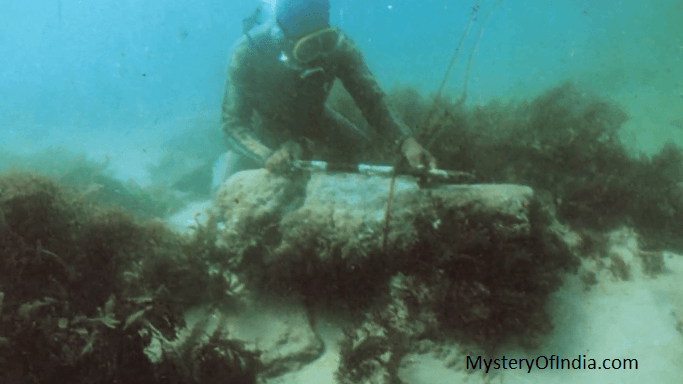
Yet there are still opposing ideas about the origin of the bridge. Mr S. Badrinarayanan, the former director of the Geological survey Institute of India states that such a natural formation would be impossible. He justifies his thesis by the presence of layers of loose sands under the coral structures, extending over the entire stretch. But normally corals form above rocks formations and not above sand. Also the head of the Department of Geology and Research Center of India, Prof. N. Ramanujam, has given a scientifically questionable explanation of the possible natural occurrences of the sand banks with the corals on top.

Despite all, the radiocarbon dating of the bridge dates on around 1,750,000 years, which roughly coincides with the Indian estimate of the mythical Treta Yuga.

Even through such controversies the Rama Setu never ceased to attract the attention of geological experts. Yet all studies have not figured out how this stretch of land was formed.

Rama Setu or Adam's bridge on Google map
The location of Adam’s Bridge between India and Sri Lanka

There have been several studies to try to understand the geological age of the ‘Bridge’. According to data scientist assume the bridge to be formed 3500 years ago indicating that the origin of its formation could be attributed only partially to the effect caused by the coral reefs of the sandy sediments carried by the currents.

This explanation certainly can not explain an artificial intervention. On a pre-existing structure consisting of coral reefs and shoals nothing states that there would have been carried artificial stones to strengthen and build a passable and usable road. 

The strange morphology of this strip of land now submerged seems to indicate this theory. Considering that the thin band is constantly beaten by strong currents and that the climatic conditions are often difficult, it is normal to think that time and neglect may have led to its disintegration and the loss of its ancient transitability.

Even if a typhoon destroyed much of the bridge in the fifteenth century, five centuries ago, we still can assume that bridge is thousands of years old. Also if its creators lost their ability to keep it in good condition it is natural that it has witnessed a gradual disintegration over the centuries and that its feasibility has been declining gradually in relation to the absence of reconstructive surgeries.

Many scholars insist in denying the evidence of the facts. These testimonies show us the last vestiges of an ancient civilization that lived in the Indian lands thousands of years ago. 

What advanced knowledge could have enabled them to create a work of engineering of such magnitude? Who were these people? Why did they disappear and why did they leave us only little traces?

We have scattered pieces of a puzzle which are slowly taking shape. Together with other Indian and American researchers we are rediscovering this lost historical memory.

The article ‘Bridge of Rama: Traces of an Ancient Advanced Civilization’ was originally published by Enrico Baccarini and has been republished with permission.

Related video:

During Tsunami which rocked the southern India few years ago some stones came to shore which are believed to be from the RamSetu. These stones are floating ones as also described in Ramayana. Check out the proof of these in the video below:

Vishnu Idol Found in Russia

There is much evidence—archeological and linguistic—to support the notion that the ancient Vedic (Aryan) civilization was spread far beyond India, and that it was much earlier than the civilizations we have been taught to believe were the first.

Controversial historian and author P.N. Oak has pushed the idea that the glorious Vedic civilization was at one time spread all over the world and it preceded the Greek and even the Egyptian and Babylonian epochs.

Vishnu Idol Found in Russia

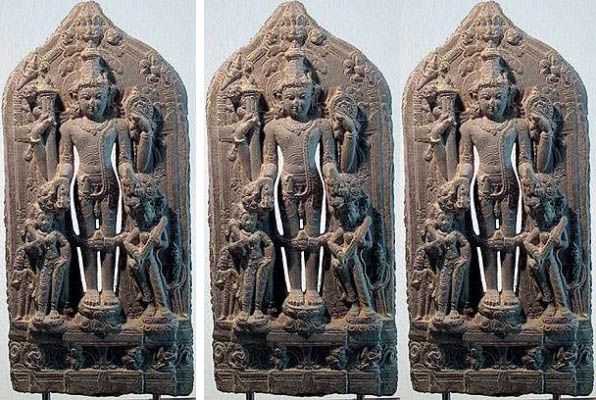
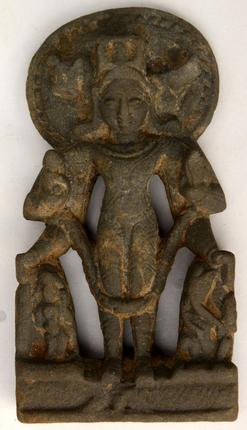
In 2007, during an excavation in an abandoned village in the Volga region of Russia, archaeologists excavated an ancient Vishnu idol. The idol dates from between the 7th and 10th centuries, was found in Staraya Maina village which is much older than Kiev, so far believed to be the mother of all Russian cities. The Times of India reported that this discovery raised questions about the prevalent view of the origin of ancient Russia.Vishnu idol found in Russia

The Vishnu idol is depicted with a hammer in one left hand while the deconglated seventh arm on the right side holds a reticulated sickle.

In the Rig Veda, there is a passage that goes:

Itham ascati pasyat syantham, ekam starayath mainaa-kaalam.

This translates into Staraya Maina is the name of the land of the 45 rivers (on whose banks the noble Rishis conducted the famous Horse Sacrifices), where the sun god descends.

The period 6-7th century also marked flourishing trade ventures by Indian rulers. Palas in the North and Cholas in the South were enterprising dynasties. During their times the Indian influence through trade spread to Far East and to regions beyond the mountainous border.

According to a 2010 religious census population of Hindu in Russia is 140,000.

The Search for Indraprastha

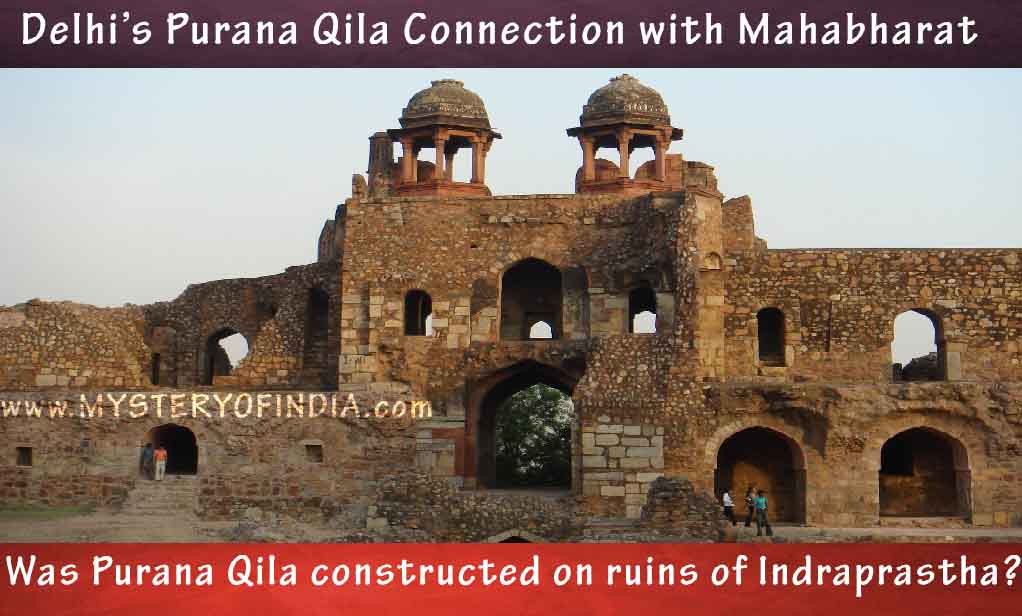
According to Mahabharata, Indraprastha was the capital of the kingdom led by the Pandava. The Demon Maya, built the city and the palace of Indraprastha for the Pandavas. The area for the palace was created by clearing the forests of Khandava by Arjuna and Lord Krishna. Pandavas also built other cities like Swarnaprastha (modern-day Sonipat) and Panaprastha (Panipat) in their province.

The exact location of Indraprastha is uncertain but Delhi is thought by some to be located at the site of the legendary city of Indraprastha. Although there is not much physical evidence about the city but locals did claim that there existed a huge mound (which could have contained the remains of the city) upon which the Mughals built the Purana Qila (Old Fort). The fact that until 1913 there was a village within the fort called Indrapat gives credence to the belief that Purana Qila was built on the ruins of Indraprastha.

The ruins of this fort are located on a small hill which once stood on the banks of the Yamuna river. It is where Humayun‘s capital Din Panah was located. The Purana Qila was constructed by Sher Shah Suri between 1538 to 1545.

The ASI's excavation that is underway at Purana Quila
The ASI’s excavation at Purana Qila in New Delhi – Image Source

In historical times, human settlements were always made closest to a river bank or source of water. The excavation spot at Purana Qila has been identified because of its proximity to the original flow of the Yamuna, so archaeologists are confident of finding evidence.

The ongoing excavation at the Purana Qila site might lead to discovery of concrete evidence that will help in studying the culture and art patronised by the Pandavas. The clue that Archaeological Survey of India’s members are looking for to establish the link is painted grey ware PGW. It is grey pottery painted with geometric patterns in black that archeologists associate with the Mahabharata period. Similar stuff has been noticed in other sites associated with the epic Mahabharata as well. If the ASI is successful in finding painted grey wares from the Mahabharata period, it will prove the existence of the city of Pandavas.

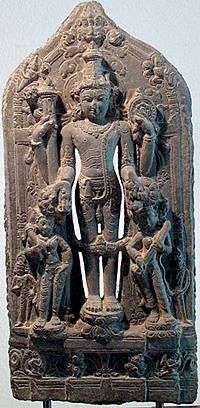
A 12th Century Vishnu idol found during the excavation.
A 12th Century Vishnu idol found during the excavation. – Image Source

There is a possibility that once we excavate further will find some evidence. In the first excavation in 1954, painted grey wares were discovered. However, the wares were not found in stratified deposit. If they were found in stratified deposit, we could support that there were traces of the Mahabharata period,” said Vasant Swarnkar, superintending archaeologist of ASI.

The Purana Qila mound contains remains of a continuous cultural habitation starting from Mauryan period (3rd century BC) to the Mughal through Sunga, Kushana, Gupta, Rajput and Sultanate periods. The archaeologists has discovered artefacts from all the eras which includes a rare 12th century sculpture of Vishnu, a terracotta seal from the Gupta period, pottery typical of the Kushan and Gupta periods, structures from the Rajput and Kushan periods, copper coins, terracotta human figurines, beads made of semi-precious stones and glass, ear studs of terracotta and charred wheat and rice grains. Latest findings included an ivory pendant, human figurines, a Gajlakshmi tablet and objects from the Mauryan period. The Archaeological Survey of India has also discovered a Mauryan Period ring well 4.4 metres below the earth.

Opened after a span of 40 years, the Archaeological Survey of India has carried out an excavation here since February this year. This was the third and largest excavation in Purana Qila after the one ASI did in 1955 and in 1969- 73. Due to Monsoon The Archaeological Survey of India has put excavations at Purana Qila on hold till November.

The ASI also hopes that it will also be able to convince the government to declare Delhi a World Heritage City.

References: India Today and The Hindu

4300 Years Old Human Skull with Successful Brain Surgery Discovered

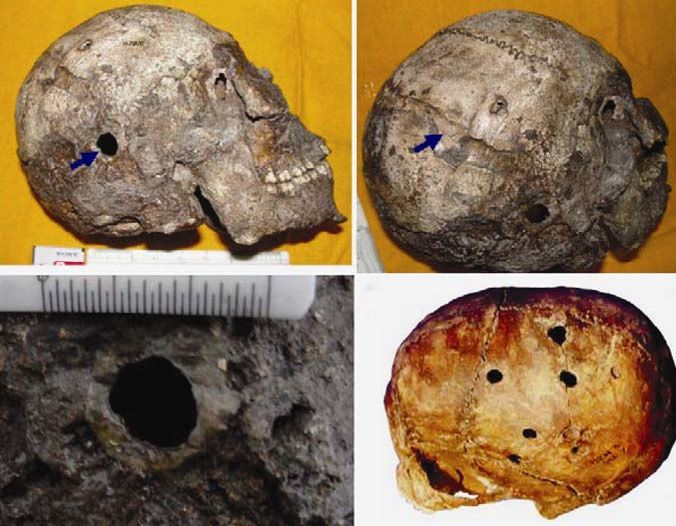
Indian Scientists have discovered the world’s oldest known case of a successful human brain surgery after unearthing a 4300 year old skull from an ancient Harappan site in India. This discovery was done by the scientists from the Archaeological Survey of India (ASI) who found evidence pointing this to be the oldest known case of successful “Trepanation” in the world meant to treat a skull injury.

The trepanation, also called “trephination” had been the oldest craniotomic surgical procedure practised by mankind since the Stone Age by way of drilling holes in the damaged skull to remove shattered bits of bone from a fractured skull and clean out the blood that often pools under the skull after a blow to the head.

Much older trepanation cases have been found across the world. It was first noticed in Peru and later in Europe as well around 5000 years ago. However, the current discovery gives a concrete proof about this being a case where the person who underwent the surgery had survived the drilling of his skull. The damages to the skull which looks like was caused by a strong blow on the head, and the areas of the surgical incursions performed with healing skull structures clearly show that the person survived the surgery for a considerable time after the brain operation.

During the Bronze Age trepanation was practised as a common means of surgery  in the Indian sub continent. Sushrutha Samhita is the oldest known surgical text and it describes in detail the examination, diagnosis, treatment, and prognosis of numerous ailments, as well as procedures on performing various forms of cosmetic surgery, plastic surgery and rhinoplasty.

Source: http://www.currentscience.ac.in/Volumes/100/11/1621.pdf

Featured Image: CurrentScience.ac.in