
Dashavatara & Darwin’s Evolution Theory

Creationism vs Evolution has always been a topic of hot debate between religious views and modern scientists. Because science claims that human beings evolved from monkeys but these religions preach that God created humans and sent them to the earth. It might come as a surprise to many people, but Indians actually explained Darwin’s theory of Evolution Thousands of years before Darwin! The ten incarnations or ‘DashaAvatara’ of Lord Vishnu is an extraordinary recording of the evolution of human life and advance in human civilization.

In Hindu religion, the three main deities are Lord Brahma, Vishu and Shiva. Brahma creates, Vishnu protects and Shiva destroys – three faces of Mother Nature. Lord Vishnu descends on Earth to uphold dharma and to cleanse the Earth of evil. So far, Lord Vishnu has appeared NINE times on Earth and the tenth, Kalki, is expected.

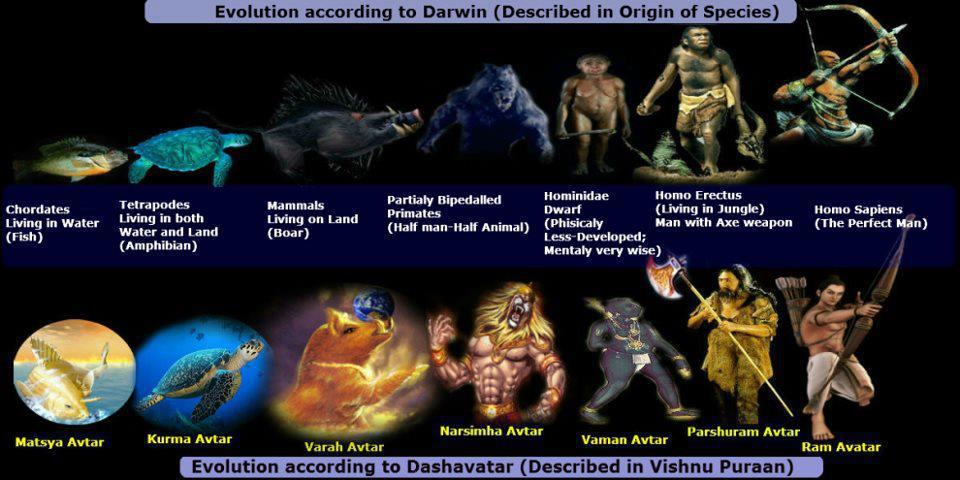
A surprising and much documented aspect of the Dashavatara story is its connection with evolutionary theory. Evolutionary theory, when viewed from a certain perspective, neatly intersects with the ten incarnations. Man’s origins in the waters is evoked by the pisciform nature of Matsya. Then come the tortoise and the boar, taking us from amphibians to land animals. This is followed by a therianthropic form (Narasimha), and then homo sapiens proper, and so on. All this was recorded by Hindu sages thousands of years before Christ.

Stage 1 – (Fish) – Life started in the water

Modern Science: Proto-Amphibians that primarily lived in the water, this can be seen as the first stage of life. Examples are prehistoric fishes.

Hinduism: The first incarnation or avatar of Lord Vishnu was in the form of a fish and is known as Matsya Avatar. It clearly parallels with the scientific view.


Stage 2 – (Tortoise) – Amphibious – Life moved from water to the land.

Modern Science: Fish finally evolved out of water became Reptiles (with legs to be accurate). The examples are tortoise, lizards etc.

Hinduism: Second avatar of Vishnu is Kurma. Kurma means Tortoise which is a reptile that walks on four legs. We all know that tortoise is a creature capable of living both on land & in water, which indicates the transition of life from water to land. Again it’s a direct parallel with the scientific view.


Stage 3 – (Boar) – Complete animal – Adapted to live on land.

Modern Science: Reptiles evolved into the semi-amphibian and then the animals that live in swamps and slush and that could bear children and lived only on the land.

Hinduism: The Varaha Avatara, in the form of a wild boar, portrays the birth of the mammal. You may ask – why Boar? Why not a deer or monkey or some other mammal? The reason is that Boar belongs the the Suina family whose maxillary or teeth are in front and therefore they do not have to swallow and regurgitate their food just like us humans! It’s extremely enlightening to note that Hinduism had such a very insightful knowhow thousands of years ago!


Stage 4 – (Half ape) – Transformation from animal to ape.

Modern Science: Finally primates were evolving into Hominidae forms that looked more like humans, were partially bipedalled (walk on legs) but their brains were still not quite developed. They can be figuratively seen as having partly human lower body and animal like upper body.

Hinduism: Narasimha Avatar is a Half man and Half animal, and indicates the transformation from animal to human form. The interesting thing to note here is that Narasimha has the upper body of a lion but lower body of a man. This is important because this directly relates to the idea of a pre-human without a well developed brain but with the partial ability to become bipedal (walk on legs). This may be early-extinct human ancestor such as someone who could be the missing link between apes and humans.


Stage 5 – (Dwarf) – Transformation from ape to human, developed intelligence.

Modern Science: Finally Hominidae got closer to Homo Erectus was evolved. He was bipedal (walk on legs) more human looking but very short (dwarf).

Hinduism: Vamana Avatar represents a being that is very close to humans but is extremely short. It indicates the complete transition into human form, and the beginning of intelligence in humans.


Stage 6 – (Forest dweller) – Humans developed stone tools.

lord parasurama avatar of vishnuModern Science: Homo Erectus and then Homo Sapien was evolved that was
about as tall as present day humans and could use tools. Homo Sapien is the present day human and biological evolution ends and at this stage the human might have a wavering mind, uncontrollable and act without reasons.

Hinduism: Sixth Avatar of Lord Vishnu was forest dweller called Parasuram, who has weapons such as axe for survival. This is the first avatar of Vishnu that has no animal characteristics and wields an Axe. So basically, Parashuaram is what the current day human would be who could also use tools, in other words Homo Sapien.


Stage 7 – (Hunter) – Humans used superior weapons, bows and arrows, created villages.

Modern Science: At this stage the humans developed to be perfect and they started giving importance to penance than the pleasure and started respecting other humans. The survival of the fittest started here and this led to mutinies between mankind. This was the beginning.

Hinduism: The seventh incarnation of Lord Vishnu is Lord Rama, who is well known among Hindus and is worshipped in temples as a deity. He civilized and has developed more superior weapons like the bow and arrows. He has cleared the forests and developed small communities or villages. He is very vigilant and protects his villages and people. Rama was a very moral man, and was very obedient to his parents. This shows the psychology and simplicity of early human beings.


Stage 8 – (farmer) – the beginning of full-fledged cultivation

Modern Science: People began planting seeds and covering the countryside with food producing plants. The earliest and most successful crops were grasses with large seeds such as barley, wheat, and rice.
 
Hinduism: The eight incarnation of Lord Vishnu is Lord Balarama. He is portrayed with the plough – the beginning of full-fledged cultivation. Human civilization has developed agriculture and is no longer depended on meat and forest for food.
 

Stage 9 – Advanced in civilizations and culture and to todays world

Modern Science: Mankind never stopped since they learned to use tools and all the Neanderthalensis were eliminated. Civilizations were formed, wars were fought, kingdoms were born and finally the world is as we see it today. The chief characteristic here is the increasing complexity of life and society. The perfect human with cleverness and ability to think and win developed at this stage. The humans started loving music, dance, etc…

Hinduism: Lord Krishna is another popular deity worshipped in many temples, and is a clear representation of advanced human civilization. Recent excavations of Dwarka city confirm the well planned construction  of cities, towns and streets. 

Stage 10: End of the World


Modern Sciences: According to Big Bang theory and other Modern theories the universe is not stable. The life in world should end at one point and the creation starts from the beginning. This whole loop continues infinite times.

Hinduism: The 10th form is the final life form where Hinduism surpasses the modern theory of evolution, and predicts the future. Remember that we are looking at all the life forms that dominated planet earth since millions of years. So what would the final dominant species look like? According to Hindu mythology 10th Avatar of lord Vishnu, called Kalki is yet to be taken and this occurs when the whole life on earth ends. He would be here to restart the whole cycle, so that it starts again. Species will be disappearing and the world will come to an end.” 

Alternate lists
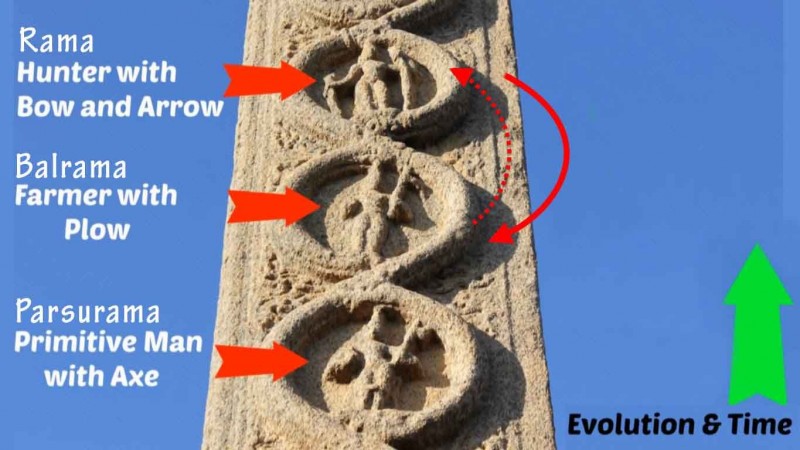
Various versions of the list of Vishnu’s Avatars exist. Some lists give Balarama as the 8th avatar and Krishna as the 9th. While other give Krishna as the 8th avatar and the Buddha as the 9th avatar. However modern day philosophers and sculptors have completely removed the Balarama (Farmer) and inserted Lord Buddha.
 
Dashavatar mistake at Rayar Gopuram at Mahabalipurum
Dashavatar carving on a pillar which show Balrama (Farmer) before Rama (Hunter)

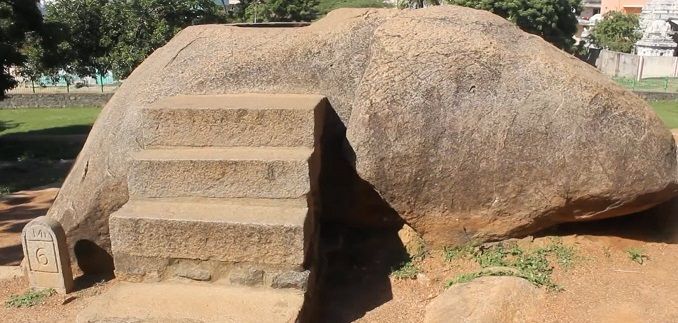
A Pillar at Rayar Gopuram in Mahabalipurum show Balarama as 8th Avatar of Vishnu. According to legends entire structure was left unfinished because a sculptor made a simple mistake in carving this pillar and carved the hunter (Lord Rama) after the farmer (Balarama). This does not fit the evolution theory and makes the entire carving pointless. However, to the so called primitive people who lived thousands of years ago, such a mistake was unacceptable and they completely abandoned the entire structure.

Historian Comments

Monier Monier-Williams wrote “Indeed, the Hindus were … Darwinians centuries before the birth of Darwin, and evolutionists centuries before the doctrine of evolution had been accepted by the Huxleys of our time, and before any word like evolution existed in any language of the world.

J. B. S. Haldane suggested that Dashavatara gave a “rough idea” of vertebrate evolution: a fish, a tortoise, a boar, a man-lion, a dwarf and then four men (Kalki is not yet born).

C. D. Deshmukh also remarked on the “striking” similarity between Darwin’s theory and the Dashavatara.

Source: Vedic-Maths.com and Wikipedia
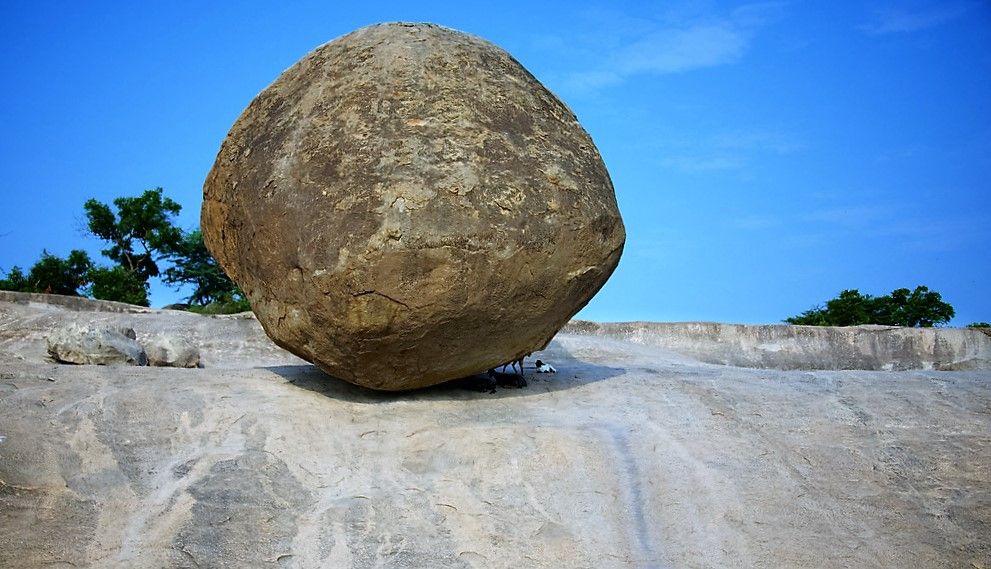
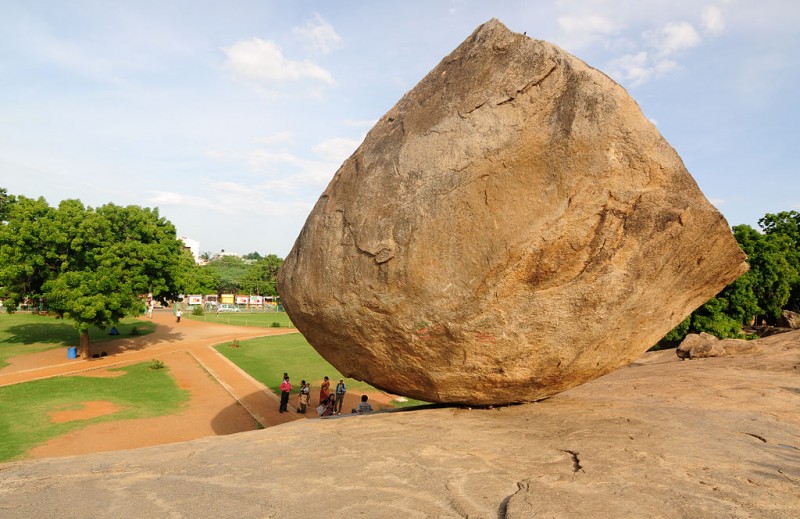
Krishna’s Butter Ball – A Balancing Rock at Mahabalipuram

The Krishna’s butterball is a giant balancing rock, 5 meters in diameter, perched on a smooth slope, seemingly defying all laws of physics. It weighs over 250 tons and miraculously stands on an extremely small, slippery area of a hill. 

This monolithic granite rock found in Mahabalipuram, India. Its original name is Vaan Irai Kal. In Tamil language, the original language of the land, it means “Stone of The Sky God“.

The rock is balanced upon a 4 feet area of the hill and is perilously resting at an angle of 45 degrees. The base of the rock is firmly attached to the hill below. This rock is bigger and heavier than the monolithic stones of Ollantaytambo, Peru. It is also much bigger than the rocks found in the mysterious Machu Picchu.

Krishna’s Butterball

In Hindu mythology Lord Krishna had an insatiable appetite for butter, and as a child, would often sneak a handful from his mother’s butter jar. Situated on a hill slope near the Ganesh Ratha this massive natural rock boulder is attributed to a bolus of butter the young Krishna would steal.

It’s a common sight to see visitors placing hands under the stone posing for pics, which looks as though they are holding it! The rock provides welcome shade if you dare to sit underneath it, and local kids have discovered that the slippery nearby hillside also makes a great natural slide.

The rock is believed to be naturally formed but theorists believe a natural formation such as this is highly improbable, as natural corrosion could not have brought upon such a shape.

There has been a lot of debate how this enormous rock ended up on the hill. Even in modern days, moving a 250 ton rock uphill would be a very difficult task and require complex equipment such as cranes. How did the people do it thousands of years ago?

Several attempts to move the rock have been made, but none of them has been successful. In 1908 the Governor of Madras (Chennai) Arthur Lawley thought that this rock was too dangerous and would slide off the hill and cause harm to people and houses nearby. So he ordered it to be moved with help of seven elephants. However, the rock did not move an inch and the Indian government gave up leaving Krishna’s Butter Ball where it is now.

This mysterious rock raises a number of unanswered questions. How does a 250 ton rock stand on less than 4 feet base? Is there something hidden underneath? If it was impossible to push this rock downhill, how was it pushed up the hill? Who or what put the rock on this slope? Why is the name of the rock related to Sky Gods?

Was the “Stone of The Sky God” placed on the hill by giants, or heavenly gods who wanted to show their strength? Could this superior ancient technology be of extraterrestrial origin?

Krishna’s butter ball stands alone on this hill, boasting of its majestic stature and is a testimony to the limits of our modern technical superiority. No matter who placed Krishna’s Butter Ball  here, it will be reminder that our understanding of history is incomplete.

Thugs – The Cult Assassins of India

Thuggees were an organized gang of professional assassins who operated from the 13th to the 19th centuries in India. The term Thuggee is derived from Hindi word ṭhug (ठग), and Sanskrit word sthaga which means Theif, deceivers, concealment and fraudulent. Sometimes described as the world’s first mafia, Thugs were Hindu and Muslim whose Thuggee cult was based on the worship of goddess, Kali.

According to the Guinness Book of Records, the Thuggees were responsible for approximately two million deaths, however estimations vary widely since there is no reliable source to confirm when the practice first began. The first known record of the Thugs as an organized group, as opposed to ordinary thieves, is in Ẓiyāʾ-ud-Dīn Baranī’s History of Fīrūz Shāh dated to around 1356. Although the Thugs traced their origin to seven Muslim tribes, Hindus also appear to have been associated with them from an early period.

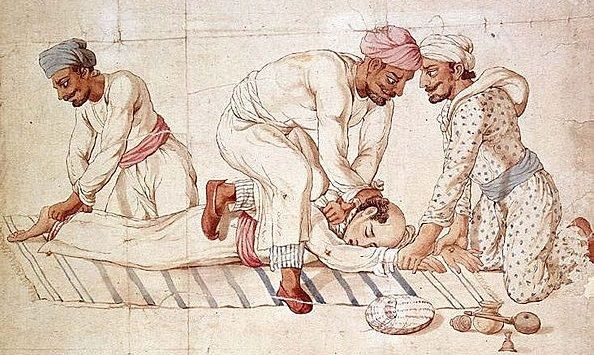
Thugs traveled throughout India in gangs of 10 to 200 members, all dressed in various guises. They targeted travelers, especially wealthy travelers; gaining the confidence of their soon to be victims. When a favorable opportunity arose, Thugs strangled their victims with a Rumal (handkerchief) or noose around the victim’s neck. Once the victim was dead, the Thugs then plundered his belongings and buried the body.

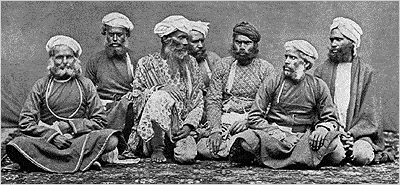
Group of Thugs
Group of Thugs – Image Source

Their crimes involved a high degree of teamwork and co-ordination both during the infiltration phase and at the moment of attack. Each member had a well-honed specialty; some distracted their quarry, some made noise or music to mask any cries, while others guarded the campsite from intruders and escapees. Thugs of the highest rank performed the actual killings. Thugs who were too old or infirm to perform the travel and ritual attacks on travelers, served as guides, spies, supply providers and more. It was a matter of honor for the Thugs to let no one escape alive once they had been selected for death. Membership to the fraternity of Thuggees was often through hereditary lines, passed down from father to son, with the women of the home being kept unaware of the men’s cult activity. Others trained with a guru, similar to an apprenticeship, or tried to align themselves with other Thugs in the hope of being recruited. Sometimes the children of travellers who were killed were groomed to become Thugs themselves, as the presence of children would help allay suspicion. Because of the closeness, secrecy and discipline of the Thug organization, they were rarely if ever, suspected of any wrongdoings. They were recognized by many as normal law abiding citizens and went unmolested for centuries. However, there were average persons, especially travelers, who were well aware of the dangers presented by the strange Thugs.

There is evidence, however, that all Thuggee assassins were united by common superstitions and rituals, which led to the gang being branded a cult or sect. The Thugs were a very close fraternity and used special jargon (ramasi) and hand signs to communicate with each other. Such secret communication methods allowed fellow Thugs to recognize each other in the furthest, most remote parts of India. They were also bound by a set of rules, such as the prohibition to steal a person’s property without killing them in accordance with ritual first. Brahmans were not killed because of their purity, killing of the sick was considered an unworthy sacrifice, and women were not killed because they were considered to be incarnations of Kali.

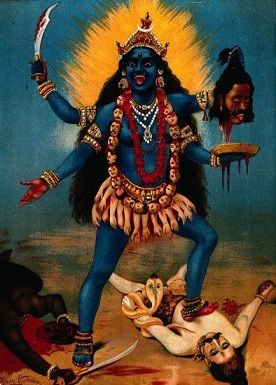
Hindu Goddess Kali
Hindu Goddess Kali – Image Source

For the members of Thuggee, murder was both a way of life and a religious duty and they considered themselves to be holy and honorable men. They believed their killings were a means of worshiping the Hindu goddess Kali. Kali is believed to be the destroyer of evil spirits and the preserver of devotees. Kali is Goddess of life, death, and rebirth. She is the Dark Mother who creates and destroys.

To the members of the Thuggee cult, she was something else entirely. Their Kali craved human blood, and demanded endless sacrifice to satisfy her hunger. According to Thuggee legend, Kali once battled a terrible demon which roamed the land, devouring humans as fast as they were created. But every drop of the monster’s blood that touched the ground spawned a new demon, until the exhausted Kali finally created two human men, armed with rumals, and instructed them to strangle the demons. When their work was finished, Kali instructed them to keep the rumals in their family and use them to destroy every man not of their kindred. This was the tale told to Thuggee initiates.

The Thuggee assassins were eventually suppressed by the British rulers of India in the 1830s,  after the implementation of the Thuggee and Dacoity Suppression Acts.

Source:

http://www.unexplainedstuff.com/Secret-Societies/The-Thuggee.html

http://en.wikipedia.org/wiki/Thuggee

Drilling Technology of Ancient India

Mahabalipuram is an ancient historic town in Kancheepuram district in the Indian state of Tamil Nadu. During the  time of Periplus (1st century CE) and Ptolemy (140 CE) Mahabalipuram was a bustling seaport, used by Ancient Indian traders who went to countries of South East Asia.

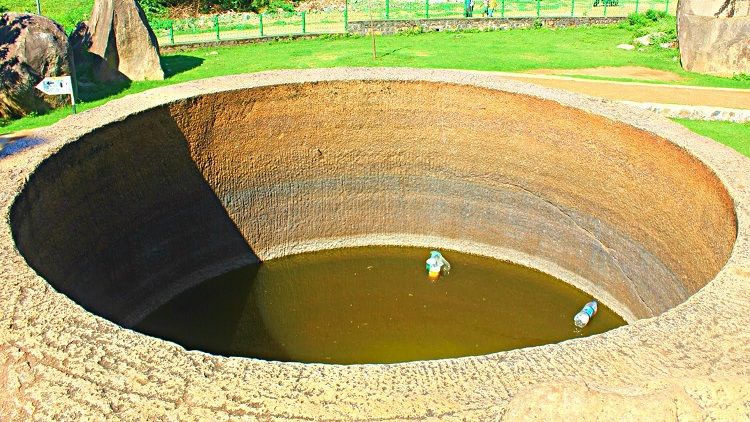
It has a group of sanctuaries, which was carved out of rock in the 7th and 8th centuries. Here in Mahabalipuram, we can find some evidence of ancient drilling technology. An eight feet wide, Giant hole is drilled out of granite rock. As we know Granite is one of the hardest rocks in the world and today we use diamond tipped tools and laser to make drills in it. How could ancient Indian drill a humongous hole like this 1300 years ago and why?

Called by locals as Seetha’s Bathtub, this Giant hole is 8 feet wide and 5 feet deep. The circumference is a perfect circle. Walls looks so smooth and looks like it is made with a modern machine. According to conventional history, People did not use any complex tools. But how can a perfect circle that is 8 feet wide be carved on a rock. Nobody knows the reason behind this giant hole drilled out of this rock.

granite rock of Mahabalipurum

Academics think that this was carved with chisels and hammers. If it was true, at one point, this would have taken years to make it look perfect. Why would they need to create a perfect cylinder out of a rock and what is the reason behind making it a perfect circle? If you wanted a well for water, you can dig one with much less manual labor. If you wanted to create a water tank, you can just use pots or metal vessels. Even water wells or tanks don’t need this much of effort. Was it used to fit something that was a perfect cylinder?

Another interesting Site at Mahabalipurum is Krishna’s Butter ball, a 20 feet high and 5 meter wide rock estimated to weigh over 250 tons miraculously stands on an extremely small, slippery area of a hill.

5,000 years old stepwell discovered

A  5,000 years old stepwell has been discovered in one of the largest Harappan cities, Dholavira, in Kutch. Dating back to bronze age, the site represents the largest, grandest, and the best furnished ancient water reservoir discovered so far in the country. It’s rectangular and 73.4m long, 29.3m wide, and 10m deep and almost three times bigger than the Great Bath of Mohenjo-Daro, which is 12m by 7m by 2.4m. Archaelogists are hopefull that the reservoir might be listed with the UNESCO. Another site, the Rani ki Vav in Patan, is listed with the UNESCO already.

Experts will now start researching for the technology used in this Harappan stepwell as they say that there is a highly advanced hydraulic engineering that has been used here. The team will be using remote sensing technology, 3D laser scanner and ground penetrating radar system. How did water flow into the well? What was the idea behind water conservation? These are some of the questions that will be probed.

5000 years old stepwell found in dholavira, gujrat, india
The stepwell that was found during the excavation. – Image Source

Various tanks, stoneware, finely furnished brick blocks, sanitation chambers and semi-precious stones such as carnelian, which were in great demand during the Harappan era, are expected to be investigated. Gujarat was the centre of bead and craft manufacturing, and agate carnelian beads were very popular.

A study of the internal structures of various forms of pottery will help them to identify the diet of various people here. The pottery typology will show what communities lived here, and what kind of precious copper and bronze artefacts were used.

V N Prabhakar, visiting faculty at IIT and superintending archaeologist, ASI said,We will conduct spot analysis in December as various surveys have indicated other reservoirs and stepwells may be buried in Dholavira.

To add further, he said, “We also suspect a huge lake and an ancient shoreline are buried in the archaeological site that’s one of the five largest Harappan sites and the most prominent archaeological site in India belonging to the Indus Valley civilization.

Source:  Times of India

Rakhigarhi is now largest Harappan site

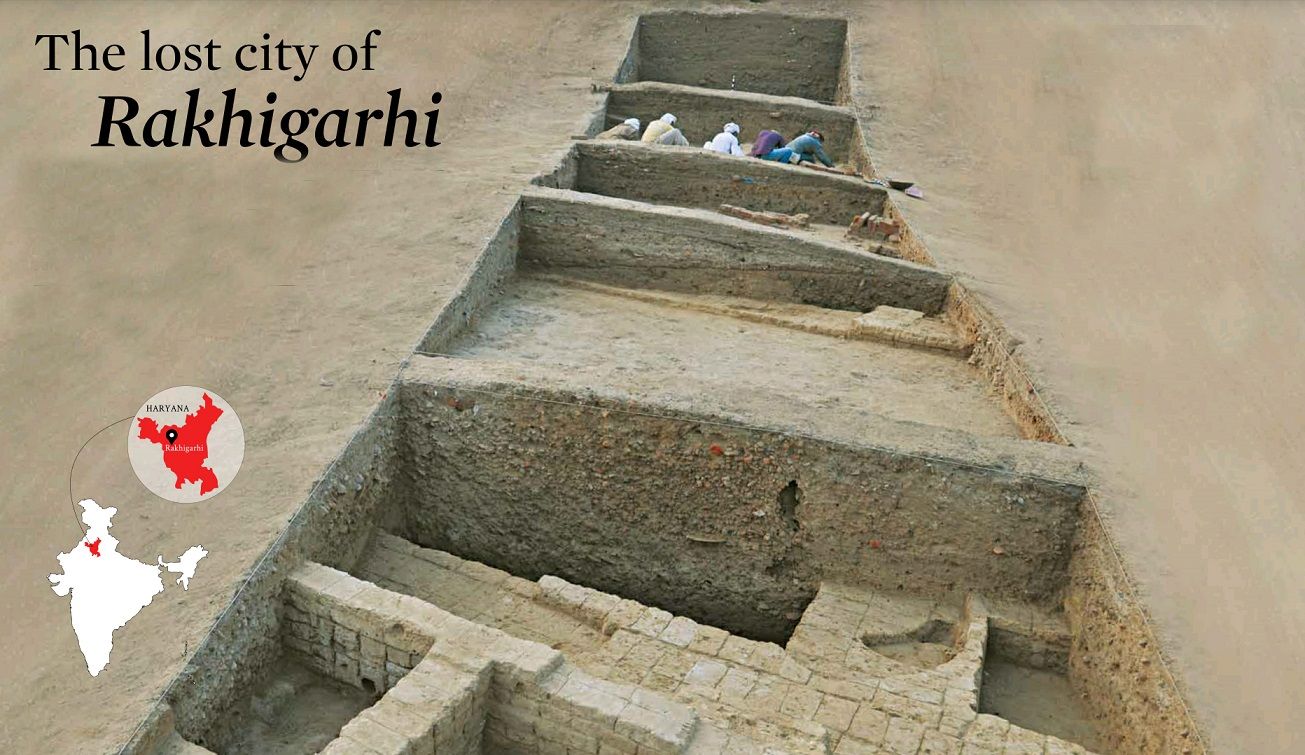
Rakhigarhi is a village in Hisar District in the state of Haryana in India, around 150 kilometers from Delhi. Spread over 350 hectares, this nondescript village is biggest Indus valley Civilisation site in the world, a city that was much larger and more ancient than Harappa and Mohenjo-Daro sites. It is situated on the dry bed of the river Sarasvati, which once flowed here and is believed to have dried up by 2000 BC.

It is the only place which has the remains of early, mature and late phase of Indus valley Civilisation at the same location. It is one of the few Harappan sites which has an unbroken history of settlement—Early Harappan farming communities from 6000 to 4500 BC, followed by the Early Mature Harappan urbanisation phase from 4500 to 3000 BC, and then the highly urbanised Mature Harappan era from 3000 BC to the mysterious collapse of the civilisation around 1800 BC.

In January 2014, the discovery of two new mounds at the ancient Harappan site of Rakhigarhi makes it the largest known site of the Indus Valley civilisation. Until now, experts believed that Mohenjo-Daro in Pakistan was the largest among the 2,000 Harappan sites known to exist in India, Pakistan and Afghanistan. With the discovery of two more mounds, adding to the seven mounds already discovered, the total area of the archaeological site of Rakhigarhi now measures 350 hectares. The eighth and ninth mounds, spread over 25 hectares each, are situated to the east and west of the main site. Archaeologists also found numerous artefacts, some around 5,000 years old.

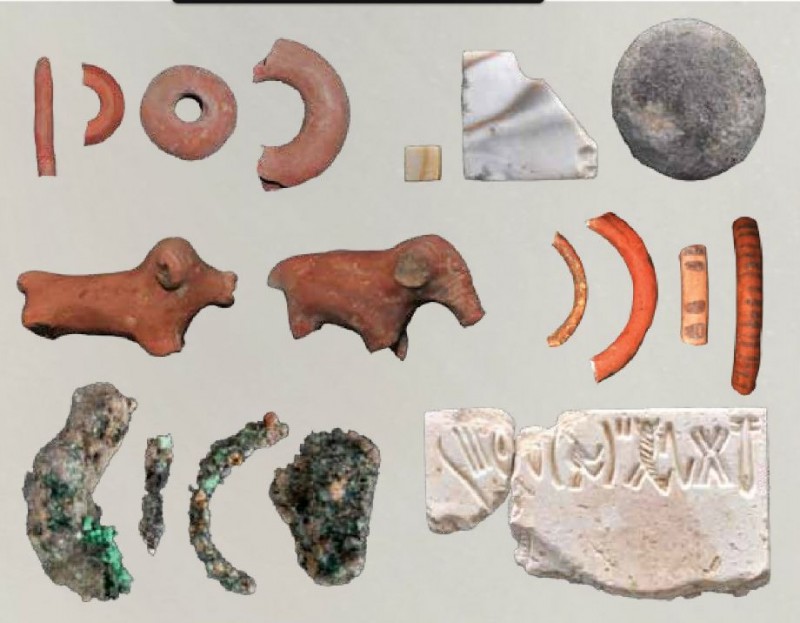
Terracotta toys, Broken bangle piece, copper objects and Harappan seal Dicovered at rakhigarhi
Terracotta toys, Broken bangle piece, copper objects and Harappan seal Dicovered at rakhigarhi. -Image by India Perspectives

Terracotta statues, bronze artefacts, copper fish hooks, terracotta seals a bronze vessel decorated with gold and silver were found here.

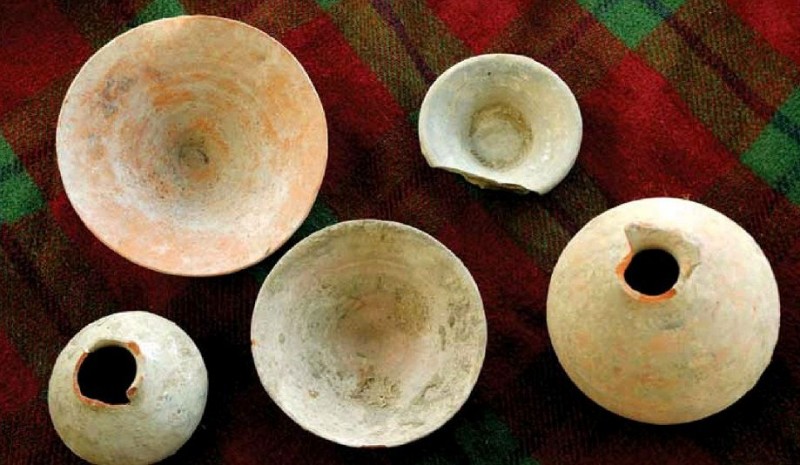
Recent excavations at the newly discovered and pre-existing mounds have also revealed a cornucopia of ancient artefacts including terracotta bangles; pottery pieces; a seal and a pot shard, both inscribed with the Harappan script; pot shards painted with geometric designs; and terracotta animal figurines, all belonging to the Mature Harappan phase of the civilisation. In addition, five trenches around the mounds have revealed residential rooms, a bathroom with a soak jar, drainages, a hearth, and a platform, all built with mud bricks. 

A burial site, with 11 skeletons with their heads in the north direction, was dug out too. Utensils for everydy use were kept near their heads. Three female skeletons had shell bangles and a goldarmlet was found near one. Semi-precious stones were found too, showing they were part of a necklace.

One of the mounds found here also shed light on the Harappan’s occupational inclinations as it showed large scale burning, indicative of metal smelting and the use of furnace technology. Archeologists also found copper slags here, which mean that this part of Rakhigarhi was an industrial area. This finding is significant because though it was known that Harappans were industrially advanced, but there was no earlier evidence about the kind of technology they used.

Pottery Items Dicovered at Rakhigarhi

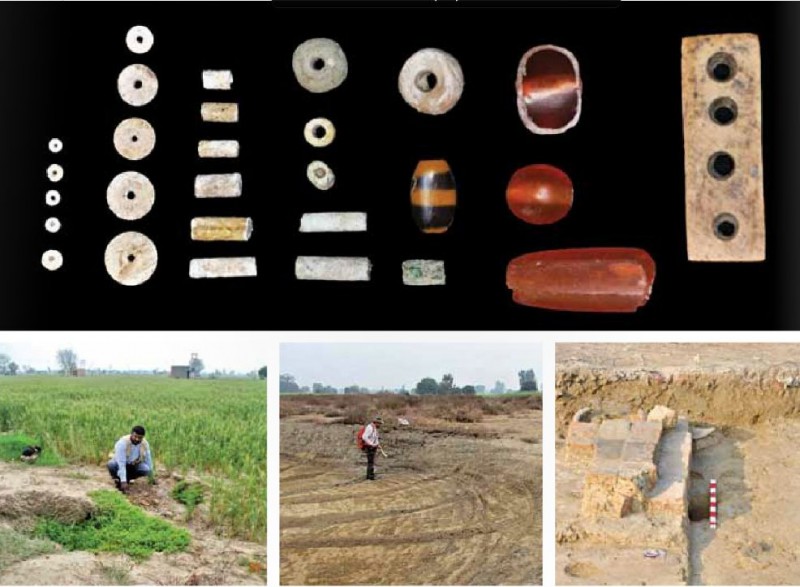
Rakhigarhi was occupied during early Harappan times as we have found eveidence of paved roads, drainage system, large rainwater collection, storage system, terracotta bricks, statue production and skilled working of bronze as well as precious metals. Jewellery, including bangles made from terracotta, conch shells, gold and semi-precious stones, has also been found. In fact, the site lies at the centre of Ghaggar Basin, the Harappan civilisation’s (2600-1900 BC) most densely populated region,” share Prof. vasant Shinde, senior archaelogist heading the excavations at Rakhigarhi.

It was in 1963 that Rakhigarhi first appeared on the archaeologists’ map when it was identified to have the remains of Indus Valley Civilisation. It was in 1997 that the Archaeological Survey of India (ASI) took the mounds under its protection and followed it up with exacations between 1998 and 2001 to reveal a city larger than Mohenjo-daro and Harappa. The rest of the ancient Harappan site of Rakhigarhi still lies buried under the present-day village. New houses are coming up at Rakhigarhi, which is destroying a big part of the Harappan site. One-third of the site is under cultivation.

Archaelogists believe that the beginning of the Harappan Civilisation took place in the Ghaggar Basin in Haryana, India and it gradually grew from here and slowly moved to the Indus valley. It was earlier thought that the origin of the early Harappan phase took place in Sindh, in present-day Pakistan, because many sites had not been discovered then. In the last ten years, Archeologists have discovered many sites in India, which are producing early dates and where the early Harappan phase could go back to 5000 BCE. 

Ornaments made by steatite fience ivory bone and carnelian (below) At the excavation site and an excavated bathroom - Rakhigarhi harappa
Ornaments made by steatite fience ivory bone and carnelian (below) At the excavation site and an excavated bathroom

The Indus Valley Civilisation is one of the three oldest urban civilisations, along with Egypt and Mesopotamia. Ancient India during the Harappan era had one of the largest populations in the ancient world, far greater than the Middle East or Europe. 

Reference: the hindu.com