Job Charnock is credited with having founded Calcutta, now Kolkata, in 1690. It was the capital of the British Indian empire until 1911 when the capital was relocated to Delhi. The word Kolkata derives from the Bengali term Kôlikata, the name of one of three villages that predated the arrival of the British, in the area where the city eventually was to be established; the other two villages were Sutanuti and Govindapur. But artifacts unearthed during a recent excavation could rewrite the history of the origins of this city.
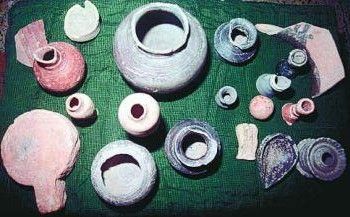
Recent excavations, at the famous Dum Dum mound, which houses the Clive House — the oldest building in the city — have yielded remains of an urban settlement dating back to 2nd Century BC, which proved that urban settlements existed in Kolkata long before a colonial town came up in the triad of villages of Kalikata, Sutanuti and Gobindapur. The site remained in occupation almost till modern time, with a break during the 12th to 14th Century AD.
Artefacts from the excavation are various and include exquisite terracotta plaques and figures from the 2nd and 1st Century BC to 8th-9th Century AD. This excavation has proved that Kolkata was inhabited by civilised people who used materials normally found in an urban settlement. The discovery of various things bearing close resemblance at many artefacts that hints that the settlement was an extension of Chandraketugarh.
Chandraketugarh is an archaeological site located about 35 km north-east of Kolkata, where archaeologists discovered many artefacts dated from 400 BC to 100 BC. According to some historians, the Chandraketugarh site and surrounding area could be the place known to ancient Greek and Roman writers as ‘Gangaridai‘.
“The excavation revealed that Kolkata did not spring up suddenly. Traces of urban settlement found during the excavation bore a close resemblance with those found in an urban settlement at Chandraketugarh,” said ASI (Archaeology Survey of India) regional director P K Mishra.
There could have been more revelations if the ASI could complete the excavation. Archaeologists believe that the revelations will not only give a complete understanding of the origins of Kolkata, but they may as well unearth a whole city. But much progress could not be made as the site is surrounded by a densely populated urban centre and further excavation could risk damaging nearby buildings.
“An extensive excavation is required to understand the real history of the city. But whatever we have found is enough to rewrite the history of the city,” claimed Mishra.
Though evacuation of this site started as late as 2001, ASI officials came to understand its importance by chance, when a telecom company digging for laying cables dug up a plaque with inscriptions.
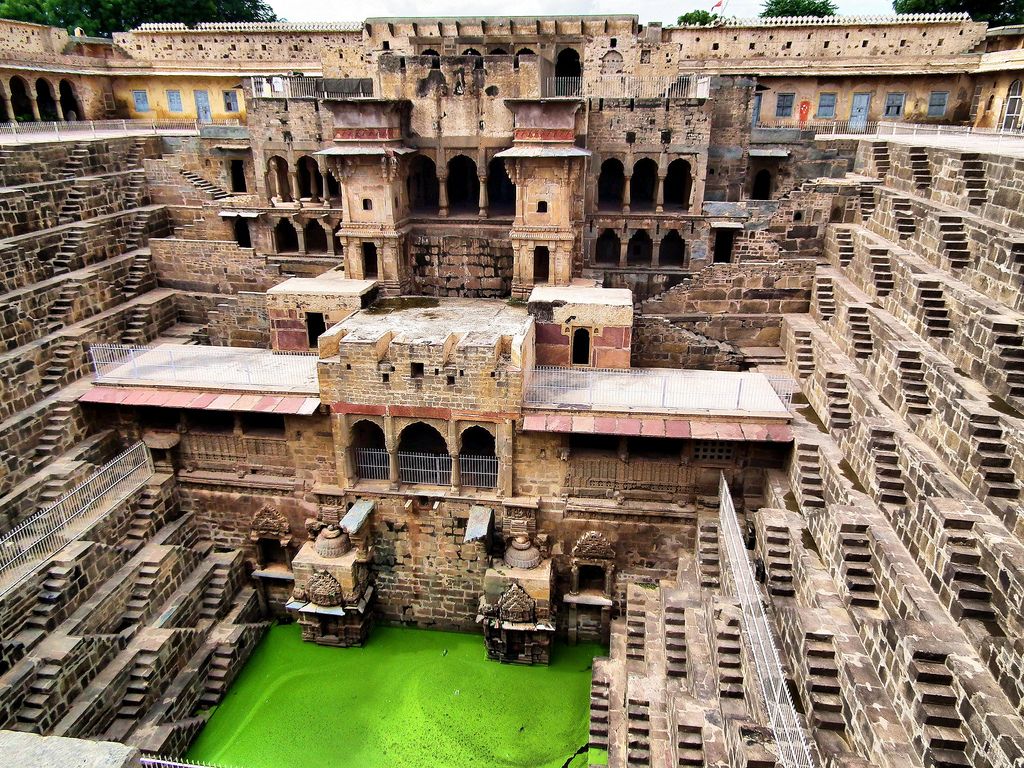
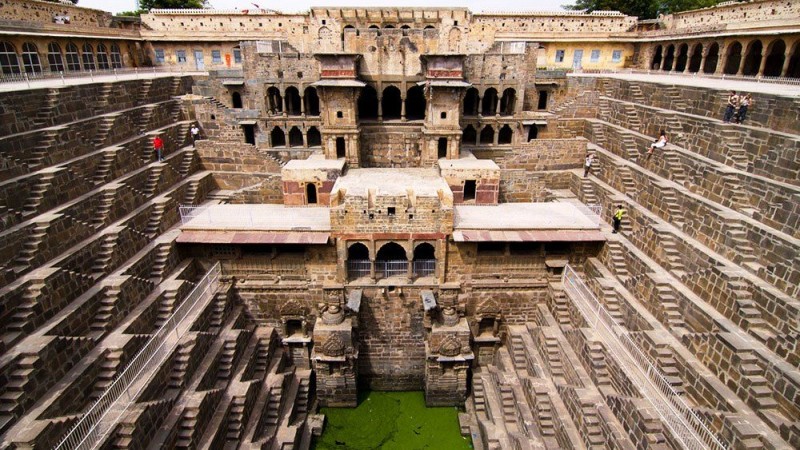
Stepwells, also called bawdi or baori, are unique to India. These wells acted as the reservoirs or the storage tanks that can store large amount of water and keep it cool as well. These wells have steps built into the sides that can be descended to reach the water at the bottom. Stepwells are generally larger than common wells and are often of architectural significance, just like Chand Baori – one of the oldest and most famous step-wells in India.
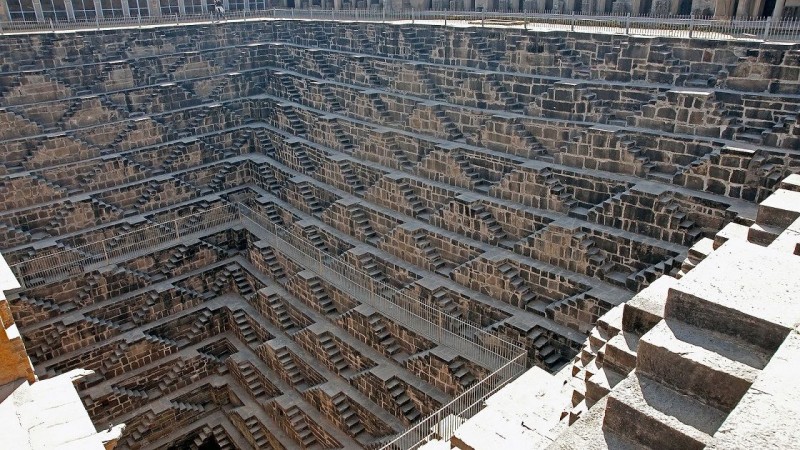
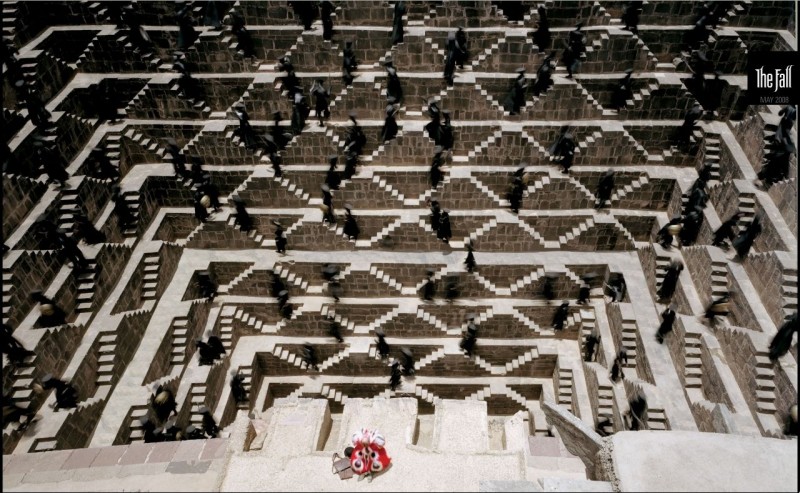
Situated in the village of Abhaneri, Rajasthan, Chand Baori is one of the deepest and largest step wells of India with 3500 narrow steps in 13 stories. It extends approximately 100 ft into the ground. The well was dedicated to Hashat Mata, Goddess of Joy and Happiness upon completion.
The place was called Abha Nagri (City of Brightness) but, with time Abha Nagri became AbhaNeri.
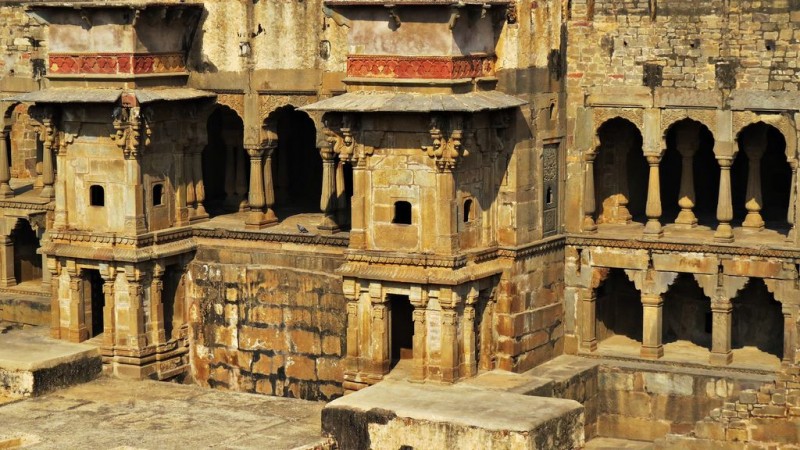
The steps and the whole surrounding is a fine example of architectural expertise of the great Indian architectures. It also displays the geometrical intelligence of the architects of the bygone era.
Chand Baori was built during the 8th and 9th century by King Chand of Nikumbha Dynasty, to give the local population easy access to clean ground water at the bottom of the well. It provided the surrounding areas with a dependable water source for centuries before modern water delivery systems were introduced.
The state of Rajasthan is extremely arid, and the design and final structure of Chand Baori was intended to conserve as much water as possible. One side of the well has a pavilion and resting room for the royals. In addition to conserving water, Chand baori also became a community gathering place for the Abhaneri locals. The townsfolk used to sit around the step well and cool off during the summer days. At the bottom the well the air is always about 5-6 degrees cooler than at the top.
Chand Baori is no longer an active well and is maintained by the Archeological Survey of India. Chand Baori was featured in the movie The Fall and also made a small appearance in Christopher Nolan’s blockbuster The Dark Knight Rises.
Water plays a special part in Hindu mythology, as a boundary between heaven and earth known as tirtha. As manmade tirtha, the stepwells became not only sources of drinking water, but cool sanctuaries for bathing, prayer, and meditation.
The earliest stepwells date to around 550 A.D., but the most famous of them were built in medieval times. There are suggestions that they may have originated much earlier, and precursors to them can be seen in the Indus Valley civilisation. It is estimated that more than 3,000 stepwells were built in northern Indian states. Although many have fallen into disrepair and have been filled in with trash in the modern era, hundreds of wells still exist.
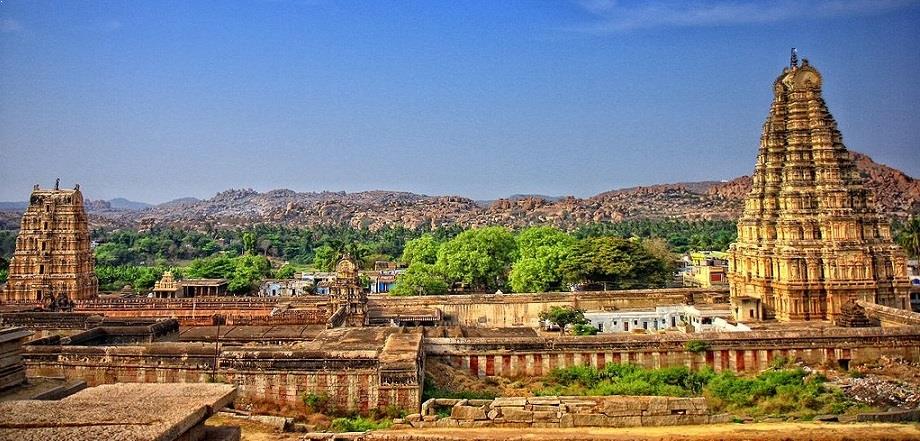
The Virupaksha Temple is one of the most stunning landmarks in India and the main center of pilgrimage at Hampi. Temple is noted for its architecture and has been listed among the UNESCO World Heritage Sites. Dating back 1,300 years, the magnificent structure consists of a layered tower of elaborate, hand-carved friezes populated by a bevy of Hindu deities and symbols.
Mathura and Vrindavan are important places for Hindus all over the world. Vrindavan is especially a very revered and sacred place for the devotees of Lord Krishna. In fact, the Holy Land of Vrindavan can be considered to be the spiritual capital of India. It is the site where Lord Krishna spent his childhood days.
Soon the holy town of Vrindavan will be home to a unique and world’s tallest Lord Krishna temple which will be built at an estimated cost of Rs 300 crore (US$49 million) here in the next five years.
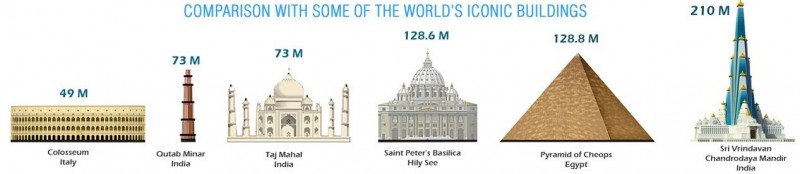
When completed, Vrindavan Chandrodaya Mandir will be the world’s tallest temple rising to a height of 210 meters – taller than other legendary landmarks and wonders of the world including the Colosseum of Rome, the Taj Mahal of Agra, the Qutub Minar of Delhi, the St. Peter’s Basilica, and the Pyramids of Giza.
The project is set in 62 acres of land and will includes 12 acres for parking and a helipad. This magnificent skyscraper has a footprint of about 5 acres and rises to a height of about 700 feet (210 metres or 70 floors).
The grand temple shall be of monumental proportions and its iconic architecture shall harmoniously combine elements of both Indian temple architecture and modern architecture.
The temple is planned to be vibrant with festivals and religious activities throughout the year.
Vrindavan Chandrodaya Mandir will not only house a temple for the worship of Lord Sri Krishna, but will also become a center for disseminating the profound message of the Bhagavad Gita and Srimad Bhagavatam, delivered in a modern context.
The temple aims to imitate Vrindavan of Krishna’s times as spelled out in the ancient texts. A look-alike of the verdant forests of Vrindavan will be recreated around this magnificent temple from descriptions in the Srimad Bhagavatam; sprawling 26 acres it will consist of the twelve forests (dvadashakanana) of Braj.
A capsule elevator will take visitors from the ground level to the 700 ft. tall viewing gallery giving an immersive 3D sound and light experience of the different planetary systems described in the Vedic literature. Visitors will be able to see the Krishna Janmabhoomi (Krishna Birthplace) and even the Taj Mahal in Agra through telescopes installed on the seventieth floor when the skies are clear.
The ‘Krishna Lila Theme Park’ attractions will include themed story telling areas, musical fountains, garden lawn and water features, Yamuna creek for boating experience, Braj heritage village and goshala to recreate the atmosphere of Vrindavan of Lord Krishna.
The indoor park will permit visitors and devotees to immerse themselves in Krishna Consciousness through-out the year, irrespective of the sometimes hostile weather conditions of Vrindavan. The indoor park also houses an expo to present the pastimes of Lord Krishna, the life of Sri Mahaprabhu and Srila Prabhupada. The park will also have a Bhagavad Gita Expo to ignite the minds and invigorate the intellect with the stupendous wisdom given by Sri Krishna, that form the bedrock of culture and philosophy of life in India.
The Krishna Heritage Museum will showcase the rich heritage and artistic celebration of Lord Krishna in diverse cultures of India, practiced and perfected over thousands of years.
The foundation stone of the temple was laid by the President of India, Pranab Mukherjee on 16 November 2014.
Speaking on the occasion, the President said “India is one of the oldest and culturally rich civilizations in the world. As we now make the transformative change from being a developing to a developed economy, there will be immense pressures on our socio-economic and moral fabric. It is, therefore, imperative that we reconnect to our spiritual dimensions. There can be no better way of doing this than spreading the Bhagvad Gita’s message of universal love and humanity.”
The temple is conceptualized by devotees of International Society for Krishna Consciousness (ISKCON), Bangalore. At cost of Rs 300 crore (US$49 million) it will be one of the most expensively built temple in world by ISKCON.
The diamonds have been first recognized and mined in India. For centuries, India was the only place one could find these precious stones. The earliest known reference to diamond is a Sanskrit manuscript, dated from 320-296 B.C., but Diamonds have been known in India for at least 3,000 years but most likely 6,000 years.
The words used for diamonds in Sanskrit are “Vajara,” meaning “thunderbolt” which was the weapon of Lord Indra (god of rain and thunderstorms), which reveals much about the spiritual properties attributed in ancient India to diamonds.
The earliest producing diamond mines were in the Golconda region of India. Diamonds were found only in alluvial deposits in Guntur along the rivers Penner, Krishna and Godavari in Southern India.
In 600 B.C. the Mahajanapada Empire had its own units of currency, and it’s own units of measurement for diamonds. The ancient Indians used a Tandula as a unit of measure, which was equivalent to the weight of a grain of rice. Their currency was called the Rupaka, and according to a price list written in Sanskrit in the Third century, a diamond that weighed 20 Tandulas was worth 200,000 Rupaka.
The empire had no banking system, so the citizens had to keep all of the currency they possessed with them. Wealthy citizens of this empire preferred to convert their wealth into diamonds, as it allowed them to better store their riches. This was the first instance diamonds were used as an investment!
In the fourth century B.C., the rules for the assessment of precious stones, the Ratna Pariksa was codified. Ratna Praiksha—an ancient science on testing gemstones—was used by Kosadhyaksha (Superintendent of Treasury) in order to control business of pearl, diamonds and all important gems in the ancient times. It was mentioned in Arthasastra (“The Lesson of Profit”) by Kautiliya (also known as Chanakya), a minister to Chandragupta of the Mauryan dynasty in northern India. This manuscript is dated to 320-296 BCE.
The author provides an insight into the history of creation of diamonds:
“owing to the great power attributed by the learned to the diamond, the diamond must be treated as the first amongst precious stones…: the eight great diamond deposits are in: Saurashtra (Himalayas), Matanga, Paundra, Kalinga, Kosala, the shores of the Vainya and the Surpara.”
“if there is a diamond anywhere in this world, which is completely transparent, light, with a beautiful color, with absolutely even surfaces, with no scratches, no scars, no damages, no scrawls, no signs of cracks—even if it is only the size of an atom, then it is indeed a gift from God…”
Significance of diamonds in ancient India
The significance of diamonds in ancient Indian society was so great that there was a separate profession for it called “Mandalins”, the diamond experts.
The diamond played such an important role in ancient India that its properties and magic powers were studied right to the minutest detail. Everything was recorded with great accuracy and implemented painstakingly in social life.
At the time of their discovery, diamonds were valued because of their strength and brilliance, and for their ability to refract light and engrave metal. Diamonds were worn as adornments, used as cutting tools, served as a talisman to ward off evil, and were believed to provide protection in battle. In the Dark Ages, diamonds were also used as a medical aid and were thought to cure illness and heal wounds when ingested.
The Hindu religious scripture called the Garuda Purana is considered to be the authoritative reference for ancient Indian gemology, and it says that the owner of a flawless diamond will be blessed with wealth, livestock, good harvests, a wife, and many children. Furthermore, the diamond will protect the owner from both fear and sorcery.
Diamonds Polishing
Diamonds were polished in India from an early time. Polishing arose from the Indian incentive to make the already nearly perfect rough stone as perfect as possible. Since diamond is hardest material known to man, what could be used to polish away such defects?
The only material for this was naturally again the diamond.
Indians discovered the possible polishing planes when one diamond polishes another and they invented the first simple diamond polishing board. This knowledge was probably kept secret. Sometime in the late Middle Ages, diamonds began to be polished in India as jewels, and the first jewels were flat diamonds which received a briolette cut (rose-cut).
Indian diamond polshing Boarda
Diamonds become known to Europe
Only with the campaign of Alexander the Great did the first diamonds come from India to the Mediterranean region. In 327 BC Alexander the Great invaded north India. He brought some diamonds back to Europe.
Indian diamonds in history reached Venice by two Mediterranean routes: the southern route was by way of Aden, Ethiopia, and Egypt, and the northern route was through Arabia, Persia, Armenia, and Turkey. Then, a direct sea route to India was established by Portuguese.
Because of their expense, Diamonds in Europe, were the possessions of the nobility and had ceremonial use. By the 1700’s, diamonds had come to represent wealth and power, and the European nobility used their wealth to invest in diamonds. Diamonds came to dominate small jewels during the 17th century and large ones by the 18th century.
England’s colonization of India brought large amounts of diamonds. English looted Indian temples and royal dynasties and took vast amounts of diamonds to England. From there, the diamonds were sold to France, Spain, Italy and other European countries.
India’s monopoly in the diamond trade end with the discovery of a diamond deposits in Brazil in 1729, and later in the 1870 in Africa. In Modern days about 49% of diamonds originate from Central and Southern Africa, additional major producers now include Siberian Russia, Canada, India, Russia, Brazil, and Australia.
Kohinoor Diamond
Koh-I-Noor, dating back to 1304, is a diamond that was originally 793 carats when uncut. Once the largest known diamond, it is now a 105.6 metric carats diamond, weighing 21.6 grammes in its most recent cut state. The Koh-i-Noor was mined in the state of Andhra Pradesh in India. The diamond was originally owned by Kakatiya Kings which had installed it in temple of Goddess as her eye. The diamond was later confiscated by various kings who won over the previous owners. Diamond was stolen by British after the death of Maharaja Ranjit Singh. Today the diamond is a part of British Crown Jewels.
Kohinoor Diamond on Queen’s crown
Diamonds in Modern India
Today diamonds are mined in about 25 countries. However, for centuries India had been the world’s only source of diamonds for a thousand years. Although the supply of India’s main mines were long ago exhausted, diamonds are still found in India.
India has the world’s largest diamond polishing industry. It provides 11 out of every 12 processed diamonds for jewelry around the world. The diamond sector in India employs 1.3 million individuals. Today, 92 percent of the world’s diamonds are cut and polished in India, mostly in the city of Surat in Gujarat.
Even with India’s recent economic downturn, diamonds have overtaken gold in the Indian jewelry market, being considered on trend and a good investment.
Diamonds are the second highest discretionary item purchased after cell phones. Couples now purchase diamond engagement rings and India is the third largest market in the world for diamond jewelry, making up 12% of global demand.
With the outbreak of war in Europe, India, the Crown Jewel of the British Empire, joined the Allies in battle on the 4th of August 1914. Contributing the most volunteers of any of the British imperial holdings that fought in the war, India produced between 900,000 to 1.5 million troops for combat by 1919. One in six men in the British Empire forces was from India.
Who can forget the heroism of Sikhs in the battlefields of World War I. Sikh formed 20% of the Indian Army even though they were only 1% of the Indian population in 1914. Known as the Lions of the Great War after the war, during the war they were often called the Black Lions.
Around 1,30,000 Sikhs served in WWI and fought in the battles of Ypres, Flanders, the Somme, Gallipoli, East Africa, Palestine, Egypt / Suez Canal, Mesopotamia, and numerous other battlefields in nearly all theatres of the war.
In the first battle of Ypres at Flanders in 1914 a platoon of Dogra Sikhs died fighting to the last man, who shot himself with his last cartridge rather than surrender.
After the bloody battle of Neuve Chapelle in 1915 the Sikh regements had lost 80% of their men, 3 regements stood at only 16% of their original compliment.
“It was the dark days of 1914 when our men had to face mortars, hand grenades, high explosive shells for which they themselves were not provided. They could reply only with their valour, their rifles and two machine guns per batallion. And yet they did it.” (Lt. General Sir James Wilcox, Commander of the Indian Corps)
Group of British & Sikh officer at Le Sart, France.
It is also said that some Sikh, captured in Belgium, were believed to have been Muslims by the Germans and taken to Turkey to fight along side their fellow ‘Mohammedans‘. However, they still remained loyal to the British Crown and escaped on a long trek to the British posts in Afghanistan, from Turkey through the Middle East, to once again fight under the British flag.
Though being paid a mere 11 rupees a month for his services to the Empire, Many Sikh soldier, however, also saw it as their duty to bring honour to their clan or caste, by fighting bravely on the battlefield. Some communities liked to imagine themselves as warriors.
A Sikh soldier, Indar Singh, fighting on the Somme in September 1916, wrote home:
It is quite impossible that I should return alive. [But] don’t be grieved at my death, because I shall die arms in hand, wearing the warrior’s clothes. This is the most happy death that anyone can die.
As Sikh soldiers were shipped out to faraway lands as part of the British Indian Army to fight the Great War, the British felt it necessary to nourish Sikh fanaticism by allowing the Sikhs areas to set up temporary Gurudwaras (Sikh Temples). Sikhs were allowed to take the Guru Granth Sahib, their Holy Book and Spiritual Guide with them as well as musical instruments for Kirtan, the singing of the Holy hymns which they regularly did in their base camps wherever they were posted.
Sikhs were also allowed to use traditional Sikh weapons such as Chakrams and Talwar swords. It reminds Sikhs of their commitment to fighting injustice and oppression in any form.
A letter home from a Sikh soldier:
“Thousand and hundreds of thousands of soldiers have lost their lives. If you go on the field of battle you will see corpses piled upon corpses, so that their is no place to place or put hand or foot. Men have died from the stench. No one has any hope of survival, for back to Punjab will go only those who have lost a leg or an arm or an eye. The whole world has been brought to destruction.“
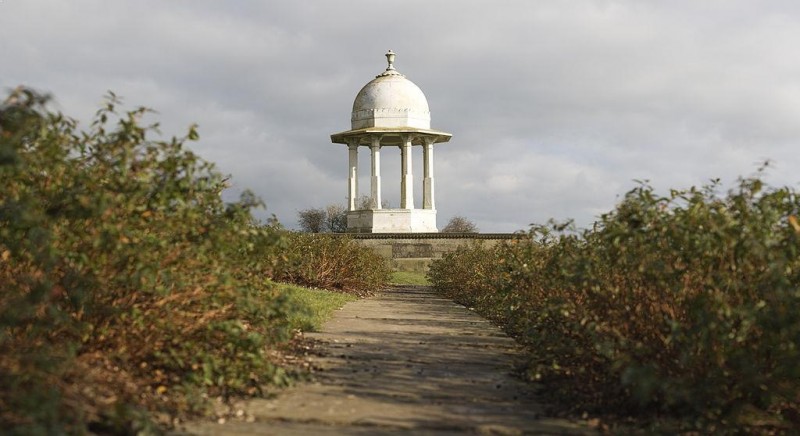
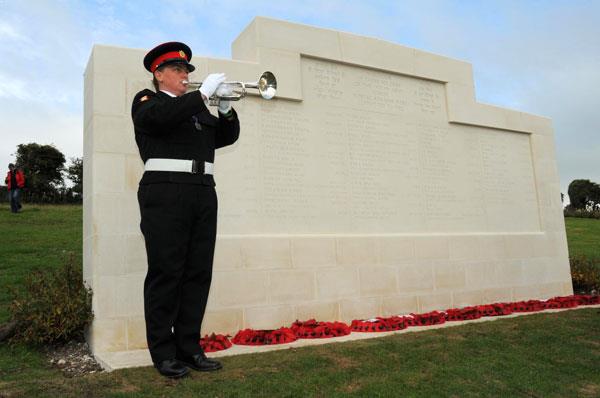
War memorial The Chattri in the city of Brighton and Hove. It stands on the site where Indian soldiers were cremated during the First World War –Image SourcePatcham Down Indian Forces Cremation Memorial records the names of the Sikhs & Hindu casualties. –Image Source
Official figures suggest that 64,449 Indian soldiers died in the war. One Indian soldier, doubting that he would survive, consoled himself with the thought that his name would be written in letters of gold and inscribed in the list of the brave. The names of all of India’s known war dead were indeed carved on the main memorial to the Indian Army, the massive arch of India Gate in New Delhi. The Indians were also commemorated on the Western Front itself. There are many Indian names on the Menin Gate at Ypres.
100 years after the First World War, the Indian Army’s significant role was acknowledged by British. The British army has honoured the contribution made by Sikh soldiers during World War One.
By continuing to use the site, you agree to the use of cookies. more information
The cookie settings on this website are set to "allow cookies" to give you the best browsing experience possible. If you continue to use this website without changing your cookie settings or you click "Accept" below then you are consenting to this.