
Eternal Flames of Jwala Ji Temple

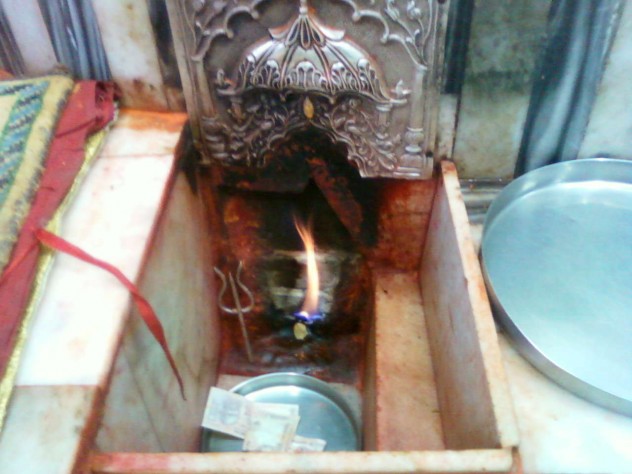
Jwala Ji is Hindu temple located in the lower Himalayan town of Jawalamukhi in Kangra district of Himachal Pradesh. Dedicated to Hindu goddess Jwala, temple is probably the most ancient temple in India. It is mentioned in the Mahabharata and other scriptures. Unlike any other temple, Jwala Ji temple doesn’t have a statue or an image, but a constantly burning blue flame that seems to come from the rocks. The flame can be seen at various places in the temple and it is burning continuously since first date of its known history.

Despite many scientific researches, the reason behind these natural flames couldn’t be found out. The scientists say there is a sleeping volcano under Jwala Ji temple and the natural gas coming out of that volcano is burning as flames, which Hindus revere as Goddess. 

During 70s a foreign company was appointed by Government of India to explore possibilities of big reservoirs of natural gas there. They worked for some years but left saying they could not find any gas.

The Mughal Emperor Akbar once tried to extinguish the flames by covering them with an iron disk and even channelizing water to them. But the flames blasted all these efforts. Akbar then presented a golden parasol at the shrine. Even Aurangzeb, returned back to Delhi after knowing Maa Jwala Devi’s powers.

There is surely some other phenomena and science that is working behind Jwala Ji eternal flame but that can be indication of glory of our ancestors. Till now no scientists or geologists says nothing since they only tried their level best to find a clue but, failed.

History of Jwala Devi’s eternal flame

The legend of the Jwala Ji Temple relates to Sati -granddaughter of Lord Brahma and wife of Lord Shiva. It is here that Sati’s tongue fell which can now be seen in the form of the flame. 

According to legends Sati immolated herself after her father insulted Lord Shiva. In his rage at loosing his wife, angry Shiva performed the fearsome and awe-inspiring Tandava dance with Sati’s charred body on his shoulders. During this dance, Sati’s body came apart and the pieces fell at different places on earth.

According to another version, Shiva placed Sati’s body on his shoulder and ran about the world, crazed with grief. The Gods called upon the God Vishnu to restore Shiva to normalcy and calm. Vishnu used his Sudarshana Chakra (a spinning, disk-like weapon) to dismember Sati’s lifeless body, following which Shiva regained his equanimity. Both versions state that Sati’s body was thus dismembered into 51 pieces which fell on earth at various places. These places came to known as Shakti Peeths. Sati’s tongue fell at the place where Jwala Ji temple is located and the goddess is manifest as tiny flame that burns flawless blue through fissures in the age-old rock. 

History of Jwala Devi Temple

The temple is supposed to be first built by a king Raja Bhumi Chandra who, on the complain of a cowherd, tried to find out the a female who came out of the forest and drank the milk of his cow. Since, the king was aware of the legend of Sati, he continued his search for the place and finally succeeded. He constructed a temple there and employed priest to perform puja (prayer). Later, Pandavas came and carried out some renovation work in the temple.
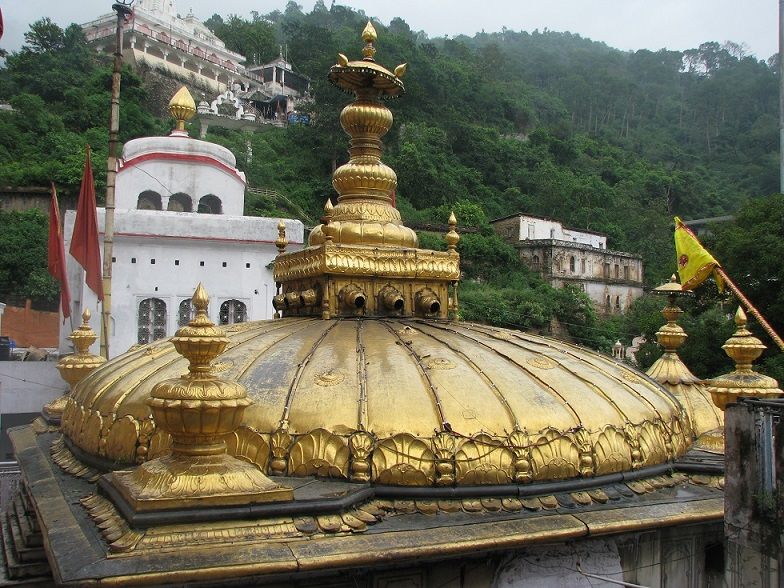
Jwala Ji temple, Kangra

The modern building of temple is with a gilt dome and pinnacles and possesses a beautiful folding door of silver plates, presented by Maharaja Kharak Singh. His father, Maharaja Ranjit Singh also presented the gilt roof in 1815 AD. The interior of the temple consists of a square pit about 3 feet deep with a pathway all around. 

The term ‘Jwala‘ means “flame” in Sanskrit and ‘Ji‘ is an honorific used in the Indian subcontinent. Goddess Jwala is also referred to as Mata Jvala Ji and Mata Jwala Mukhi Ji.
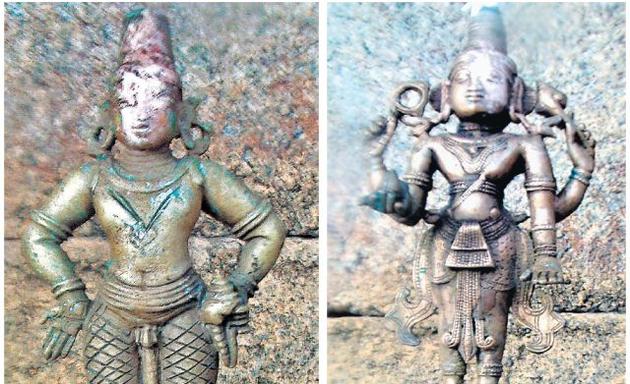
14th Century Bronze Idols Discovered

Recently two bronze icons dating back to the Vijayanagar period have been found. The icons of Lord Vitthala and Lord Janardhana were found at the Janardhana temple in Belanje village near Hebri in Karkala taluk. 

The icon of Lord Vitthala is 28 cm in height and stands on a lotus pedestal, while the icon of Lord Janardhana is 18 cm in height. Both icons were found by T. Murugeshi, associate professor in ancient history and archaeology.

Prabalgad Fort – The Most Dangerous Fortress

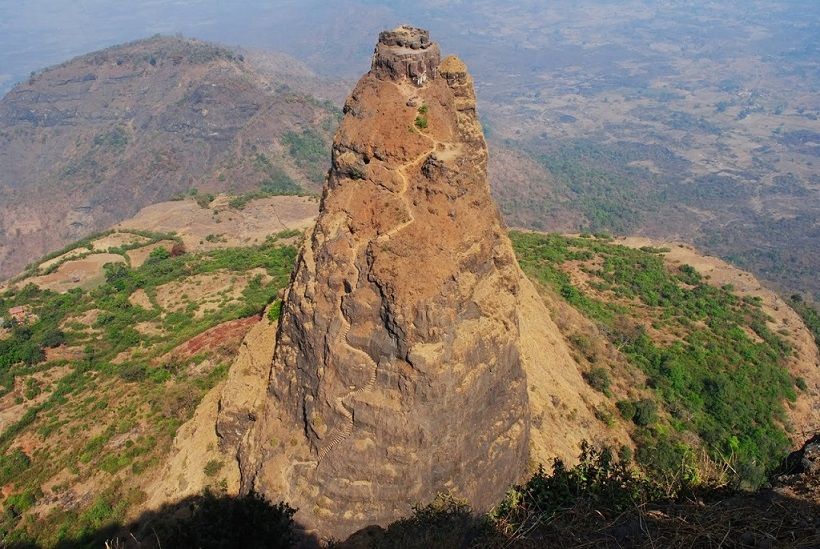
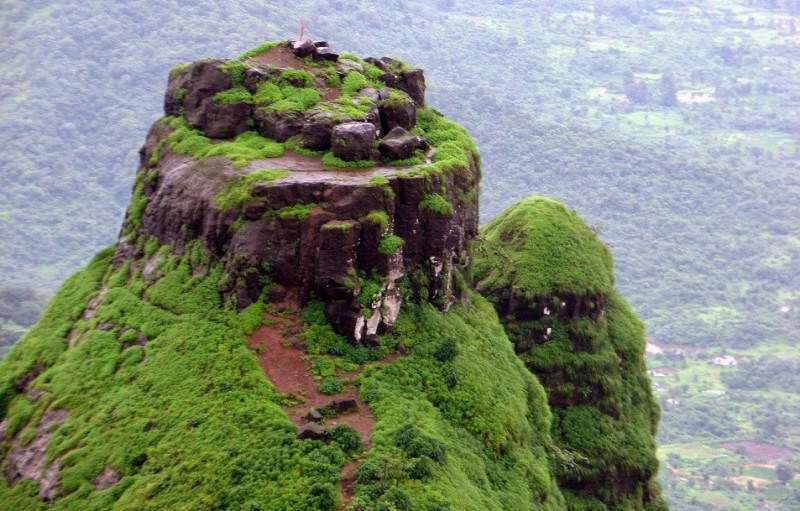
Prabalgad Fort, also known as Kalavantin Durg, is located between Panvel and Matheran in the Indian state of Maharashtra. The structure is built at a height of 2300 feet on top of a plateau which is located close to Matheran. Previously, the fort was known as Muranjan until it was taken over and renamed by the Maratha forces under Shivaji’s rule.

This fort is built of granite stones cut from the same hills. The bonding materials used here is the commonly used lime stone. It has got thick and strong walls, which are still not weathered off. The fort contains a temple to Ganesh and some stone ruins. On the inner part, there are many small and medium complexes found here. It does have watch towers on its top.

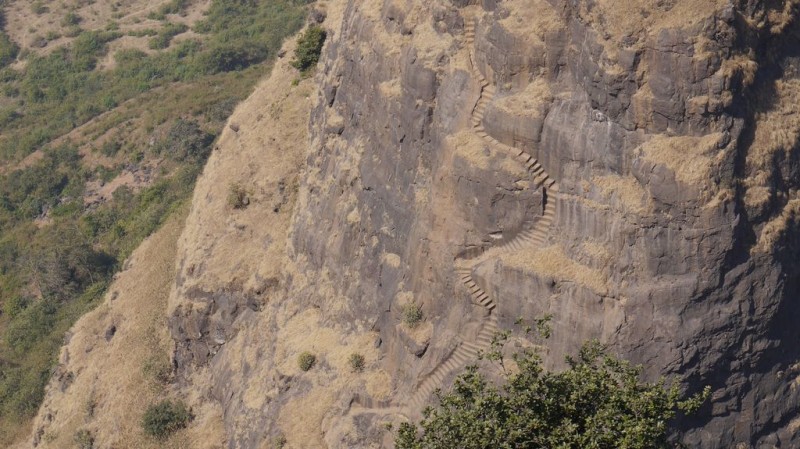
The fort can be approached via a chillingly steep climb. The steps leading up to the fort were cut into the rock of the hill. There are no safety rails on the edge and no ropes on the wall to grab on to.

The origins of Prabalgad Fort are unknown but it is believed to have been built during the time of Buddha or in or around 500 BC for a queen named Kalavantin. It is a bit saddening for an explorer to know that this is the only information locals can give and so many marvels and mysteries of the fort have died without leaving a record behind.

Walls of Prabalgad Fort
Image Source

Around 1458 Malik Ahmad, the prime minister of the kingdom of Ahmednagar, took over the fort during his conquest of Konkan. After the collapse of the Ahmadnagar Sultanate, the Mughals took control of Prabalgad along with Kalyan, Mahuli, Karnala and a number of other forts.

In the 1657 AD, the great Maratha King Shivaji Maharaj won this region with a great battle with the Mughals and took over this fort. At the time of the attack the fort was governed by Kesar Singh, a Mughal sardar, and was the only fort to put up a strong resistance. On seeing the signs of defeat the women in the fort performed Jauhar, a tradition of self immolation to ensure an honorable and respectful death. Kesar Singh died during the battle in October 1657, Shivaji in an act of kindness allowed Kesar Singh’s mother and her grandchild a safe passage out.

Soon after the decline of the Maratha Kingdom and the advent of British rule made many Indian to revolt against the British. As such one of the first men who protested against the British was Umaji Naik Khomane. He is belied to occupy this palace and was residing here mostly as a hideout place from 1826 AD to 1832 AD.

Kalavantin Durg or Prabalgad
Image Source

Prabalgad consists of a sister fort which is named Irshalgad Fort. It is situated in the vicinity of the main fort and is comparatively smaller in area. However there are numerous water reservoirs that were cut from rock.

From the top of the fort one can see Peb, Chanderi, Karnala and Irshalgad forts. The City of Mumbai is also visible and catching a bird’s eye view of the surrounding makes one wonder how people must have built such a marvelous structure with simple tools.

Prabalgad Fort – The Most Dangerous FortressPrabalgad Fort

Magnetic hill of Ladakh

Can anyone ever imagine the movement of a vehicle up a steep mountain, with its ignition off? Sounds quite unbelievable! Well, this magnet magic can be experienced while you are traveling to Leh-Ladakh. Located about 30 km from Leh, at a height of 11,000 feet above sea level, the hill supposedly has magnetic properties which attracts metallic objects, making vehicles move up at a speed of about 20 km/h with their engines off.

Not only are the vehicles traveling on the road attracted by the magnetic powers of this hill, even the helicopters and aircraft feel the same magnetic impact. Locals and the Indo-Tibetan Border Police (ITBP) personnel claim that when the helicopters and aircrafts come with in the radius of this hill, they start to jerk. To avoid accidents, the fliers are advised to fly at specific speed and height. In fact, the Indian Air Force pilots always steer clear of the Magnetic Hill.

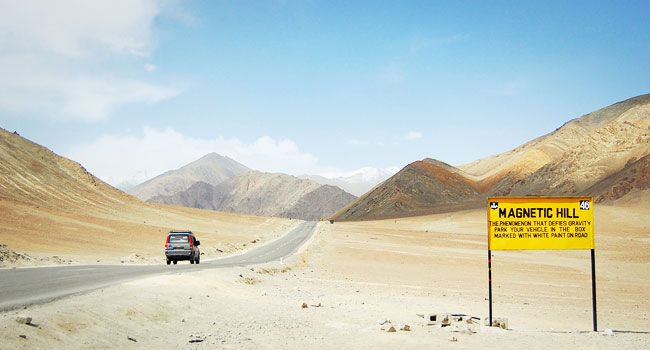
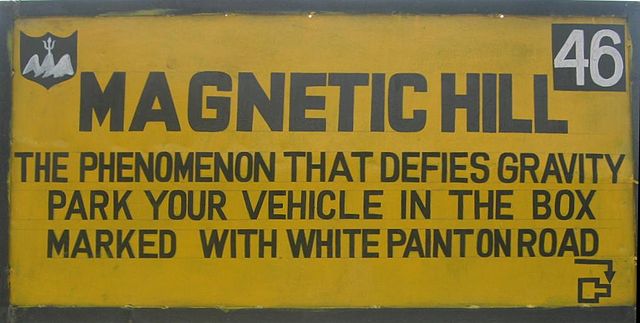
The local administration has also put up a bill board to help tourists recognize the Magnetic Hill. The board clearly states the phenomenon leaving you to try this experience for yourself. 

Sign board at Magnetic Hill of Leh Ladakh
Image Source

What is the mystery of the Magnetic Hill in Ladakh?

There are many explanations to it. Some claim that the vehicles move because of the magnetic properties present in the hill. According to them, the magnetism here is so strong that it pulls the vehicles on its own. Others assign this spectacular phenomenon to supernatural powers.

However, a third explanation that is much closer to the truth is optical illusion. It is believed that the surrounding land at Magnetic Hill produces an optical illusion, which makes a downward slope appear upward. Thus, a vehicle left out of gear will appear to be rolling uphill.

Leh is one of the two districts that constitute Ladakh, the other being Kargil. It is a part of the Indian state of Jammu & Kashmir. The magnet Hill is located on the Leh-Kargil-Srinagar national highway, about 30 km from Leh. On its south side flows the Sindhu river (Indus), which originates in Tibet and goes to Pakistan.

A Sikh Gurudwara Pathar Sahib is located near the magnetic hill. The Gurdwara was built in 1517 to commemorate the visit to the Ladakh region of Guru Nanak Dev, the founder Guru of the Sikh faith.

Due to both the Gurudwara and the gravity hill, the area has become a popular sightseeing destination. The magnetic hill has become a popular stop for domestic tourists on car journeys.

Kumbhalgarh – The Great Wall of India

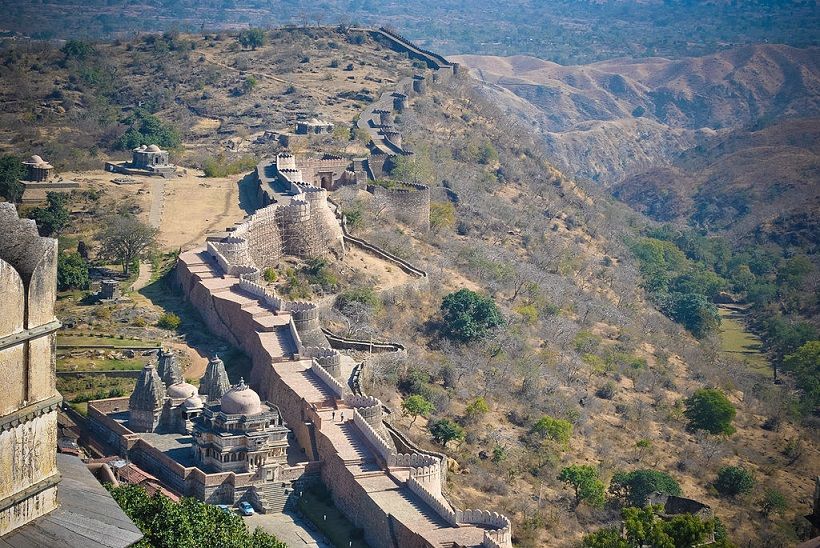
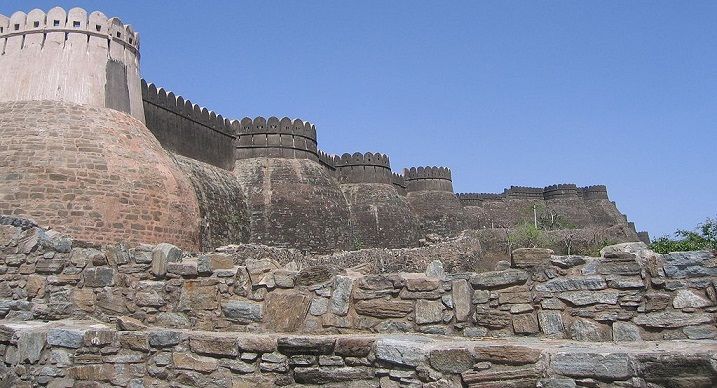
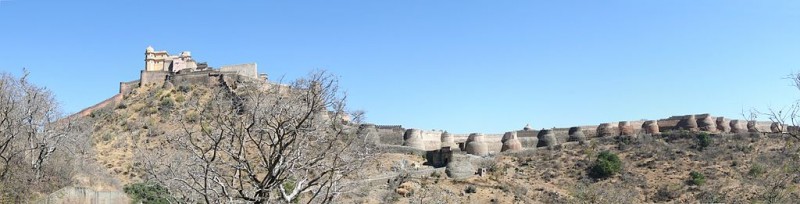
The wall that surrounds the ancient fort of Kumbhalgarh is one of the best-kept secrets in India, and perhaps the world. Protecting a massive fort that contains over 300 ancient temples, the wall was constructed by Rana Kumbha in 15th century. 

Often referred to as Kumbhalgarh Wall or simply as Kumbhalgarh Fort as a whole, the wall is perhaps best known by its most sensational — and fitting — name: The Great Wall of India. This is appropriate, as the wall extends over 36 Kilometers around the perimeter of the fort, making it the second-longest continuous wall on the planet after the Great Wall of China. 

Standing majestically on the high ridge with elevation of 1100 metres (3600 feet) above sea level, it represent the past glory of the Rajput rulers. The wall, which runs through mountain cliffs and valleys, is a great example of architectural brilliance of the Rajput era proved by the fact that in spite of being around 700 years old it is still intact and is in a good shape. 

Aerial view of Kumbhalgarh fort wall
Image Source

Kumbhalgarh is located in southern Rajasthan in western India. During the time of Rana Kumbha, the kingdom of Mewar extended from Ranthambore to Gwalior, including vast tracts of present-day Rajasthan and Madhya Pradesh. Out of the 84 forts in his dominion, Rana Kumbha is said to have designed 32 of them, of which Kumbhalgarh is the largest and most elaborate. The fort was built to serve a refuge for Mewar rulers in times of strife. 

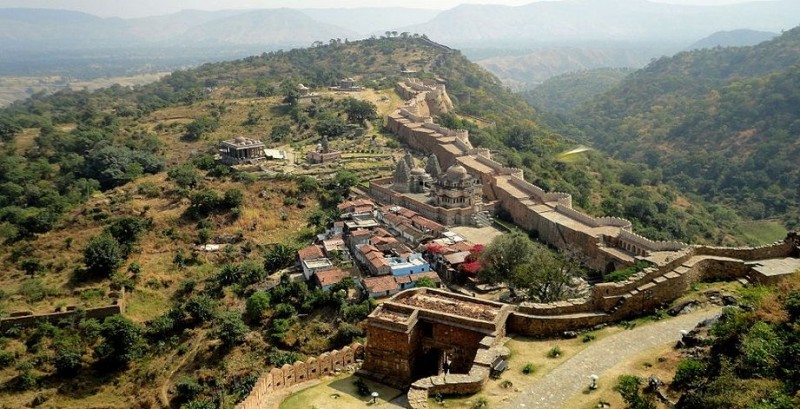
The great wall was built around the fort to protect it from invasion. The wall is massive, and breathtakingly majestic as it snakes through valleys and along mountaintops. Although at certain points the walls look fairly thin, in some places they are over 15 feet wide and beautifully masoned with thousands of stone bricks and decorative flourishes along the top.

The fort is also protected by 13 mountain peaks of Aravalli range. The fort can be accessed by any of the seven gates which are named as Aret Pole, Hanuman Pole, Ram Pole, Vijay Pole, Nimboo Pole and Bhairon Pole.

More than 360 temples are protected within the precincts of the fort. Sixty or so of the temples are Hindu, and the others are Jain temples.

It is said that in the days of the Rana Kumbha, the walls held so many lamps that consumed fifty kilograms of ghee (oil) and a hundred kilograms of cotton to provide light for the farmers who worked during the nights in the valley.

The Fort is also known for its famous palace that resides on the top of structure. This beautiful palace is known as ‘Badal Mahal‘ or the Palace of Cloud. It is also accredited to be the birth place of great warrior Maharana Pratap,  who was one the of the greatest warrior kings of Mewar.

It is said that the history of the place where Kumbhalgarh Fort was built dates back to the 2nd century, the Mauryan Era of ancient India.

Yet, despite its size and its history, the Great Wall of India is almost unknown outside its region.

This fort is inducted in the list of UNESCO World Heritage Sites in the month of June, 2013 along-with five other hill forts of Rajasthan. 

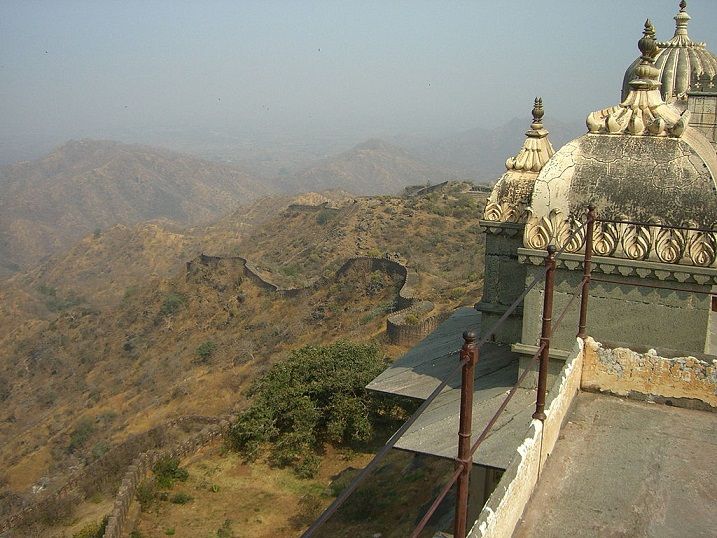
Occupied until the late 19th century, the fort is now open to the public. It is the most important fort in Mewar after Chittorgarh. The fort also provides a panoramic view of the countryside. From the top of the fort one can see a beautiful view of the walls surrounding the fort in the midst of the Aravalli Ranges. The sand dunes of the Thar desert are also visible from the walls.

Tourists are warned that some of the lesser travelled areas of the wall should not be climbed. Ancient defence mechanisms and traps, although mostly disabled, are still assumed to exist in some of its more remote positions. Those wishing to explore the miles of ruins on their own are warned that accidents can happen.

Must read: Vijay Stambh – Tower of Victory in Rajasthan

Great wall of kumbhalgarh
Image Source
Walls of Kumbhalgarh
Image Source
Kumbhalgarh fort - Great wall of India
Image Source

Featured Image: Wikiedia

Similarities between Noah’s Ark and Manu’s Boat

Native global flood stories are documented as history or legend in almost every region on earth. It is possible that these flood myths of each culture are actually based on a real catastrophic event that occurred at some point far in the past history of the world and each culture has passed the tale of this flood incident down through the generations. Westerners might be most familiar with the story of Noah told in the Old Testament book of Genesis, but similar flood myths also exist in tales from ancient India, Sumer, Babylonia, Greece, the Maya of Americas and the Yoruba of Africa.Â