

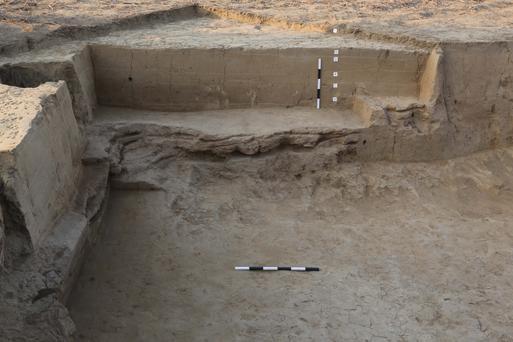
The Archaeological Survey of India during its excavations carried out at Chandyan village in Baghpat district of Uttar Pradesh, has found remnants of a house that correspond to the late Harappa period. This is the first time when remnants of old civilization pertaining Harrappan period are found in the Upper Doab region which lies between Ganga and Yamuna rivers.
Stone alignment with solar and other sightlines in South India
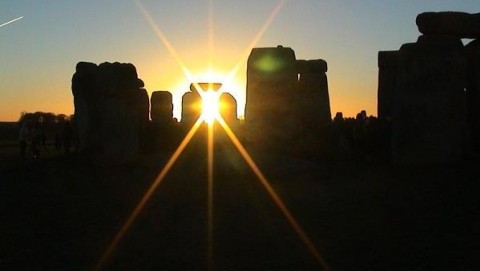
Large megalithic stone structures were created by man from Neolithic times for sepulchral as well as non-sepulchral purposes, including astronomy. One of the most spectacular and well known of these is Stonehenge in England, which has definite astronomical associations. Not many though, might be aware that India has its own version of Stonehenge. Located in Byse village in Karnataka these Megaliths structures dates back to 1000 BC and have been found to be aligned with certain Solar and Stellar movements including solstices and equinoxes.
Buddhist sculptures & Heads discovered in Pakistan
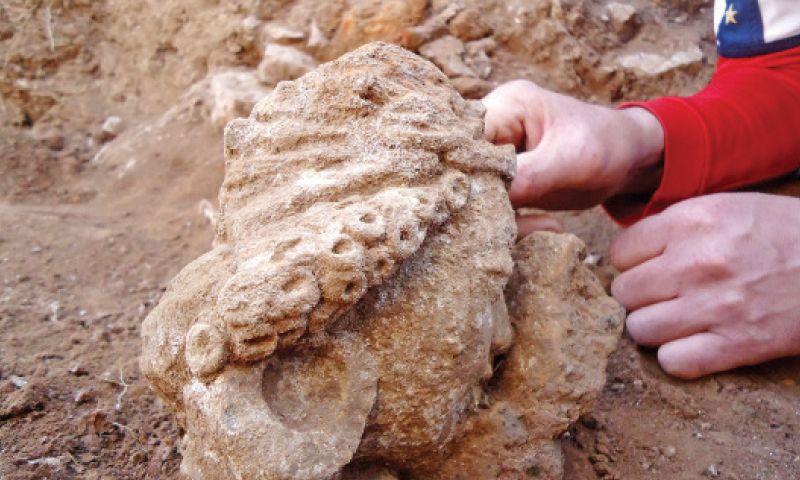
Archaeologists have discovered Buddhist sculptures and heads in Haripur district of Pakistan.
Buddhist sculptures and heads dating back to second to fifth century AD had been discovered by archaeologists during ongoing excavation at the site of an ancient Buddhist Stupa known as Bhamala Buddhist Complex.
The ruins of Telhara University older than Nalanda
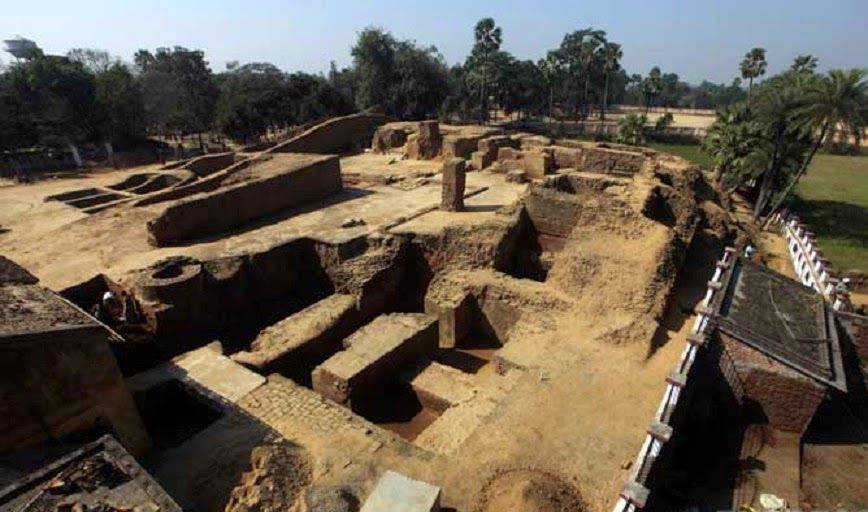
Telhara is a village in the Nalanda district of Bihar, India. It was the site of a Buddhist monastery in ancient India. Located about 33 km from the ruins of the famous Nalanda University, Telhara could be ‘Tilas-akiya’ or ‘Tiladhak’, the place Chinese travellers Hiuen Tsang visited and wrote about during his travels through India in 7th century AD? So far, there were only vague references but recent excavations at the mound suggest that Telhara was indeed an ancient university, older than Nalanda and Vikramshila universities.
Mustang – Sky caves of Nepal
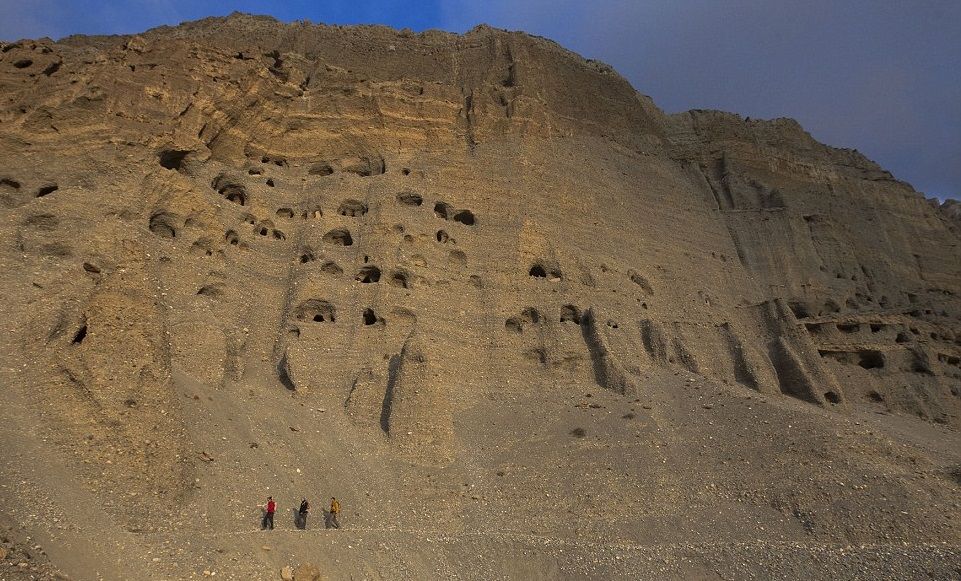
Mustang, the former Kingdom of Lo in northern Nepal is home to one of the world’s great archaeological mysteries. The region is known for it’s vast, mysterious, and nearly impossibly complex system of man-made caves. These mysterious caves nestled in rugged Himalayan terrain are around 10,000 in number. While some of them are easily accessible, others are too small to fit in a human.
Located at the height of 155 ft from the ground, these man-made caves are at least 2,000 years old but no one knows who built them or why. Or even how people climbed into them.
Some sit by themselves, a single open mouth on a vast corrugated face of weathered rock. Others are in groups, a grand chorus of holes, occasionally stacked eight or nine stories high, an entire vertical neighborhood. Some were dug into cliff sides, others tunneled from above. Some caves are even located on a single windswept rock and some were discovered to have been dug in such a way that it connects an entire neighborhood.
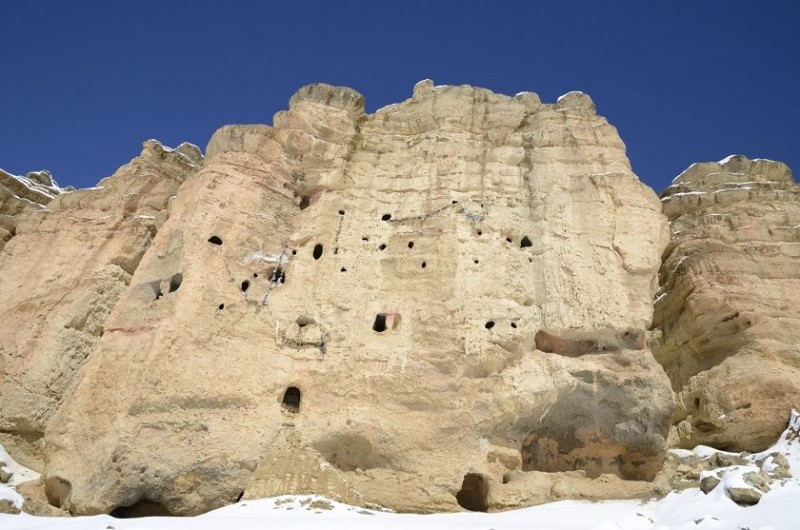
According to researcher, local used ramps or ladders to get to a level, and then the flats themselves. Inside the caves, vertical shafts have been found that connect the upper and lower levels together, and these likely had wooden ladders in them.
The residential caves also had kitchen areas, storage rooms with built-in containers, and rooms probably used primarily for sleeping.
While exploring these mysterious caves in Mustang, the researchers found priceless 14th-century wall paintings which included a 55 panel depiction of Buddha’s life, almost 3000 years old ancient human remains and centuries-old hidden library consisting of 8,000 calligraphed manuscripts—a collection, most of it 600 years old, that included everything from philosophical musings to a treatise on mediating disputes.
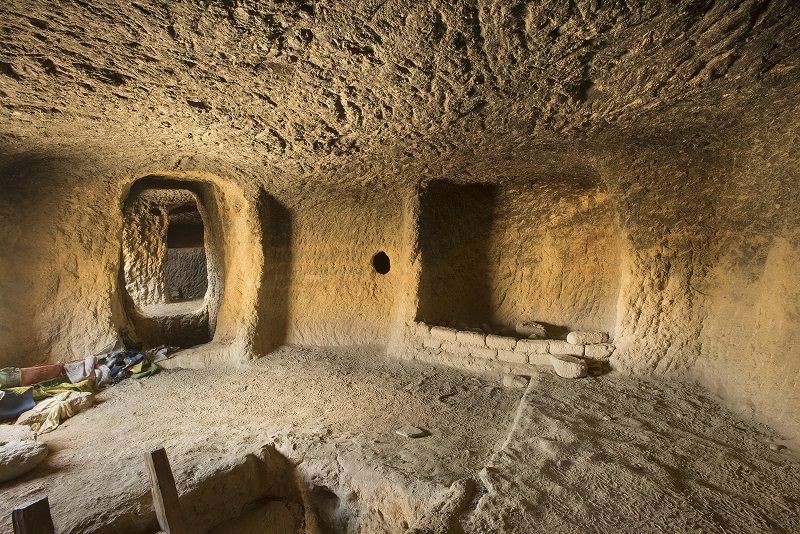
Scientists divide cave use in Upper Mustang into three periods. As early as 1000 BC, the caves were used as burial chambers. During the 10th Century, the region is thought to have been frequently battled over, and consequently, placing safety over convenience, families moved into the caves, turning them into living quarters. By the 1400s, the caves functioned as meditation chambers, military lookouts or storage units as people moved into villages.
In 2010, a team of mountaineers and archaeologists uncovered 27 human remains in Samdzong’s two biggest caves. The bones date from the third to the eighth centuries—before Buddhism came to Mustang—had cut marks on them. Scientists believe that this burial ritual may be related to the Buddhist practice of sky burial. To this day, when a citizen of Mustang dies, the body may be sliced into small pieces, bones included, to be swiftly snatched up by vultures.
Seven hundred years ago, Mustang was a bustling place: a center of Buddhist scholarship and art, and possibly the easiest connection between the salt deposits of Tibet and the cities of the Indian subcontinent. Salt was then one of the world’s most valuable commodities.
Later, in the 17th century, nearby kingdoms began dominating Mustang. Economy of Mustang started declining when cheaper salt became available from India. The great statues and brilliantly painted mandalas in Mustang’s temples started crumbling. And soon the region was all but forgotten, lost beyond the great mountains.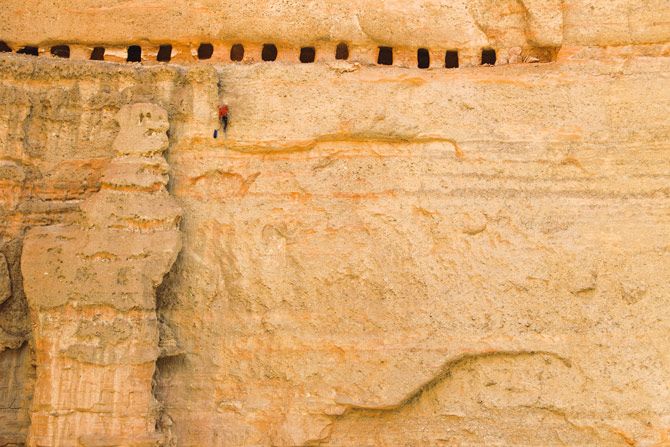
Even after the discovery and finding a little bit more about these caves many questions remains unanswered like “Who built them? Who lived there? What was the purpose of building them so high off the ground? How did they get inside the caves if it is so hard for the explorers to get to even with the help of modern equipments?”
Featured Image: Dailymail
Source: National Geographic
Drawings of Indus Valley discovered near Hampi
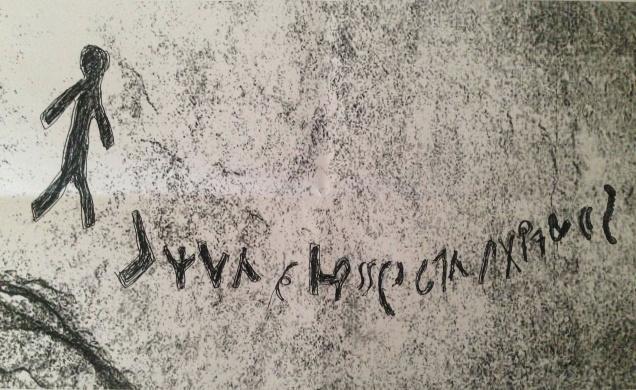
The Indus Valley Civilisation has puzzled archaeologists and researchers ever since it was first discovered in the early twentieth century. Who were these ancient people who lived along the Indus River between 3,300 and 1,300 B.C.? Could they have been wiped out by a flood or there may have been an epidemic or some terrible disease which killed the people? Or did they abandon the northwest part of the subcontinent because the river (Saraswati river) they depended upon dried up, or changed course, to migrate to other parts like South India?
The writing system of the Indus Valley Civilization is not deciphered and it still remains a mystery. All attempts to decipher it have failed. This is one of the reasons why the Indus Valley Civilization is one of the least known of the important early civilizations of antiquity.
“On the goddess Kotamma temple woollen market way there is a rocky roof shelter for shepherds and sheep to stay at night up to morning.”
The sentence emerged after a set of 19 drawing and pictographs discovered on a hilltop in Hampi (Karnataka, India) were deciphered using root morphemes of Gondi Tribe language.
Eleven of the Hampi pictographs resemble those of the Indus valley civilisation. This innocuous sounding statement could actually be a revolutionary find linking the Gond or Gondi tribe to the Indus Valley civilisation.
The Gondi people are a Dravidian people of central India, spread over the states of Madhya Pradesh, eastern Maharashtra (Vidarbha), Chhattisgarh, Uttar Pradesh, Telangana and Western Odisha. With over four million people, they are the largest tribe in Central India.
“Eleven of the Hampi pictographs resemble the Late Harappan writing of the Indus Valley Civilisation”, says Dr KM Metry, professor of tribal studies at the Kannada University. The professor claims that this shows that after the collapse of the civilisation situated in North-West India, the Harappans moved to other parts of the country, with some of them settling in Central India and a majority of them in the South.
Years of his research on Gondi culture, visits to tribal areas in Chhattisgarh and recent discovery of drawing led him to believe that undeciphered script of the Indus Valley Civilisation is a combination of Gondi symbols.
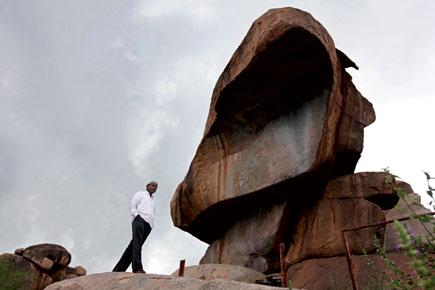
“The ability to decipher the script has proven elusive because no one has attempted to study the script using Gondi symbols and language. When you start looking at the script keeping in mind Gondi symbols, then everything becomes clear,” says Dr. Motiravan Kangali, a linguist and expert in Gondi language and culture from Nagpur.
Though the discovery is yet to be authenticated, Dr. Metry and his associates are very optimistic about their work. If the discovery stands the scrutiny of experts in the field, it would mean that the Gonds living in central and southern India could have migrated from the Indus Valley civilisation.
Featured Image and Source: The Hindu