

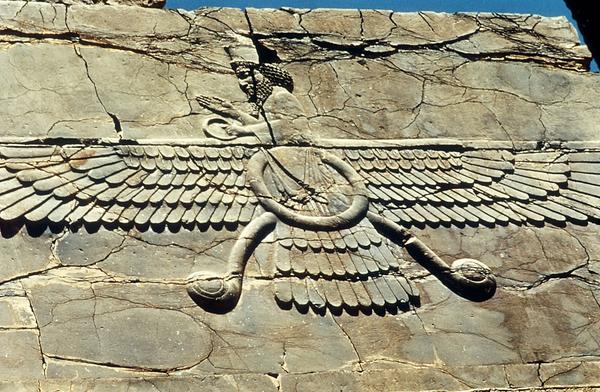
The title of this article may sound somewhat strange to many. But historical traditions of the ancient world supports this view. Zoroastrianism is one of the religion that was prevalent in the ancient world prominently. Much has been written about it by various eminent scholars about it. My view in this article is to prove their Indian Origin through historical traditions.
Beautiful stone carvings of Unakoti

Unnakoti is a unique place, which can not be compared to any other place in the country in terms of absolute grandeur and artistry. Located about 178 km from Agartala, capital of Tripura, this site consists of several huge vertical rock-cut carvings on a hill side. Huge sculptures were chiseled out from the rock-sides and the images were carved. The site is situated between the lush green forests and mountains.
Nikola Tesla was Influenced by Swami Vivekananda
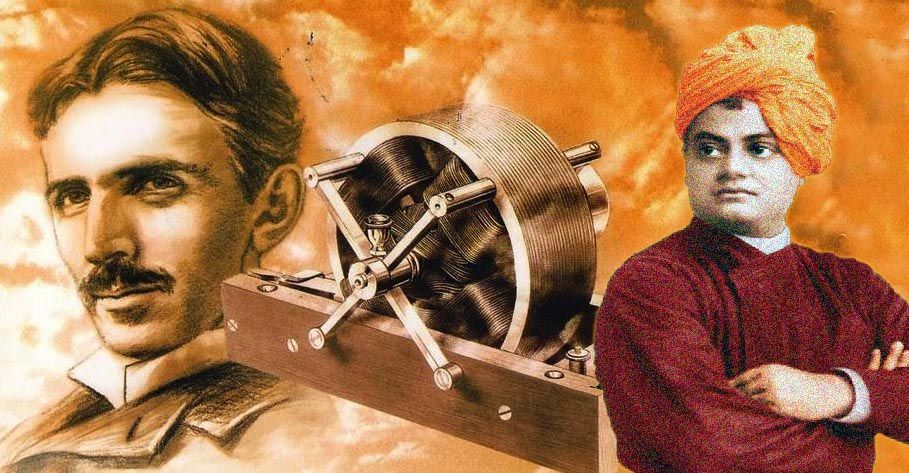
Nikola Tesla (1856-1943) was the genius who lit the world, whose discoveries in the field of alternating polyphase current electricity advanced the United States and the rest of the world into the modern industrial era. As early as 1891 Tesla described the universe as a kinetic system filled with energy which could be harnessed at any location and invented many useful devices like a system of arc lighting (1886), the alternating current motor, power generation and transmission systems (1888), systems of electrical conversion and distribution by oscillatory discharges (1889), and a generator of high frequency currents (1890), to name a few. His concepts during the following years were greatly influenced by Veda.
The Vedas are considered the earliest literary record of Vedic Civilization, and the most sacred books of India consisting of hymns, prayers, myths, historical accounting, dissertations on science, and the nature of reality, which date back at least 5,000 years. The nature of matter, antimatter, and the make up of atomic structure are described in the Vedas. The language of the Vedas is known as Sanskrit.
“All perceptible matter comes from a primary substance, or tenuity beyond conception, filling all space, the akasha or luminiferous ether, which is acted upon by the life giving Prana or creative force, calling into existence, in never-ending cycles all things and phenomena.”- Nikola Tesla, Man’s Greatest Achievement, 1907
As you can see, Tesla was aware of ancient concepts and the correlation it had with the science he was working on – using sanskrit worlds like “akasha,” and “prana” to describe the force and matter that exists all around us. These words come from the Upanishads (a collection of Vedic texts).
But where did Tesla learn Vedic concepts and Sanskrit terminology?
According to the information obtained from the archive in the Nikola Tesla Musem, Tesla gained knowledge of the Vedic terminology during his meetings with Swami Vivekananda. Leland Anderson, founder of Tesla Society, suggested that it was through association with Swami Vivekananda that Tesla may have come into contact with Sanskrit terminology.
Where can we go to find God if we cannot see Him in our own hearts and in every living being.
– Swami Vivekananda
Swami Vivekananda (1863—1902) was an Indian Hindu monk and a key figure in the introduction of Indian philosophies of Vedanta and Yoga to the western world. He was one of the most influential philosophers and social reformers in his contemporary India and the most successful and influential missionaries of Vedanta to the Western world. In 1893 Swami Vivekananda began a tour of the west by attending the Parliament of Religions held in Chicago. During the three years that he toured the United States and Europe, Vivekananda met with many of the well known scientists of the time including Lord Kelvin and Nikola Tesla.

Nikola Tesla was much impressed to hear from the Swami Vivekananda his explanation of the Samkhya cosmogony and the theory of cycles given by the Hindus. He was particularly struck by the resemblance between the Samkhya theory of matter and energy and that of modern physics.
Nikola Tesla was introduced to the Vedas by Swami Vivekananda Ji after he asked Swami to enlighten him on spiritual connections and why western scientists were praising, while talking all about the Vedic texts. Swami Vivekananda’s effect on Tesla was so Great that he became vegetarian and began using the Sanskrit words.
In 1895, Swami Vivekananda shared with Tesla the idea of matter and energy to be one, and requested him to prove it through mathematics. However, Tesla failed to accomplish it. Vivekananda also interacted with the other two giants of Western science, namely William Thomson (Lord Kelvin) and von Helmholtz in New York. Eventually after 10 years, in 1905, Albert Einstein proved the oneness of matter and energy (E = mc2).
Nikola Tesla taking original knowledge from Vedas, invented many things that we all use on a daily basis but most people have never even heard of him because his name was removed from common history (just like much of the teaching of the Vedas) and he was eventually murdered. He knew too much and wanted to share it freely for the betterment of mankind, not to exploit it. Unfortunately not everyone saw eye to eye with him.
Here is just a partial list of some of Tesla’s contributions to the world based on his research and experiments from Vedas, that he had not been given credit for:
- Alternating Current -AC electricity (Thomas Edison literally stole his ideas from him and took the credit for it).
- Radio (Marconi just robbed the ideas and work of Tesla and got the credit for it)
- Hydro-electricity (Tesla Built the first Hydro-electric power plant at Niagara falls As a result we see whats there now)
- X-rays
- transistors
- Resonant frequency (every one else figured it out 50 yeas later)
- Fluorescent and Neon lighting
- The induction motor
- The rotating magnetic field (precursor to gyroscope)
- Arc lighting
- Tesla coil
- Oscillators
- Encryption technology and scrambler
- Wireless communication and power transmission
- remote control
- Telegeodynamics (a way to search for metals and minerals)
- Tachometer and speedometer
- Refrigeration machines
- Bladeless turbines and pumps
- Cryogenic engineering
- reactive jet dirigible (precursor to Harrier jet)
- Hovercraft Flivver plane (precursor to Osprey helicopter/aircraft)
- Particle-beam weapons (precursor to Star Wars)
Likewise in ancient India, some selective greatest teachings were passed to the deserving Sages verbally, which remain stored in their memories, so that the power of knowledge is not misused by demonic beings referring to texts, if it were written. Only the knowledge which was helpful for mankind were passed to common human beings.
True to this belief of Vedas, all Tesla’s engineering was done in his head, he never worked things out on paper or used scale models to come to a functioning final result. Things would appear in his head and he would simply record it exactly as it came to him, similar to Beethoven.
Tesla died with the BrahmaAstra (Scalar Interferometer) knowledge in his head, as he did NOT want to give this destructive Vedic technology to the US military and Vatican, as promised to Vivekananda. It was to help mankind, NOT to destroy or enslave.
Source: arizonaenergy.org | Wikipedia | Linkedin
The hanging pillar and other wonders of Lepakshi
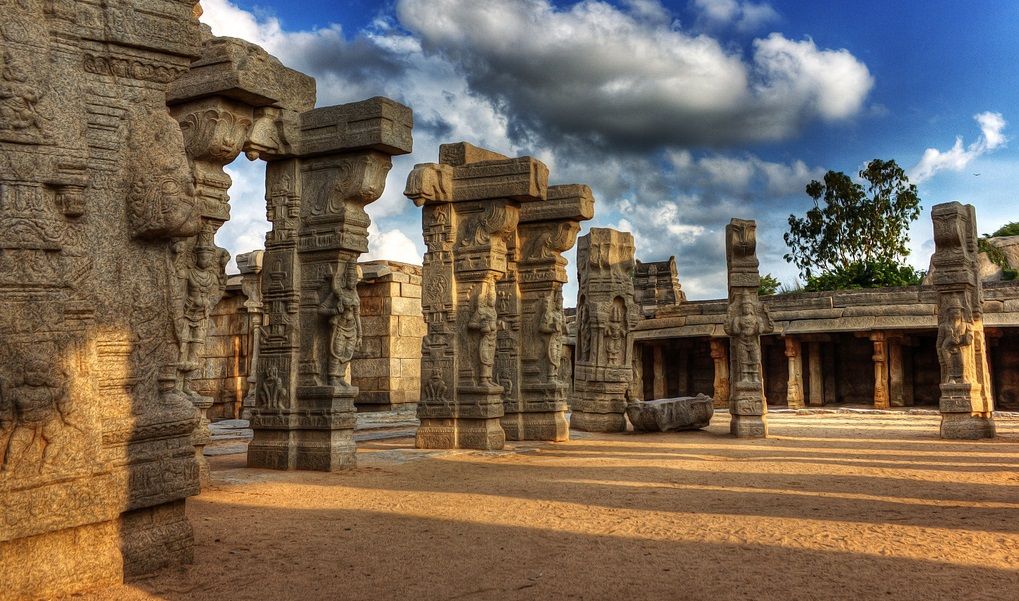
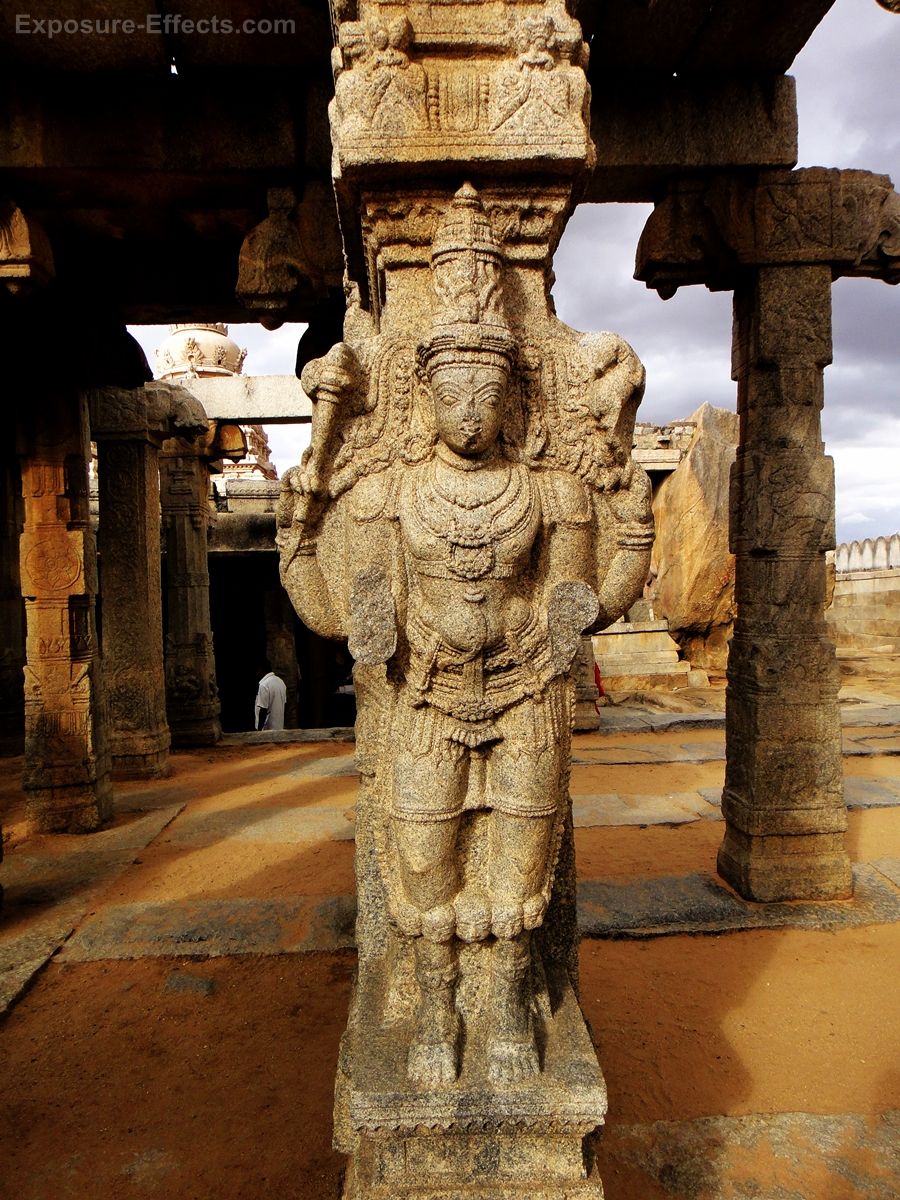
Lepakshi is a small town in Anantapur district of Andhra Pradesh, India. Town was built during the Vijayanagara period (1336–1646) and it is historically and archaeologically significant, with three shrines dedicated to Shiva, Vishnu and Veerabhadra. The most interesting thing about Lepakshi is its hanging pillar.
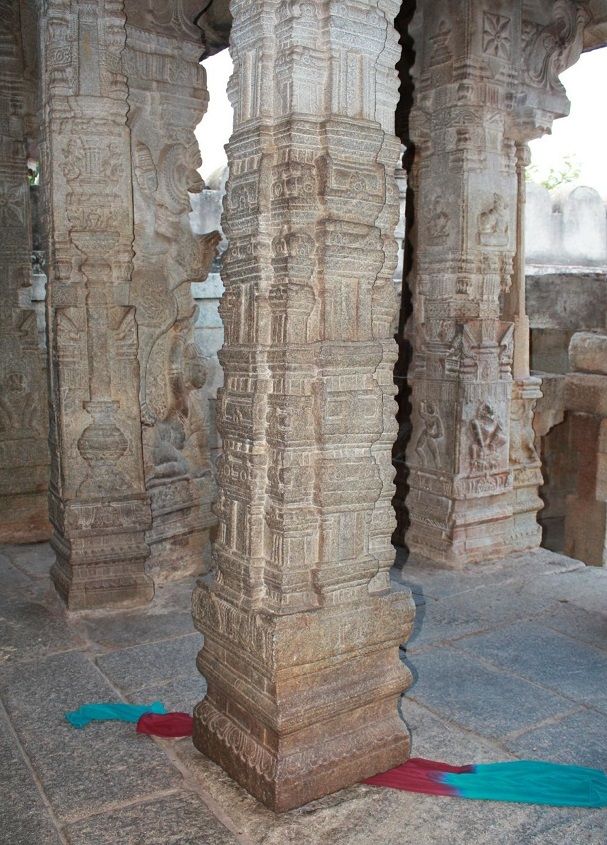
A pillar which is attached with the ceiling but not to the floor. One can easily swipe a piece of cloth or paper mid-air that separates the ground and the pillar. The pillar is at Veerabhadra temple and it is famous as Aakaasa Sthambha (floating pillar). There are about 70 pillars at this fabulous temple of stone in Vijayanagar style, but this one is the best known and a tribute to the engineering genius of ancient and medieval India’s temple builders.
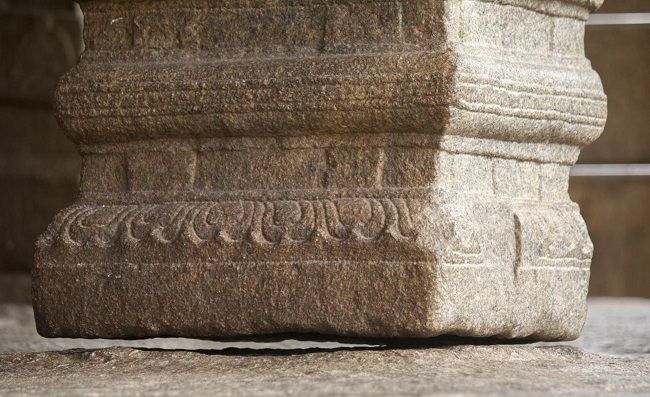
The 70 feet pillar is believed to have been dislodged by a British engineer who unsuccessfully tried to remove it to uncover the secret of its support.
The Veerabhadra temple dates back to 1583 and was built by two brothers Virupanna and Veeranna, who were allies of the Vijayanagar empire.
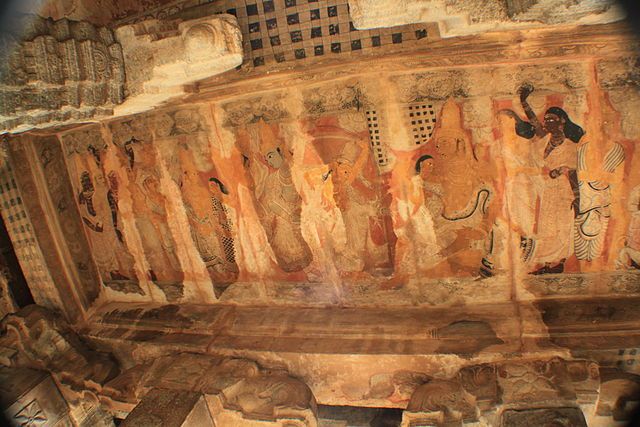
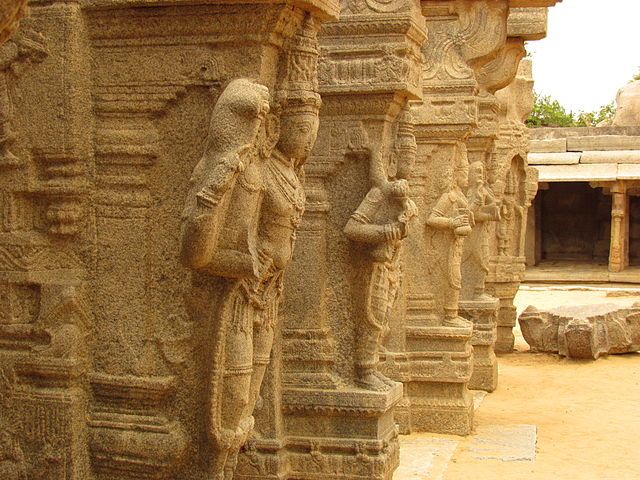
Temple is famous for its sculptures, which were created by the artisans of Vijayanagara empire. Lepakshi is also renowned for having one of the best collections of mural paintings from the Vijayanagar Kings period. Many old Kannada inscriptions dating back centuries can be seen on its walls. The inside of the temple is carved out of granite.
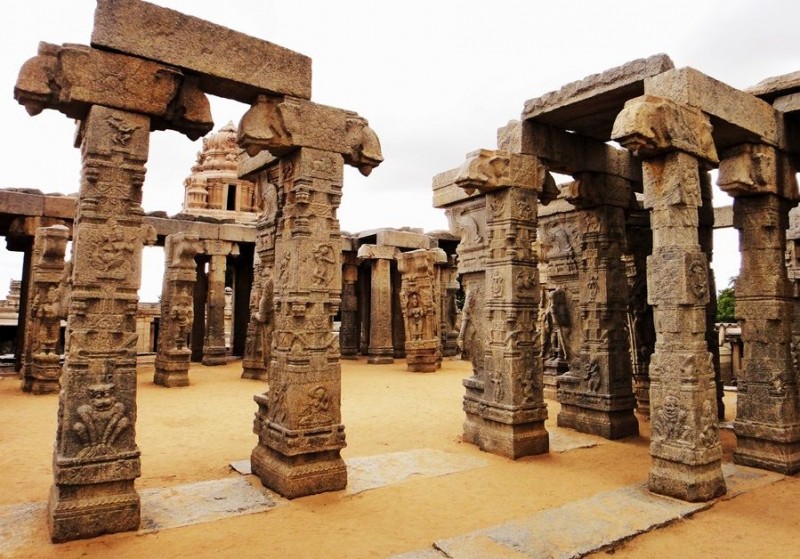
The murals in the temple have been damaged due to prolonged exposure to vagaries of nature but still can be identified as depicting various stories like the marriage of Shiva with Parvati, wars, architects of the temple praying before Shiva, and many more.
There are several forms of Shiva here — a majestic Kankala Murthi, Dakshinamurthi (Guru of Gurus), Tripuranthaka or Tripurasurasamhara (vanquisher of demon Tripura), Ardhanareeshwara (the half-female, half-male form, where Shiva and Parvati are equally represented in one body), etc. Another shrine has the fiery goddess Bhadrakali, though bearing an uncharacteristically serene expression.
According to legends, the history of this place dates back to the Ramayana. It was the site where Lord Ram’s faithful follower Jatayu fell down after having been injured mortally by Ravana, who was taking away Sita in his Vimana (flying chariot).
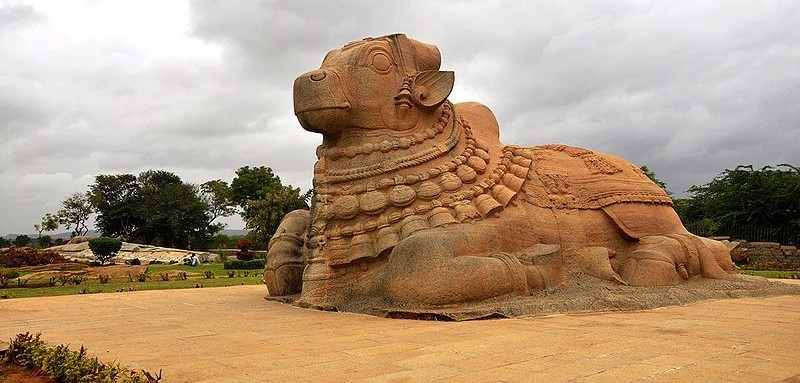
Besides the Hanging Pillar, another draw is the spectacular Nandi bull made out of a single granite stone. At 27ft in length and 15ft in height, it is a colossal structure, reputedly India’s biggest monolithic Nandi. Besides the record size, the perfectly proportioned body, finely-carved ornaments, and smooth contours add to its grandeur and make it a popular photo-op with visitors. It has been positioned such that it faces the Shiva Linga shielded by a huge serpent inside the temple.
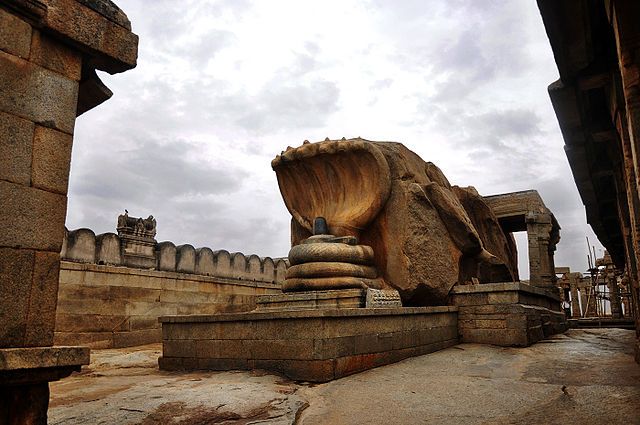
The huge Nagalinga or serpent with three coils and seven hoods can be seen cut out of granite rocks to create a breathtaking structure. Here the Shiva Lingam is protected by the hood of the serpent and legend has it that the entire structure was carved out by a craftsman while his mother prepared lunch for him. It also has a sculpture of Ganesha.

Mystery of Sri Yantra Geoglyph in Oregon Dry Lake Bed
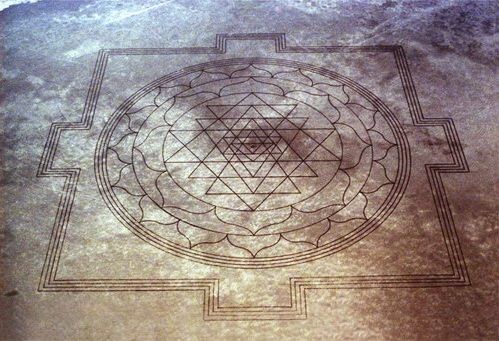
On 12th September, 1990 Boise TV station aired the story about the discovery of a giant pictograph about a quarter of a mile wide appearing in a dry lake bed east of Steens mountain, about 70 miles S.E. of Burns, Oregon in United States. The glyph had a machine like precision in its shape and clarity of lines and it was quickly identified as perfectly formed, the ancient Hindu meditation device ‘the Sri Yantra‘ identical in shape and proportion, and in its geometrical properties. This symbol was over a quarter of a mile in length, and consisted of 13.3 miles of lines, was scored into the hardpan at a depth of 3 inches and were 10 inches wide.
Dasharajnya – The Battle of Ten Kings
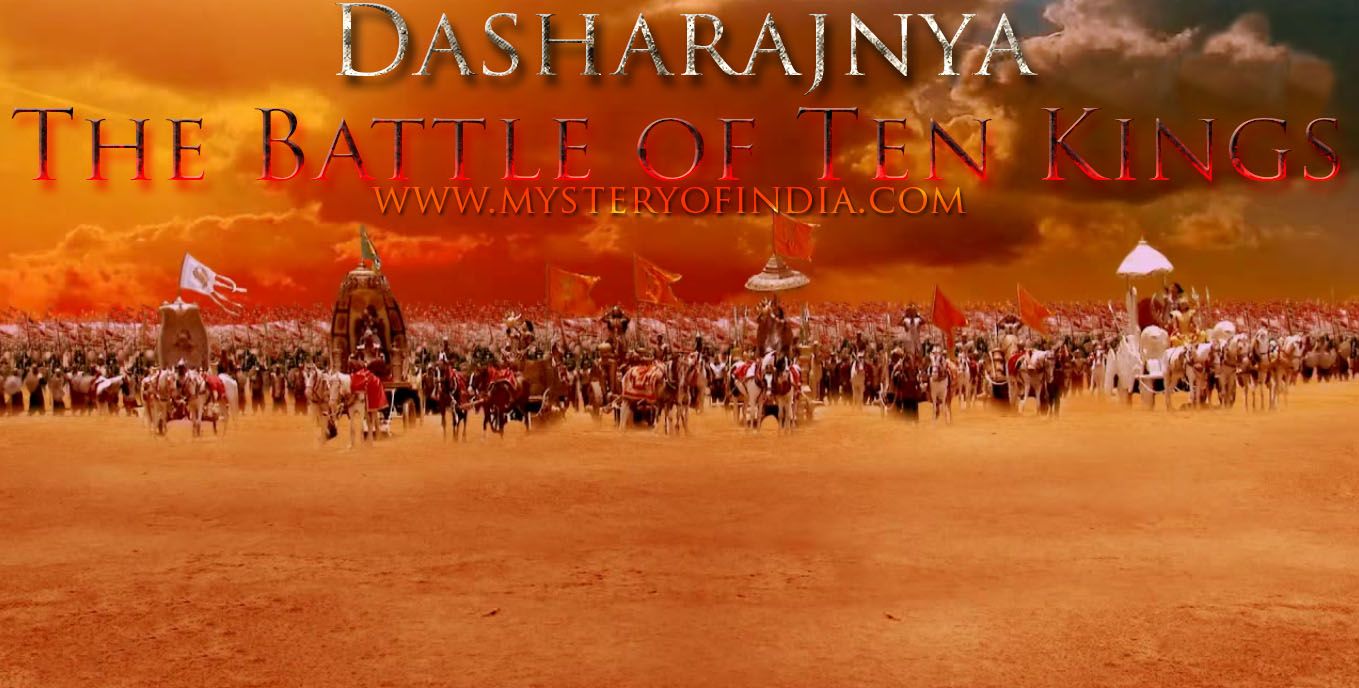
When asked about the ancient classics of India, most would quickly reply with The Ramayana and The Mahabharata. Although this answer is correct, there is an even more ancient story that has been forgotten. That ancient story is called the Dasharajnya or ‘Battle of ten Kings’.
This battle is memorialized in the 7th Mandala of the Rigveda, in hymns 18, 33 and 83.4-8). In this Battle of Ten Kings all the people of the Rigvedic India were involved. It took place near the Parusni River (Ravi River) in Punjab. The place where they fought later became the site of the city of Harappa, possibly the first modern urban center in history.
This Battle is also Important as it heralded the spread of Vedic beliefs to other parts of the world, for the simple reason the kings and their subjects were forced to pay tributes and had to migrate outwards towards the present lands now called as Iran, Iraq, Egypt etc… An Aryan migration, out of India could be seen here.
In the battle some of the powerful Puru tribes created an alliance with other tribes from the India and Persia. Guided by the royal sage Vishvamitra, this army came on to oppose the Bharata King Sudas (Note: King Sudas was also descendant of Puru Dynasty) in battle. But, Sudas defeated them all, and captured all the Rigvedic tribes.
King Sudas was the grandson of the powerful king Divodas Atithigva and son of King Pijavana. Divodas had his empire in the regions of Punjab and earned fame as a warrior by waging a long war with the powerful non-Arya King Sambara whom he ultimately defeated and killed.
Sudas’s capital city was on the Sarasvati River. He inherited the kingdom from his grandfather and greatly expanded it. He was also supported by the spiritual mentorship of his guru, the legendary sage Vasishta. In the process, he alienated all the neighboring kingdoms surrounding him. After years of subjugation, a group of roughly a dozen or ‘ten’ (dasha) kings and chieftans (‘raja; rajnya’) formed a confederacy to combine their strength and defeat King Sudas once and for all.
The list of confederate kings involved in this war is actually slightly over ten, but was referred to roughly as ‘dasha’ (ten) in the Rig Veda. It may be that they belonged to ten tribes in all. Some of the Tribes mentioned in Rigveda are:
- Alinas: it was suggested that they lived to the north-east of Nuristan, because the land was mentioned by the Chinese pilgrim Hiouen Thsang.
- Anu: Some place them in the Parusni (Ravi) area.
- Bhrigus: The priestly family descended from the ancient Kavi Bhrigu. Later, they are related to the composition of parts of the Atharva Veda (Bhṛgv-Āṅgirasa).
- Bhalanas: Some scholars have argued that the Bhalanas lived in the Bolan Pass area.
- Druhyus: Some align them with the Gandhari. (Later age Druids of Europe)
- Matsya: are only mentioned in the Rigveda (7.18.6), but later in connection with the Salva Kingdom.
- Parsu: The Parśu have been connected by some with the ancient Persians.
- Purus: one of the major tribal confederations in the Rigveda.
- Panis: Also the name of a class of demons; later associated with the Scythians.
These kings, though some are described as Aryans, were actually fallen Aryans, or rebellious and materialistic kings who had given up the spiritual path and were conquered by King Sudas. Occasionally, there was a degeneration of the spiritual kingdom in areas of India, and wars had to be fought in order to reestablish the spiritual Aryan culture in these areas.
The war was started on the banks of the Parusni (Ravi) river and it span for many years between Puru and Bharata. According to Rig veda, Sudas and his army was forced to retreat but managed to cross the Parusni river safely, while his foes, trying to pursue, were scattered by a flood and either drowned or were slaughtered by Sudas’s men. Later on, he had to fight Aja, Shigru and Yakshas on the Yamuna river and he defeated them too.
Sudas was able to defeat the entire confederacy of ten+ Kings and emerge as victorious. All enemies of Sudas were defeated, thousands were killed.
There are diffferent account as to when this battle actually took place due to different hypothesis from different scholars. Some date it back to near 3000-4000 BCE while other consider it to be dated around the 2350 BCE.
The Battle of Ten Kings or the dasharajanya war is the Worlds first recorded Battle. Not just that, it was no mere neolithic stick and stone fight. It was the first organized war with infantry, archers and elephants.
After the Battle of Ten Kings, many inhabitants of India got scared and out of fear migrated westwards into Iran and beyond.(RV-VII:18,19,33,83). Western scholars easily misinterpreted this battle to mean an invasion of nomadic people called Aryans rather than simply a war in which the superior Aryan kings re-established the spiritual values and the Vedic Aryan way of life.
It is important to note that the Sanskrit word ‘Arya’ (English: ‘Aryan’) has no racial connotation in the Vedas and is a term originally used to identify the members of the Puru-Bharata Dynasty. The Vedic Aryans were not the ultimate ancestors of the different tribes and peoples found in the Sanskrit texts. They have a definite historical identity: the Vedic Aryans were the Purus of the ancient texts.
The Purus were a confederation of tribes located at the banks of the Sarasvati River. According to the Puranas (ancient Hindu texts), the Bharatas are descendant of the Purus. “Bhārata”– the official name of the Republic of India — is actually named after a descendant of the Puru dynasty King Bharata and King Sudas was the descendant of Emperor Bharata. This Puru-Bharata dynasty provided the continuity of leadership for thousands of years which is documented in the ancient scriptures, particularly the Rigveda.
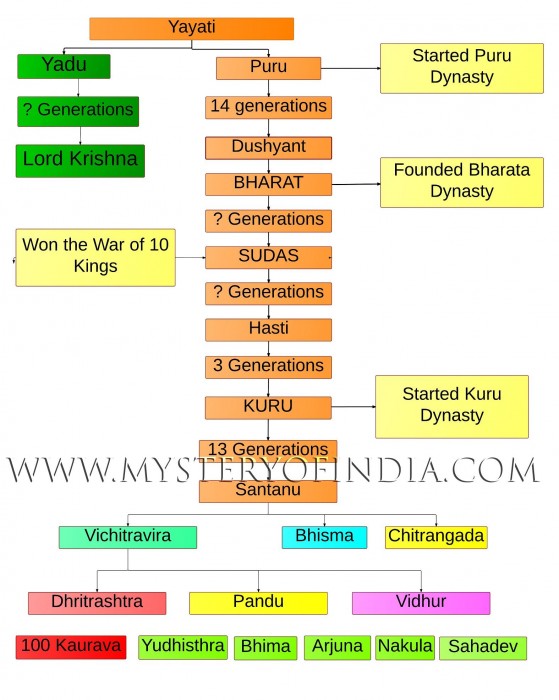
The Bharata ruler later allied and merged with the Purus Tribe, to form the Kuru Dynasty. It was King Sudas, whose later descendants fought the great Mahabharata war.
After 15 generations of Kuru Dunasty, Kauravas and Pandavas were born who fought the epic battle of Mahabharata.
According to historian, King Porus who fought Alexander in the Battle of the Hydaspes River, was descendant of the Purus and Pandava of Mahabharat. The modern Punjabi surname Puri may have originated with the Puru tribe.
Source: Harekrsna.com | VVRishikulum.com
Wikipedia: Battle of the Ten Kings | Bhāratas | Puru | Emperor Bharat