

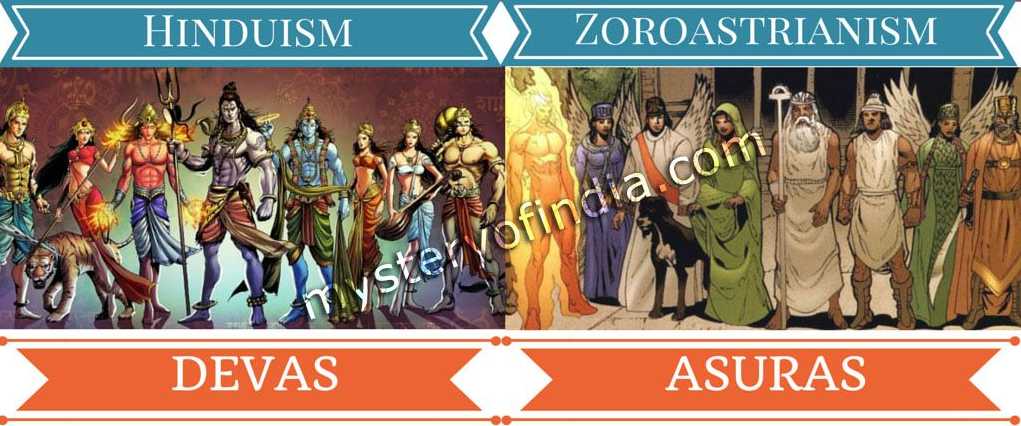
Indians (Indus valley residents) and Iranians (Mesopotamians) shared a common religious past, which led historians to sometimes even term the common ancestral religion as Proto-Indo-Iranian religion. Have we ever understood the implications of this common religious past of the two communities on the historical studies of the two regions?
Hydrology in Ancient India
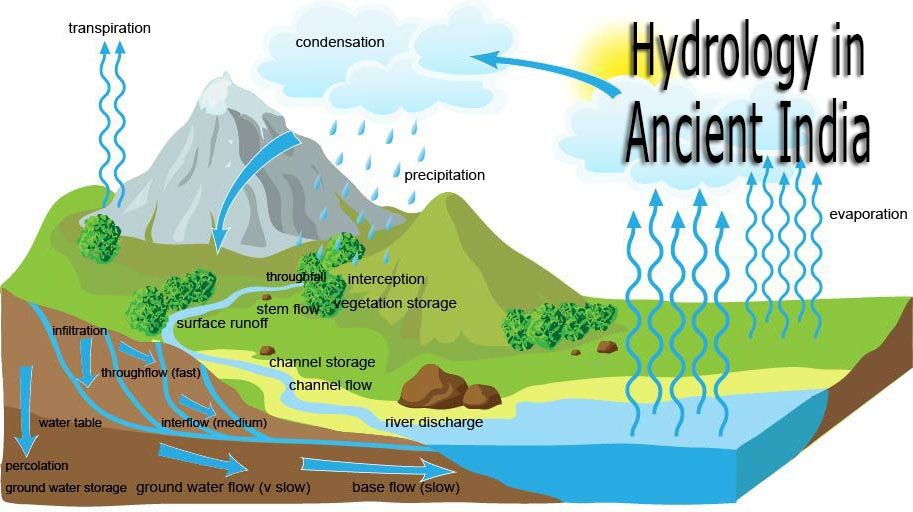
Natural entities and forces, such as Sun, Earth, Rivers, Ocean, Wind, Water, etc. have been worshipped in India as Gods since time immemorial. Perhaps it is not a sheer coincidence that the King of these Gods is Indra, the God of Rain. Clearly, ancient Indians were aware of the importance of rain and other hydrologic variables for the society. The ancient Indian literature contains numerous references to hydrology and a reading of it suggests that those people knew the basic concepts of hydrological processes and measurements. Important concepts of modern hydrology are scattered in various verses of Vedas, Puranas, Meghmala, Mahabharat, Mayurchitraka, Vrhat Sanhita and other ancient Indian works.
The Beautiful Key Monastery Of Himachal Pradesh
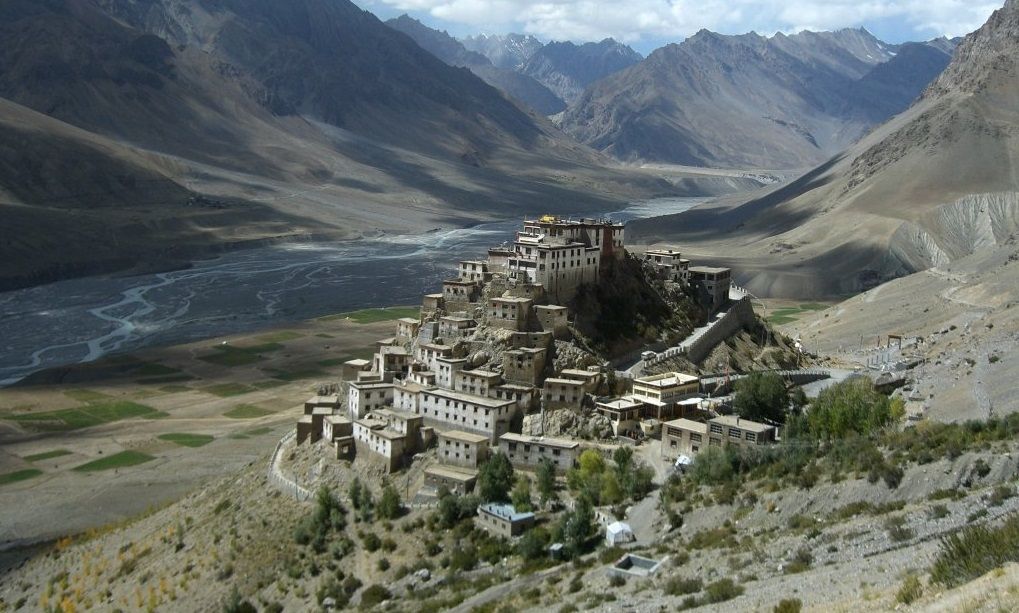
Key Monastery is Buddhist monastery located on top of a hill at an altitude of 4,166 metres above sea level, in Lahaul Spiti district of Himachal Pradesh in north India. Also known as Key Gompa, it is biggest centre of Buddhist learning in Spiti Valley and the oldest training centre for Lamas. It is home to around 300 lamas who receive their religious education here. The place is considered to be one of the most important research and debate centre for Buddhists.
India’s Sunken Cities
Underworld: Flooded Kingdoms of the Ice Age: Season 1, Episode 2
https://www.youtube.com/watch?v=Va0BIqfzpvo
Graham Hancock’s mind bending series on underwater civilisations, lost to humanity after being buried by the great floods at the end of the Ice Age. Are the stories about a great flood that come from all over the world true? Do these ancient traditions and myths talk of real events, and can this time be pinpointed to the end of the ice age when sea levels rose by four hundred feet? In this programme, a huge city is found under the sea off the Western coast of India which could be related to the ancient Indus Valley civilisation. Does this civilisation go back farther than five thousand years? Also, in southern India a new site is found off the coast…
Marine archaeology shows a number of submerged sites off the coast of Kachchh and Cambay in what would have then been the old Sarasvati delta region. A Gulf of Cambay urban site has been dated by Indian archaeologists to 7500 BCE. This would totally change our view of history as we now date cities only after 3500 BCE.
Read also: Dwarka Mythical City Found Under Water
Transmitting Knowledge: Oral memory, practice and methods of communication of India
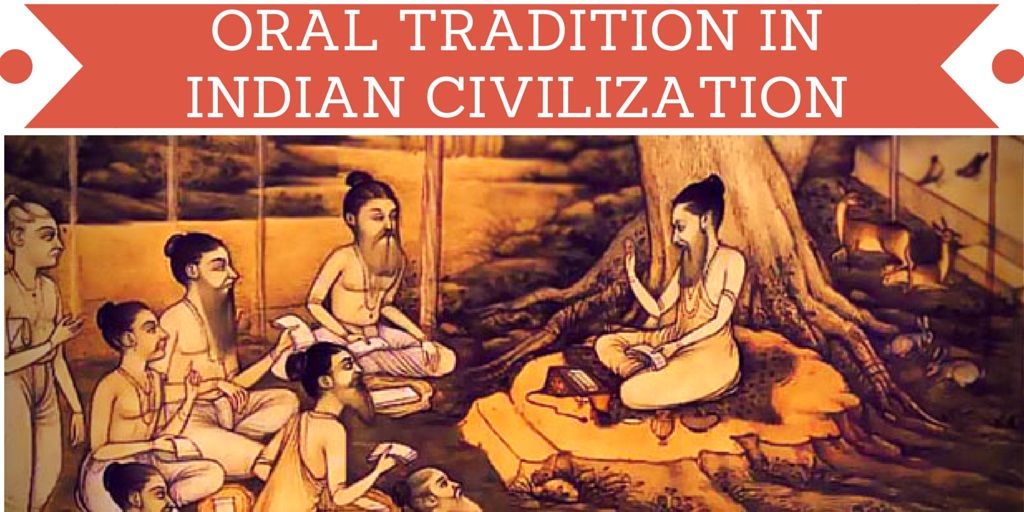
In India, oral transmission of knowledge still continues to be the most important method by which we communicate messages, educate our children on early lessons, learn our scriptures and texts, transmit our stories and nurture knowledge about life and art.
All cultures have found ingenious ways to pass on their knowledge systems, through developing formal and informal ways of communication and preservation. Most pre-written cultures had developed systems of transmission of their knowledge such as Homer’s poetry, or the Christian gospel spreading by word of mouth through the apostles of Christ down to the early Christian era. The oral tradition of West Africa was to propagate their stories, and epics by establishing a class of people who took on the task of memorizing and handing down that knowledge to succeeding generations. The markers of this memory consisted of symbols, codes and images that represented different facets of knowledge. Many societies across the world developed elaborate mnemonic devices and formal rituals which became part of remembering and recollecting knowledge in domains such as tales, parables, proverbs, songs and legends, skills pertaining to arts, healing and medicine.
When we examine some significant ways in which India preserved and transmitted its knowledge, we see that lndia’s oral tradition has followed both fixed and floating patterns of transmission, in codified and un-codified forms. While the knowledge contained in the Vedas and its ancillary branches came to be transmitted through an established, meticulous code of memorization, a parallel dimension of non—structured, free transmission also existed side by side. Often these two traditions are seen to interact, respond and support each other, because they emerge from the large stock of the shared wealth of a collective imagination.
While the codified system of handing down Vedic corpus became dependent on an organized system of learning through the guru-shishya parampara, the narrative-performative tradition of recitation carried on the dissemination of much of our indigenous knowledge. Much of India’s myths and epics such as the Mahabharata and the Ramayana, tales and fables such as Kathasaritsagara and Jataka stories, ballads, legends, songs, and a multitude of knowledge and skill in every field were carried on through a largely flexible mode of communication, which extends the narrative through interpolations, conscious extensions and embedding sub-narratives. Even if there was an early written tradition, it was believed that “pustakeshu cha yaa vidya/parahastagatam dhanam/samaye tu paripraapte/na saa vidyaa na taddhanam” (the knowledge from books and money gone to another person are not useful, because they cannot come to one’s aid when needed).
The mode of oral narration of stories goes back a long way in India. We find that many later texts, which later came to be fixed through the written form, existed as floating stories and versions in specific local milieus. These stories have considerable freedom of interpretation depending on the skill and creative imagination of the narrator, and are open-ended and collaborative, rather than fixed and inflexible. Even when the basic story remain the same, the interpretation changes according to who says it, where it is said and how it is said.
In India, there were professional storytellers attached to the temples who narrated stories from the Ramayana and the Mahabharata. A class of itinerant story-tellers told and retold the epics, Puranas legends not merely in the temples but in public spaces across the coutry. Diffrent texts and traditions emerged with local variations and stories and sub-stories began to be integrated into the main plot. With the interpretative skills of the story-tellers, even complex ideas in the Ramayana and the Mahabharata became accessible to a wider audience. Apart from embellishing the same story through sub-narratives, another device of story telling that became popular in India was the stringing of several stories into the same narrative structure; tales and fables such as kathasaritsagara, Panchatantra and Brhadkatha provided a single frame in which multiple stories were embedded.

A powerful instance of narration of the oral tradition of story-telling is Prabandha Koothu from Kerala, which in dovetailed into Kutiyattam, the Sanskrit theatre. The comic character Vidushaka, the protagonist verbally elaborates diffrent episodes and stories from the epics in Malayalam, a language that was accessible to all levels of people. While narrating the story, the actor spins new stories and anecdotes into the main plot, with copious references to contemporary situations, and the actor directs his attention through ridicule to members of the audience also. Couched in the guise of relating to the texts, the actor through the medium of humour makes references to topical incidents, and the immediacy of the situation become highly entertaining to the audience. The introduction of the ‘Prabandhas’ written by eminent poets like Melpattur Narayana Bhattathiri also enlarged his repertoire. However, irrespective of the nucleus of the text, oral content become the real text in Prabandha Koothu.
Performative elements such as singing and dancing are also popular devices to reach out to audiences. Folks and regional performances like Ramlila, Pandvani and a host of other performances across India also popularized these stories and excited. Ramlila, the story of divine play of Lord Rama, has diverse representations across India and is generally based on the text of Tulsidas’s Ramacharitmanas.
Dwarka: Atlantis of the East
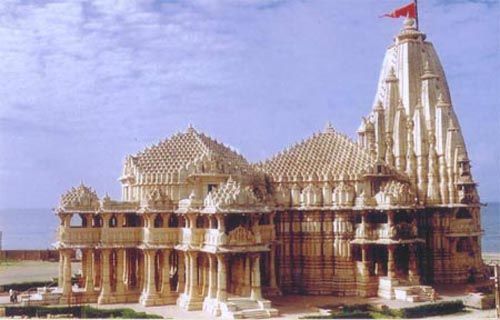
Is the buried city of Dwarka the oldest civilization known to man? Did it house anachronistic technologies like flying machines and even nuclear weapons? The Ancient Explorers Movement answers these questions in their debut documentary film, “Dwarka: Atlantis of the East”.
Ancient Explorer, Amish Shah travels to the west coast of India in search of an ancient submerged city. With a passion for the truth, he stumbles into a cover up and in this film, he goes public with what he found.
Read also: Dwarka Mythical City Found Under Water
Law of Gravity was Discovered by Indian
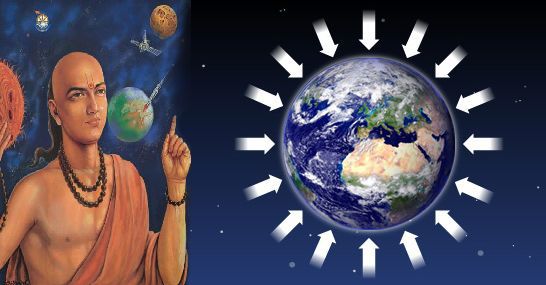
When we talk about gravity, the first name that pops into our heart is Sir Isaac Newton. In school we all have been told the story of how Newton was inspired to formulate “The Universal Law of Gravitation” when an apple fell from a tree. The world believes that Newton was the first to discover the gravitational concepts. You will be surprised to known that Indians knew the Laws of Gravity hundreds of years before Newton.
India’s contribution to the subject of gravity began with Varahamihira (505–587 CE), a Hindu astronomer and mathematician who thought of the idea of gravity but did not give it a specific name or meaning. Varahamihira claimed that there should be a force which might be keeping bodies stuck to the earth, and also keeping heavenly bodies in their determined places.
The second Indian who commented on gravity was Brahmagupta (598-670 CE). He was a Hindu astrologer and mathematician who held the view that the earth was spherical and that it attracts things. He even compared it to elements like water and fire. He also talked about ‘gravity’ in one of his statements saying:
Bodies fall towards the earth as it is in the nature of the earth to attract bodies, just as it is in the nature of water to flow.
The Sanskrit term for gravity is Gurutvakarshan, which is an amalgam of Guru-tva-akarshan. Akarshan means to be attracted. The term Guru-tva-akarshan can be interpreted to mean, “to the attracted by the Master”.
The 11th century saw the coming of another Hindu astrologer named Bhaskarachaya, also known as Bhaskara II.

Bhaskaracharya was one of the most prominent astronomers and mathematicians of the 12th century. He is also considered as the greatest mathematician from the medieval era. He is known amongst the theorist for discovering principles on astronomy and calculus.
In his treatise Siddhant Shiromani he writes on planetary positions, eclipses, cosmography, mathematical techniques and astronomical equipment.
He continued the efforts of Brahmagupta and also contributed to ‘Surya Siddhanta‘, an astronomical text dated around 400 A.D.
In Surya Siddhant, he explains that earth has gravitational force (gurutvakarshan shakti). There is a mutual attraction between the planets and this allows them to hold themselves firmly in space.
Surya Siddhanta is partly based on Vedanga Jyotisha, which itself might reflect traditions going back to the Indian Iron Age (around 1000 BCE).
Here are some of the slokas of Bhaskaracharya that mentions how gravitation works:
Objects fall on the earth due to a force of attraction by the earth. Therefore, the earth, planets, constellations, moon and sun are held in orbit due to this attraction.
The spherical earth stands at the centre of earth in space due to the dharanatmikam sakti which prevents earth from falling away and helps it to stand firm.
He also mentioned the shape of the earth while answering his daughter’s question. Bhaskaracharya states that what we see is not the reality, Earth may appear flat but it is spherical in reality. He further explains this theory by stating:
if you draw a very big circle and look at one fourth of its circumference, you see it as a straight line. But in true sense it is a circle. Similarly earth is spherical in shape.
These historical mentions are the proofs that laws of gravity was first discovered in India. India is considered as a traditional country but the world is unaware of our contributions to this modern world. Our theories were used as a base for many concepts such as weather forecast, astronomy, astrology, aviation etc. India has developed some of the best mathematicians the world has ever seen. Many of these geniuses were not given credit for their work.
Source: http://veda.wikidot.com/bhaskaracharya & Economictimes.Indiatimes.com
Headless Buddha Statue Found in Tamil Nadu
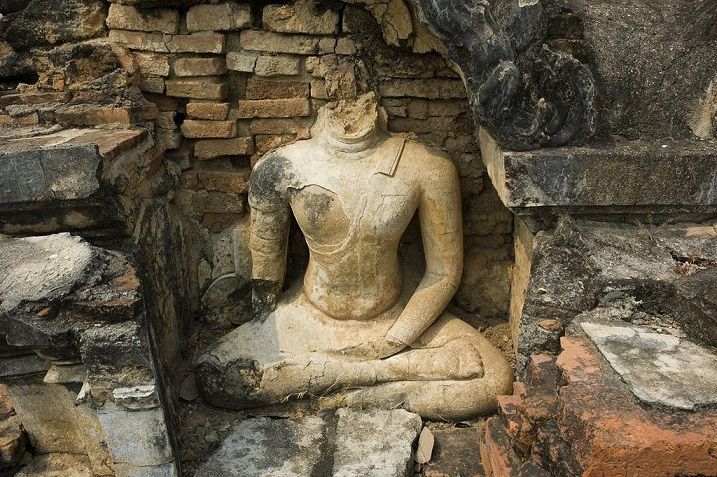
A headless sculpture of Buddha belonging to the Chola period of 10th century AD was excavated from a sugarcane field at Manalur village in Thanjavur district of Tamil Nadu. Both the head and the right hand of the granite statue were missing when it was excavated. The findings of Buddha sculptures in and around the area show the existence of a Buddhist temple in Thanjavur.
The three-foot long sculpture of Buddha was discovered by Buddhist scholar B. Jambulingam and heritage enthusiast Mani Maaran. It was found based on information given by a school teacher, Sethuraman. Since 1980s, Jambulingam has identified 67 Buddha idols in Thanjavur, Tiruchi and Pudukottai districts during his field study.
“The iconographical features of the sculpture show similarity to those found in the region earlier, mostly belonging to 10th-11th century AD. The findings of Buddha sculptures in and around the area show the existence of a Buddhist temple here,” The Times of India quoted superintendent of Tamil University Jambulingam as saying.
In Thanjavur, Buddha sculptures were found in various places and the prominent among them are those in Vayyacheri, Cholanmaligai, Kumbakonam, Madagaram, Manganallur, Pattiswaram, Perandakottai and Vikramam. Jambulingam said that there is a possibility that the headless statue belongs to the head found earlier in Vayyacheri.
Buddhism came to Tamil Nadu during the 3rd century BC and prevailed in the Chola country up to the 16th century AD.
How Rupee came into being
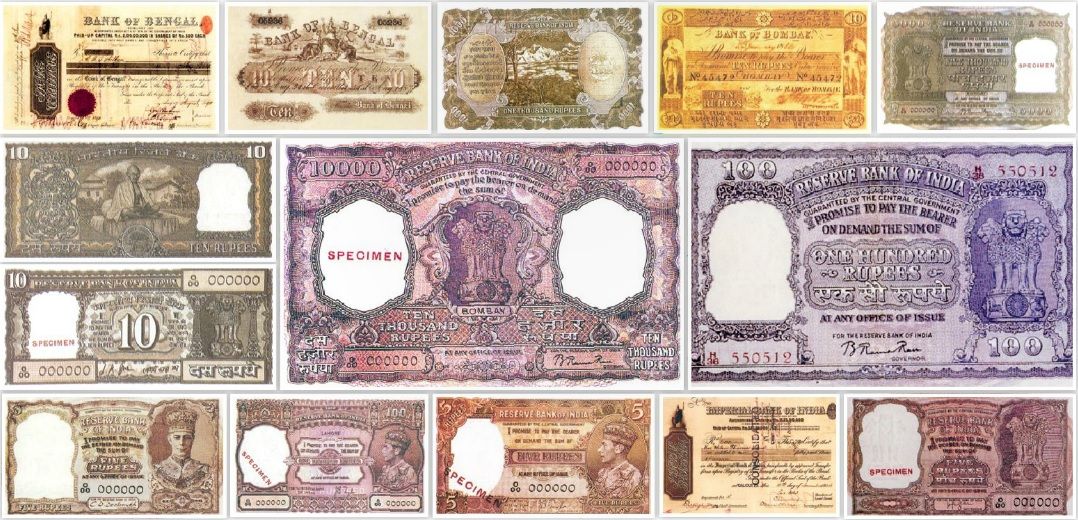
India was one of the first issuers of coins (circa: 7th/6th century BC), and as a result it has seen a wide range of monetary units throughout its history. There is some historical evidence to show that the first coins may have been introduced somewhere between 2500 and 1750 BC. However, the first documented coins date from between the 7th/6th century BC to the 1st century AD.
The Hindi word rūpaya is derived from Sanskrit word rūpya, which means “wrought silver, a coin of silver“.
Arthashastra, written by Chanakya, prime minister to the first Maurya emperor Chandragupta Maurya (c 340-290 BCE), mentions silver coins as ‘rupyarupa‘, other types of coins including gold coins (Suvarnarupa), copper coins ( Tamararupa) and lead coins (Sisarupa) are also mentioned.

Over the next few centuries, as traditions developed and empires rose and fell, the country’s coinage designs reflected its progression and often depicted dynasties, socio-political events, deities, and nature. This included dynastic coins, representing Greek Gods of the Indo-Greek period followed by the Western Kshatrapa copper coins from between the 1st and the 4th Century AD.
In 712 AD, the Arabs conquered the Indian province of Sindh and brought their influence and coverage with them. By the 12th Century, Turkish Sultans of Delhi replaced the longstanding Arab designs and replaced them with Islamic calligraphy. During his five-year rule from 1540 to 1545, Afghan king Sher Shah Suri issued a coin of silver, weighing 178 grains, which was termed the Rupiya.
The silver coin remained in use during the Mughal period, Maratha era as well as in British India.
The princely states of pre-colonial India minted their own coins, all which mainly resembled the silver Rupee, but held regional distinctions depending on where they were from. During the late 18th Century when political unrest occurred, agency houses developed banks such as the Bank of Bengal and Bahar, The Bank of Hindustan, Orient Bank Corporation and The Bank of Western India. These banks also printed their own paper currency in the Urdu, Bengali and Nagri languages.
The period before 1861 was of free banking in which established banks were at liberty to issue bank notes. The semi—government owned Presidency banks dominated this activity as their notes were accepted by the Government. For this privilege, Presidency banks had to submit themselves to the legislative controls including restrictions on the kind of business the banks could engage in. The limits of the note issue were determined as a proportion of the capital as well as cash in hand.
Early bank notes were issued in denominations then deemed convenient. Banks based around Calcutta (now Kolkata) issued notes denominated in Sicca Rupees as well as in gold mohurs. Towards the end of the 18th century, one gold mohur was equivalent to 16 Sicca Rupees in Bengal and this ratio formed the rationale for the issuance of some early notes in denominations of four, eight and 16 rupees, e.g. the note issues of the Bank of Hindostan. These denominations also represented the system of bimetallism in vogue during the period (early 19th century). Banks based in Madras (now Chennai), issued notes denominated in Arcot Rupees as well as the gold Star Pagodas.
In 1818, these monetary units in Madras were replaced by silver rupee weighing 180 grains troy (11.66 g) containing 165 grains of fine metal. By 1835, the Rupee was standardised to this specification on the basis of Indian Coinage Act 1835. Thereafter, notes were denominated in Comapany’s Rupee; by the mid-19th century, the prefix was dropped and merely Rupee retained.
With the establishment of the Reserve Bank of India (RBI), asset backing for the note issued came to be governed by section 33 of the RBI Act which originally prescribed a proportional reserve of gold and sterling securities against note issue. At least 40 per cent of total assets backing note issue were to be in the form of gold coin and sterling securities of which gold coin and bullion was not to be less than RUPEE 40 crore in value with gold being valued at RUPEE 18.23 per 10 g.
Financial instruments, especially the bills of exchange known as Hundis, have a venerable history. However, paper money, in the modern senses, traces its origins to the late 18th century. Among the earliest note issues were those by the Bank of Hindostan (1770-1832), the General bank in Bengal and Behar (1773-75), the Bengal Bank (1748-91) etc. Few of those notes survived. With the establishment of semi-government banks in the 19th century (the Bank of Bengal, the Bank of Bombay and the bank of Madras alluded to as the Presidency banks) paper money came to enjoy wider circulation, though restricted to a small class of privileged users.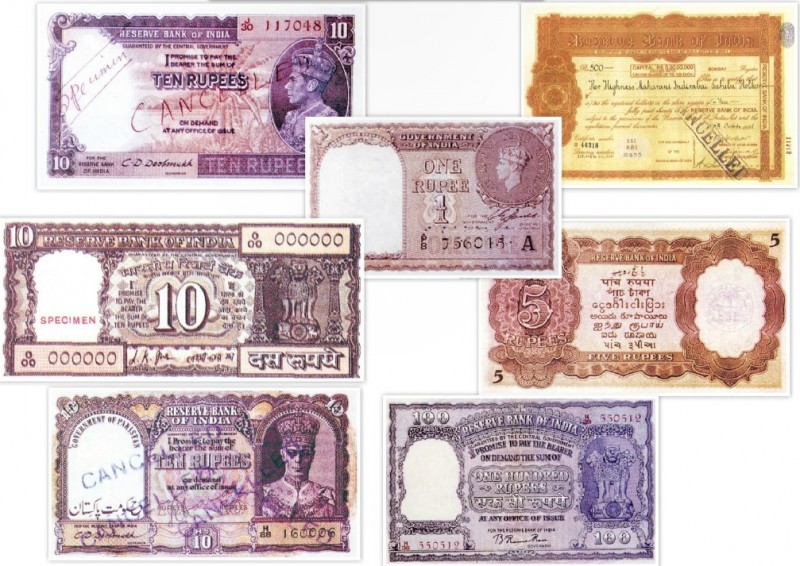
Paper currency was managed by the Government till April 1, 1935, when RBI was established as the central bank of the country and took over the function of note issue. RBI initially followed a proportionate reserve system of note issue where, at least, 40 per cent of the assets backing note issue were to be in the form of gold and foreign securities. In 1956, the proportionate reserve system was replaced by a minimum reserve system.
In August 1947, the notes in circulation in undivided India amounted to ₹1,181 Croe (₹11.81 Billion)
Independence also brought with it the trauma of Partition of country into India and Pakistan. The transition of currency management from colonial to independent India was a reasonably smooth affair despite the considerable dimensions involved. In August 1947, the notes in circulation in undivided India amounted to ₹1,181 crore (₹11.81 billion). The task was to replace Indian notes and coins circulating in the newly- formed Pakistan with distinct notes and coins of the new state and apportion assets against the liability of the notes issued.
The bank issued from April 1 to June 30, 1948, inscribed bank notes in the denominations of ₹2, ₹5, ₹10 and ₹100 and inscribed Government of Pakistan one rupee notes and Pakistani nickel rupee and other subsidiary coins of distinctive design.
These notes and coins were to be legal tender in Pakistan only. The arrangement for the Reserve Bank to continue as currency authority of Pakistan was terminated on June 30, 1948. The State Bank of Pakistan was established on July I, 1948.
The task in India was simpler. Between Independence and the declaration of the Indian Republic on January 25, 1950, RBI continued to issue the extant notes. The first note issued by Independent India was the One Rupee note issued by the Government of India in 1949 with KRK Menon as the signatory. RBI issues coincided with the declaration of the Republic. The Bank was nationalised on January 1, 1949.
Symbols for Independent India had to be chosen. At the outset, it was felt that the King’s portrait be replaced by a portrait of Mahatma Gandhi. Designs were prepared to the effect. In the final analysis, the consensus moved to the choice of the Lion Capital of the Ashoka Pillar at Sarnath in lieu of the Gandhi portrait. The new design of notes was largely along earlier lines.

In 1951, Hindi was displayed prominently on the new notes. The debate regarding the Hindi plural of Rupaya was settled in favor of Rupaiye. High denomination notes (₹1,000, ₹5,000 and ₹10,000) were reintroduced in 1954. India reformed its monetary system in 1957. In the earlier system, one rupee was divided into 16 annas and one anna consisted of 4 pice; one pice equalling 3 pies. Thus, one rupee consisted of 64 pice or 192 pies. A commemorative design series in the honour of the birth centenary Mahatma Gandhi was issued in 1969, depicting a seated Gandhi with the Sevagram Ashram as backdrop. The designs and sizes kept changing over time.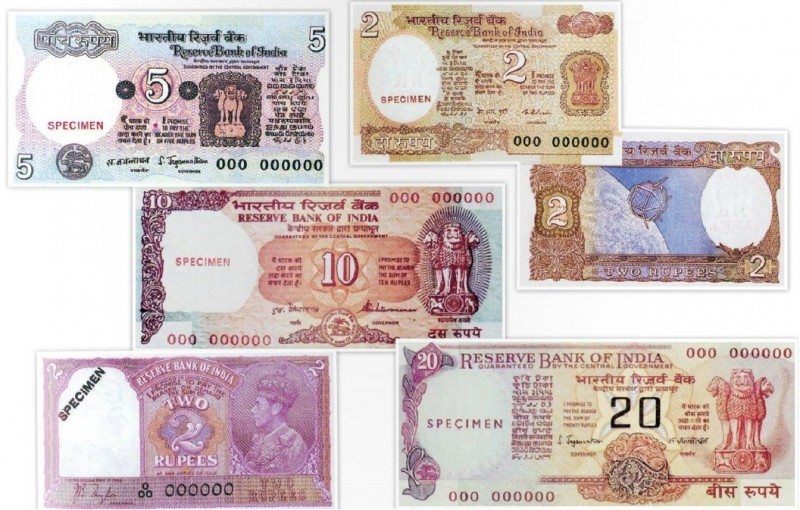
The modern rupee is subdivided into 100 paise (singular paisa). The Indian rupee symbol ‘₹’ (officially adopted in 2010) is derived from the Devanagari consonant “र” (ra) and the Latin letter “R”. The first series of coins with the rupee symbol was launched on 8 July 2011.
Source: India perspectives Magazine by Indian Diplomacy and Wikipedia
The Zoroastrians or Parsees – The Forgotten Children Of India
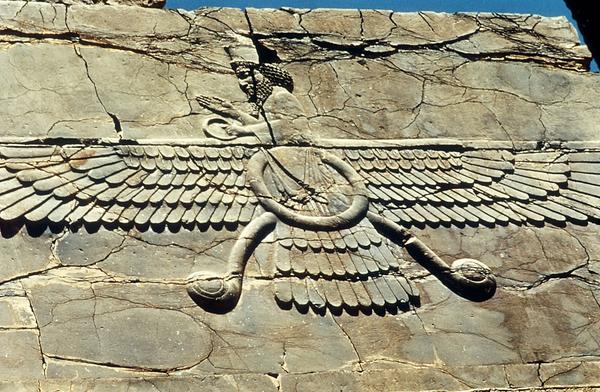
The title of this article may sound somewhat strange to many. But historical traditions of the ancient world supports this view. Zoroastrianism is one of the religion that was prevalent in the ancient world prominently. Much has been written about it by various eminent scholars about it. My view in this article is to prove their Indian Origin through historical traditions.