
Mount Kailash – A man-made pyramid?

Kailash is a sacred Tibetan mountain shrouded in mystery and legends. With an impressive height of 6718 meters, Mount Kailash represents the axis of the world or the stairway to heaven for the people in the region. Both Buddhists and Hindus, as well as older religions, recognize Mount Kailash as an ancient holy place. Its shape is like the pyramids in Egypt with four nearly symmetrical sides. Its glistening snow-covered top makes it the most eye-catching one. Approach Kailash not only prohibited, but dangerous. In the immediate vicinity of mountains time flows much faster, and people have gone to the mountain, often not returned.

Its shape is remarkable and has led to speculations over the centuries. The area around this great mountain is the source of four life-giving rivers; the Indus, Brahmaputra, Sutlej and the Karnali River (a tributary of the Sacred River Ganga). Two lakes are situated at the base of the mountain. The higher lake Manasarovar (one of the highest freshwater lakes in the world), is the sacred lake, and is round like the sun. The lower lake Rakhast Tal (one of the highest salt-water lakes) is the devil’s lake and has the shape of the crescent moon. The two lakes represent solar and lunar forces, good and negative energies respectively.

Mount Kailash is a Pyramid?

In 1999, the expedition of Russian scientists led by Professor ER Muldasheva found that the top of Mount Kailash is actually a giant man-made pyramid from ancient times. It is surrounded by more than 100 other small pyramids and various monuments, clearly oriented to the cardinal points. According to tentative estimates, the height of the rest of the complex of pyramids lie in the range 100-1800 m (for comparison: the pyramid of Cheops – 146 m). This complex, moreover, might be the centre of a worldwide system connecting other monuments or sites where paranormal phenomena have been observed. If this is true, then human history has to be re-written. It is larger than any pyramid known today.

Scientists headed by Professor ER Muldasheva concluded that the complex of pyramids Kailash, the so-called “City of the Gods“, was built by the representatives of advanced civilization, who knew the laws of subtle energy (torsion field) and the time and knew how to manage them they had been, and is subject to gravity. Otherwise it is impossible to move large masses of stone or grinding of mountain ranges that had to be done during the construction of these Pyramids, and “mirrors”. 
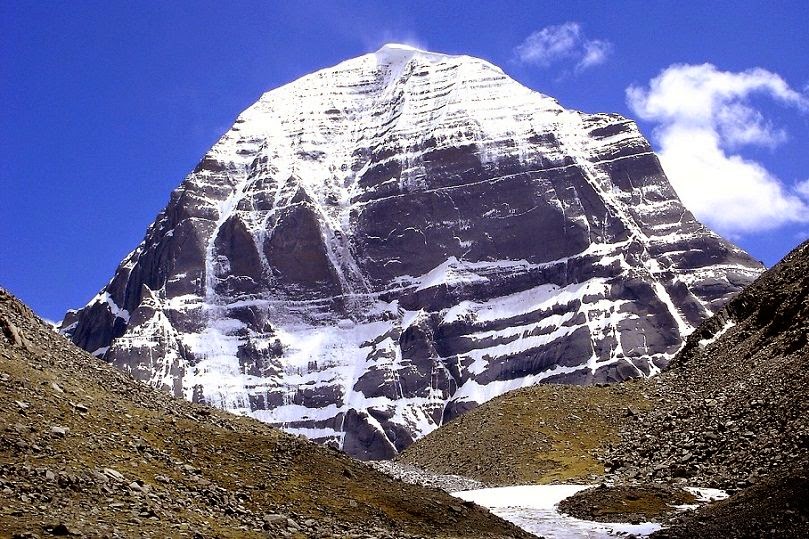
North face of Mount Kailash
North face of Mount Kailash – image Source

In shape it (Mount Kailash) resembles a vast cathedral… the sides of the mountain are perpendicular and fall sheer for hundreds of feet, the strata horizontal, the layers of stone varying slightly in colour, and the dividing lines showing up clear and distinct…… which give to the entire mountain the appearance of having been built by giant hands, of huge blocks of reddish stone. (G.C. Rawling, The Great Plateau, London, 1905).

The idea of the pyramid in this region is not new. It goes back to the timeless Sanskrit epic of the Ramayana.

 
Vedas mentioned Mount Kailash as cosmic axis and world pillar, center of the world, and world tree. It has other names… Meru, Sumeru, Sushumna, Hemadri, Deva Parvata, Gana Parvata, Rajatadri, and Ratnasanu. Kang Tisé or Kang Rinpoche (the ‘Precious Jewel of Snow’ in Tibetan), Meru (or Sumeru), Swastika Mountain, Mt. Astapada, Mt. Kangrinboge (the Chinese name) – all these names, real or legendary, belong to one of the holiest and most mysterious mountains in the world – Mount Kailash. In religion or mythology, the world center or the connection is between Heaven and Earth. As the celestial pole and geographic pole, it expresses a point of connection between sky and earth where the four compass directions meet.  

According to Hinduism, Lord Shiva, the destroyer of ignorance and illusion, resides at the summit of mountain Kailash, where he sits in a state of perpetual meditation along with his wife Pārvatī. Hindu mythology recognises it as the only abode of the gods that can be visited by man in his mortal body.

To Tibetan Buddhists, Kailash is the abode of the tantric meditational deity Demchog.
Jains revere Kailash as the site at which their first prophet received enlightenment.

The Bön, an aboriginal religious sect of the Tibetan pre-Buddhist era call it Yung-drung Gu-tzeg, or “9-storey Swastika” because on the south face of Kailash can be seen a swastika.

Perhaps the Buddhist legends about Mount Kailash gives the most interesting indication of its true significance. Buddhists believe that ‘their’ sorcerer Milarepa challenged the sorcerer of the Bön religion, Naro Bön-chung. There was a fierce superhuman battle, but both sorcerers turned out to be equally powerful. They then decided to race each other to the top of Mount Kailash. Now what is interesting is that one of them used some sort of magic drum to reach the top, while the other won by using ‘rays of the sun’.

What does this sound like, if we take it literally? Did one of these legendary figures use a spacecraft and the other some form of teleportation? What if these magicians were actually ancient aliens, using advanced technology that primitive humans could only explain by calling them ‘Gods’?

However, it is only fair to add that the Russian claims to have discovered in the Mt.Kailash area the highest ever human-built pyramids were denied three years later by Chinese scientists in the official Chinese Press.


Reference: http://www.unspecial.org/UNS640/t47.html
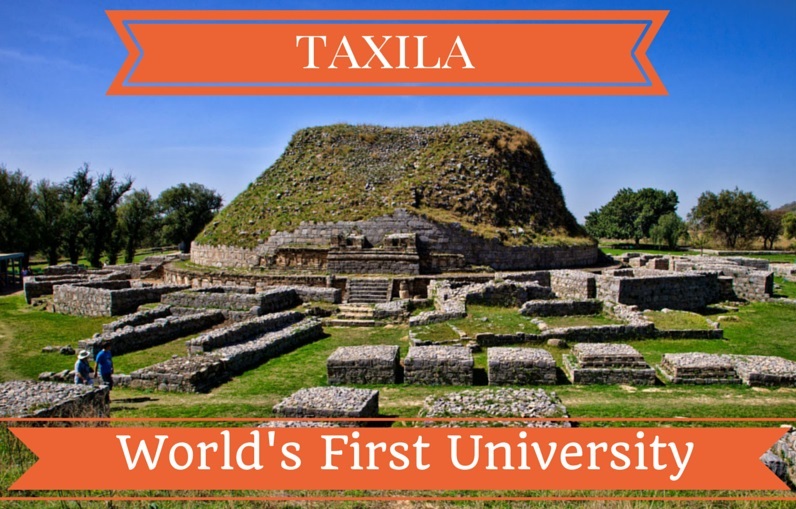
Takshashila – Worlds oldest University

India has a long and venerable history in the field of higher education. In ancient times, the country was known to have been home to the oldest formal universities in the world.

More than 2700 years back a huge university existed in the ancient India where over 10,500 students from all across the world came for higher studies. This was the Takshashila university of ancient India (wrongly spelled as Taxila today). It was an important Vedic/Hindu and Buddhist center of learning but wasn’t as well organized as the University of Nalanda.

According to historical references Takshashila University date back to the 5th or 6th Century BCE. As per the Indian epic, Ramayana, the city name Takṣaśilā came from Taksa, who was the son of Bharata, the brother of the Lord Rama (Don’t confuse with Emperor Bharata). It is believed that Taksa was the first ruler of the kingdom Taksa Khanda and founder of the city Takṣaśilā.

According to another theory the variant of the name Takṣaśilā is very closely related to Taksaka that in Sanskrit means ‘carpenter’. In ancient India, this was another name given to the Nagas.

Taxila is also described in some detail in the Buddhist Jātaka tales, written in Sri Lanka around the 5th century. In this text, Taxila has been mentioned as the capital of the kingdom of Gandhara and a great learning center.

Chinese travellers like Fa Hian (Faxain) and Huien Tsang (XuanZang) also speak of Takshashila in their writings.

The site initially began to develop as a loosely connected group of buildings where learned persons resided, worked and taught. Over the years, additional buildings were added; rulers made donations and more scholars migrated there. Gradually a large campus developed, which became a celebrated seat of learning in the ancient world.

During its times this university was the IIT and MIT of the world. The campus accommodated students who came from as far as Babylonia, Greece, Arabia and China and offered over 64 different fields of study like Vedas, grammar, philosophy, Ayurveda, agriculture, surgery, politics, archery, warfare, astronomy, commerce, futurology, music, dance, etc. There were even curious subjects like the art of discovering hidden treasure, decrypting encrypted messages, etc.

Chanakya
Chanakya

Admission into this university was purely based on merit. Students were admitted to this university at the age of 16 after they had completed their basic education in their local institutions. They were supposed to pay for their expenses. However, if a student was unable to pay then he could work for his teacher. Students would come to Takshila and take up education in their chosen subject with their teacher directly. Entrance exam to Takshashila was very difficult and only 3 out of every 10 students passed the admission test.

Takshashila is perhaps best known because of its association with Chanakya. The famous treatise ArthaShastra (Ancient Indian treatise on statecraft, economic policy and military strategy, written in Sanskrit) by Chanakya, is said to have been composed in Takshashila itself. He was also mentor and Professor of Chandragupta Maurya who founded the Great Mauryan Empire, and also served as the prime minister of the Mauryan Empire. Even Chandragupta Maurya studied at Takshashila.

Another great student from Takshashila university was Vishnu Sharma, the author of the great book that teaches the art of political science in the form of simple beautiful stories called the Pancha Tantra (meaning the five techniques).

Panini was another great product of this university. He was an expert in language and grammar and authored one of the greatest works on grammar ever written called Ashtadhyayi.

Charaka, the famous ancient Indian Ayurvedic physician was a product of Takshashila university. He originally authored the Charaka Samhita.

Jivak was another genius who came out of the Takshashila university. He was a doctor and an expert in pulse reading. Jivak was the personal physician of Buddha and also cured the Nadi Vran of Buddha. There are over 15000 handwritten manuscripts of Jivak’s expertise passed on by generations to their children and are still preserved in India even today.

Under the king Asoka of Mauriya Empire, the city touched its peak in terms of development. Taxila after this saw the most creative period under the rule of Gandhara. In the next 200 years, Taxila became a center of great learning.

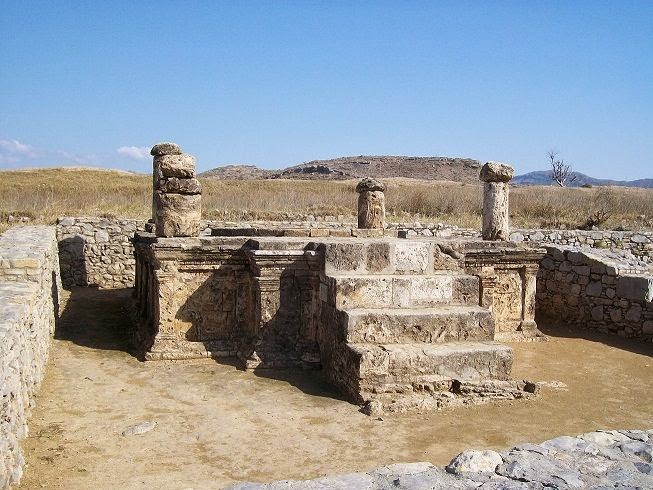
Ruins of taxila city

Being near the north-west frontier of India, Takshashila had to face the brunt of attacks and invasions from the north and the west. Thus the Persians, Greeks, Parthians, Shakas and Kushanas laid their destructive marks on this institution. When Alexander’s armies came to the Punjab in the fourth century B.C., Takshashila had already developed a reputation as an important seat of learning. Thus on his return Alexander took many scholars from there with him to Greece. In the second half of the 5th century, it was severely damaged by Hephthalite (White Huns) invasions. They destroyed the whole city, University and all Buddhist monasteries which never again recovers. During the 7th century it was gradually abandoned by its inhabitants.

Taxila was excavated by Sir John Hubert Marshall (British Archaeologist) in 1920s who at the time of excavation was the Director General of the Indian Archaeological Survey (1902-31). Takshila was listed by the UNESCO as one of the World Heritage Sites in 1980.

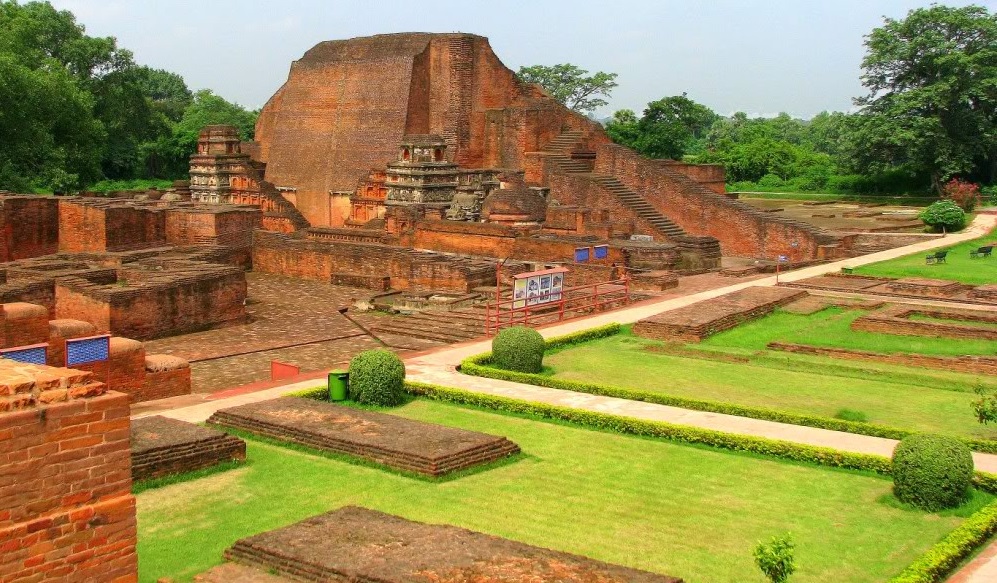
Ancient Nalanda University of India

Nalanda University was an ancient centre of learning in India. Established in the 5th century AD by Gupta Kings, Nalanda University was among the first great universities in recorded history, pre-dating such institutions of higher learning like Al-Azhar in Egypt (10th century AD), the University of Bologna in Italy (11th century AD), and Oxford University in England (12th century AD).

Vijay Stambh – Tower of Victory in Rajasthan

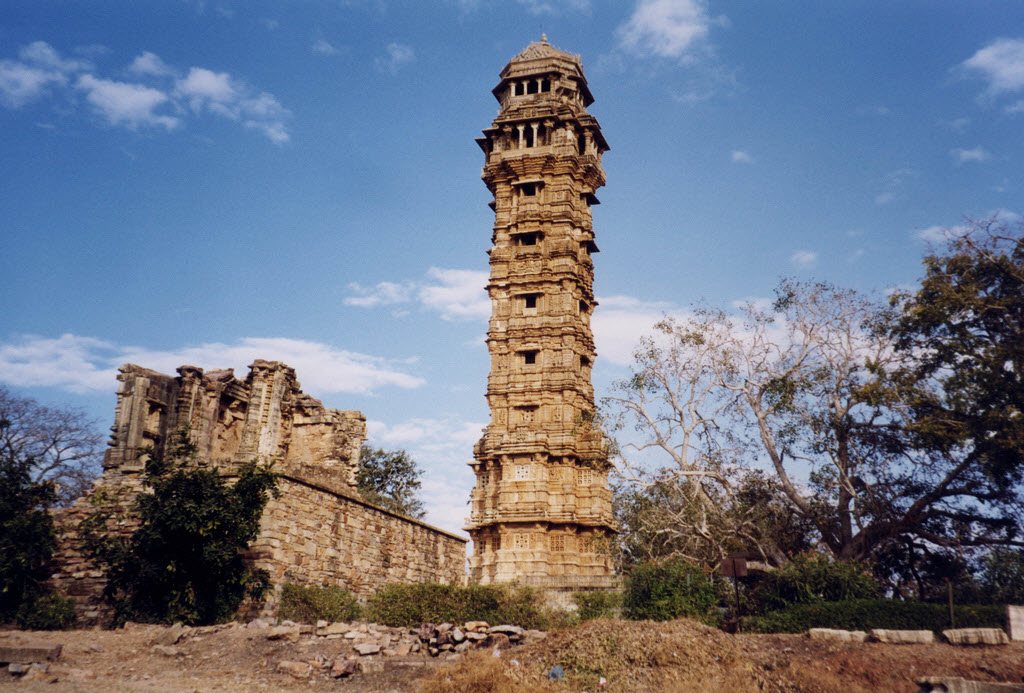
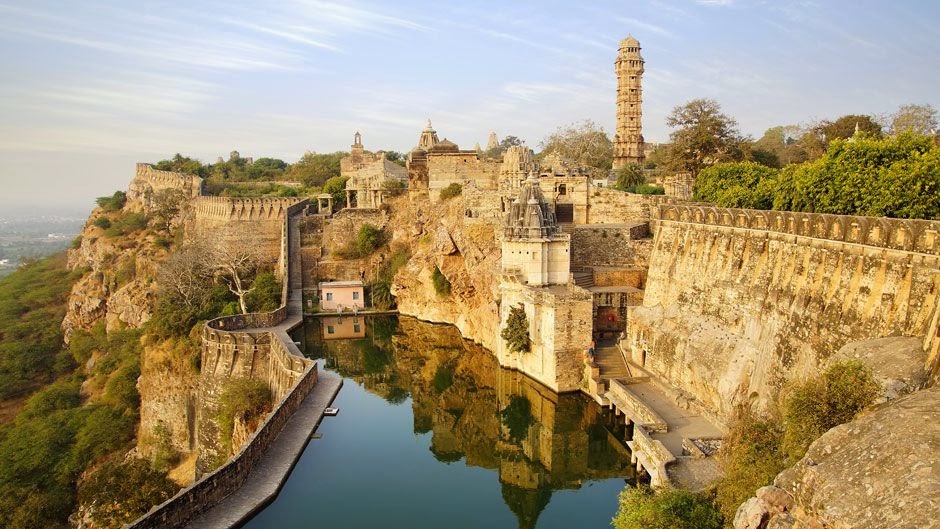
Vijay Stambha or Tower of Victory is one of the most famous monuments of India and is an important tourist attraction of Rajasthan.  Located in Chittorgarh fort in Rajasthan, India, Tower of Victory was constructed by Mewar king Rana Kumbha between 1442 AD and 1449 AD  to honour his distinguished victory over the joint attacks of Sultan Mohammad Khilji of Malva and Sultan Kutubuddin Shah of Gujarat.

Its graceful and immaculate architecture is unique. Dedicated to Vishnu, this 37.19 m high tower was constructed on a 14 m square platform. Its base width is 9 m. The Tower is built partly of red sand stone and partly of white marble.  

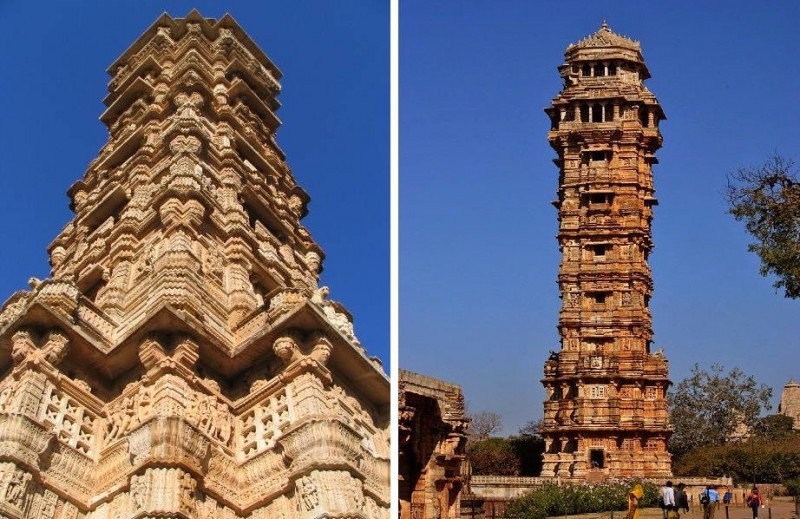
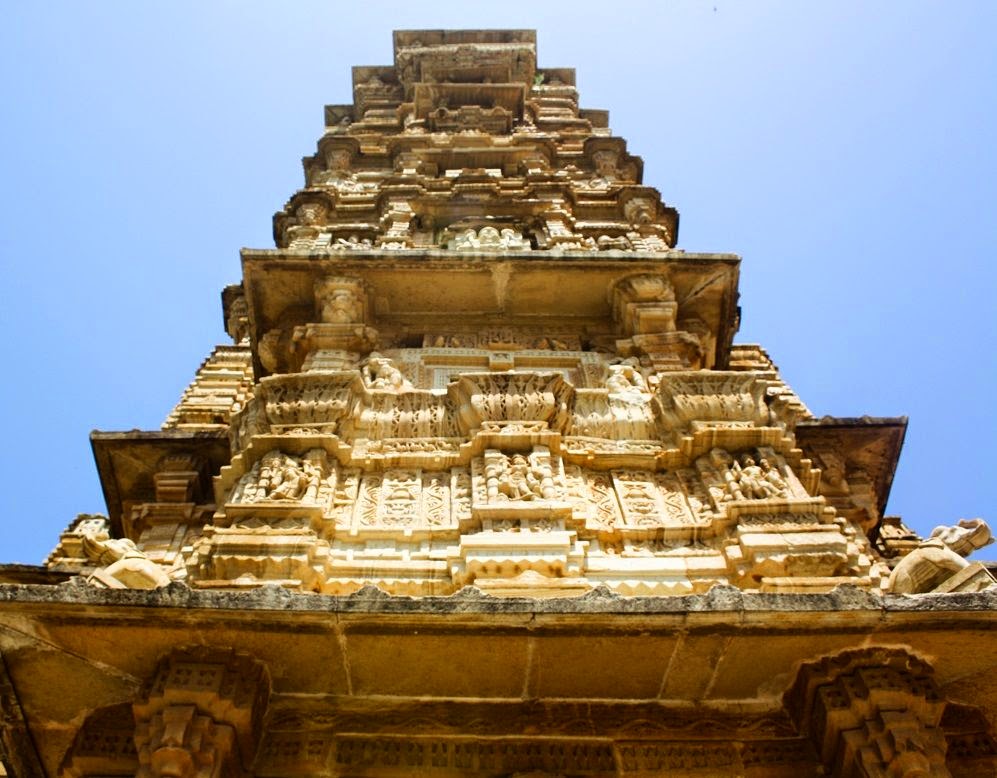
The interior and exterior are delicately carved showing Hindu deities of mythological characters with names. The inscribed slabs in the uppermost story contains genealogy of the rulers of Chittaur from Hamir to Rana Kumbha. The entire tower is covered with architectural ornaments and inscribed images of gods and goddesses, seasons, weapons, musical instruments, etc. Its inscribed sculpture are a veritable text-book of Hindu iconography. The portraits of the architect of this tower Jaita and his 3 sons, Napa, Puja, and Poma are carved on the fifth floor of the tower. Architecture of Towern Of Victory Rajasthan

The Tower has nine storey, each of the nine storey are distinctly marked with openings and balconies at every face of each storey. The 157 circular and narrow steps which leads to the terrace is also a noticeable feature of the architecture. After reaching at the top of tower, anyone can see a great and unique view of the whole city. The uppermost floor has been sealed off and is no longer accessible to visitors. 

Chittorgarh fort and Tower of victory

The area around the Vijay Stambh is littered with an impressive number of further remains, including a pair of monumental gateways and a number of florid temples, including the superbly decorated Samiddhesvara Temple, whose shrine houses an image of the trimurti, a composite, three-headed image of Shiva, Brahma and Vishnu.

Several temples line the route, but the most impressive monument is Kirti Stambh. The inspiration for the tower of victory, this smaller Tower of Fame is 22 metre high and was built by a Jain merchant Jeeja Bhagerwala during the reign of Rawal Kumar Singh (1179-1191) for the glory of Jainism.

In the night, colourful lights increase its beauty. When reaching near Vijaya stambh (Tower of Victory) and viewing it from bottom gives great feelings of old time architecture and joy of victory. So really its a great piece of monuments and must be included in great architecture of India. 

Vijay Stambha -Tower of Victory, Indian architecture

Tower of victory | Vijay Stambha - view from bottom
A View from Bottom

Mystery of 1600 years old Iron Pillar of Delhi

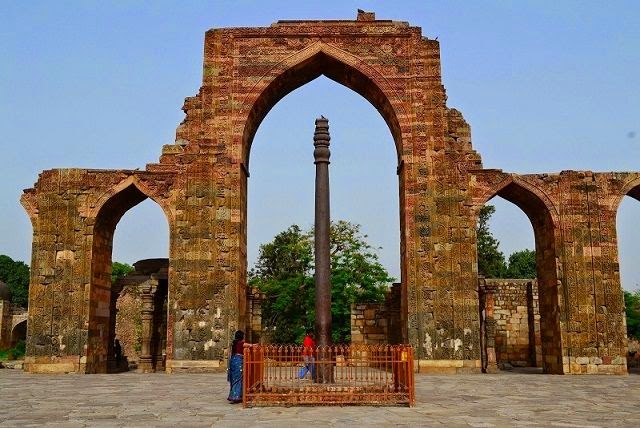
The skill and the technology possessed by ancient Indians may not be agreed by present day ‘secular’ historians, but the truth cannot be suppressed for long. The Iron Pillar standing tall at Mehrauli, Delhi is stands proof of how advanced science was in ancient India.

The pillar which has not rusted for the past 1600 years has been found to be the handiwork of a great Vishnu Bhakth namely Chandragupta II Vikramaditya. The inscriptions on the pillar are in Sanskrit and refer to the mighty king. Inspite of all these evidences, school children will still continue to be taught that it was the Mughals who were responsible for the pillar. Yes, the Mughals were responsible for stealing the pillar from its original place!

It is arguable that Indian scientists and technologists were producing high-quality corrosion-resistant iron and steel as early as 400 AD. There is considerable evidence of the ingenuity of ancient India’s metallurgists in the form of permanent installations, museum exhibits and pillars installed in places of worship across the country. The most famous of these – one which has defied and confounded students and professors of metallurgy in India and abroad — is the 32 ft high pillar of rust-free iron sited contiguous to the 239 ft tall red sand stone in Qutab Minar. And the wonder of this metallurgical marvel is that it has not rusted or succumbed to atmospheric corrosion despite being unprotected against the elements for over 1600 years. During the past two centuries since the existence of this wonder pillar was brought to public attention by British archaeologist James Prinsep in 1817, over 250 books have been written on this subject. The first systematic research was done by British metallurgist Sir Robert Hodfield in 1912, and since then several scientists from across the world have researched, presented papers and written books on the pillar.Details of the top of iron pillar of Delhi

The iron pillar in Delhi fascinates scientists all over the world, due to its excellent resistance to atmospheric corrosion. This is an attempt to explain the story behind the pillar in a very simple manner, so that a lay reader can appreciate the history, science and technology of the iron pillar. In addition the artistic merit of the pillar is highlighted …It is sincerely hoped that the imagination, especially of the young readers, will be fired by the facts and ideas presented in this book,” writes Balasubramaniam.

The Story of the Delhi Iron Pillar traces the history of this metallurgical wonder and recounts that it was engineered in Udayagiri. The author reveals that the iron pillar was originally installed atop a hill near Udayagiri in the hinterland of Madhya Pradesh during the reign of Chandragupta II Vikramaditya (374-413 AD) of the Gupta dynasty. The original site of the pillar was the exact location where the imaginary line that is the tropic of cancer crosses India from where one can observe the sun rising in the east and setting in the west on spring and autumn equinox days. However in 1234 King Iltutmish (1210-36 AD) the third sultan of Delhi’s slave dynasty captured Udaygiri and transported the pillar to Delhi as part of his victory booty.

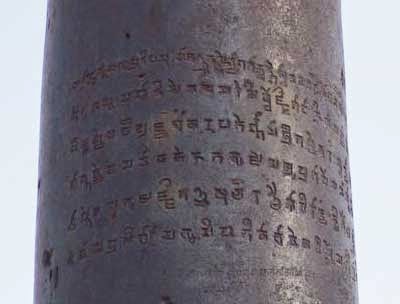
Inscription on the rust resilient Iron Pillar from Delhi.

The pillar carries a number of inscriptions and graffiti of different dates which have not been studied systematically despite the pillar’s prominent location and easy access. The oldest inscription on the pillar is in Sanskrit, written in Gupta-period Brahmi script.This states that the pillar was erected as a standard in honour of Viṣhṇu. It also praises the valor and qualities of a king referred to simply as Chandra, now generally identified with the Gupta King Chandragupta II. Some authors attempted to identify Chandra with Chandragupta Maurya and yet others have claimed the pillar dates as early as 912 BCE. The dating of the inscription is supported by the nature of the script and the Sanskrit poetics, both of which reflect the conventions of Gupta times.

That the Delhi iron pillar is indeed an engineering marvel was conceded by the president of the Institute of Mechanical Engineers, London. The incumbent professor of materials and metallurgical engineering at IIT-Kanpur, Balasubramaniam also unravels the mystery of the amazing durability of Delhi’s iron pillar. According to him unnamed engineers of that era used the film forming quality of phosphoric acid to create a thin protective layer of ‘misawite’, a compound of iron, oxygen and hydrogen to prevent rusting and corrosion. This protective film encapsulated the pillar within three years after its erection and has been growing imperceptibly since. Today 1,600 years later, the film is of a thickness of one-twentieth of a millimeter.

Source: Prof. R. Balasubramaniam’s Story of the Delhi Iron Pillar

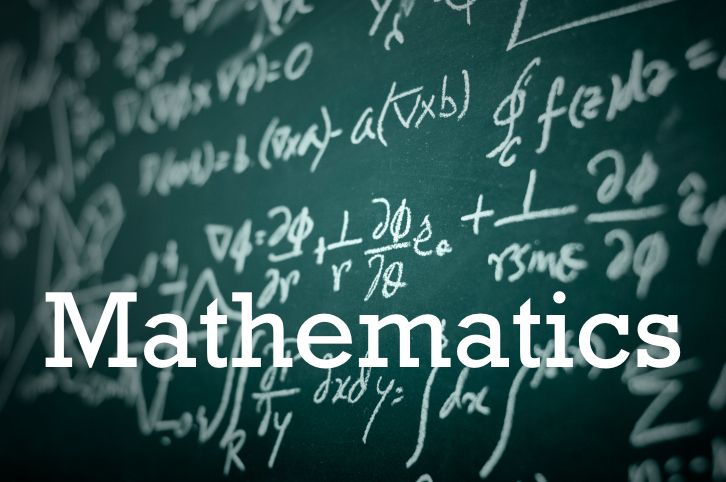
Ancient India’s contribution to Mathematics

Mathematics represents a very high level of abstraction attained by human brain. In ancient India, roots to mathematics can be traced to Vedic literature, which are around 4000 years old. Between 1000 BC and 1000 AD, a number of mathematical treatises were authored in India.

Will Durant, American historian (1885-1981) said that India was the mother of our philosophy of much of our mathematics. 

It is now generally accepted that India is the birth place of several mathematical concepts, including zero, the decimal system, algebra and algorithm, square root and cube root. Zero is a numeral as well as a concept. It owes its origin to the Indian philosophy which had a concept of “sunya“, literal translation of which is ‘void‘ and zero emerged as a derivative symbol to represent this philosophical concept.

mathematician Aryabhatta
Mathematician Aryabhatta

Geometrical theories were known to ancient Indians and find display in motifs on temple walls, which are in many cases replete with mix of floral and geometric patterns. The method of graduated calculation was documented in a book named “Five Principles” (Panch-Siddhantika) which dates to 5th Century AD. A. L. Basham, an Australian Indologist, writes in his book, The Wonder That was India that “… the world owes most to India in the realm of mathematics, which was developed in the Gupta period to a stage more advanced than that reached by any other nation of antiquity.”
The success of Indian mathematics was mainly due to the fact that Indians had a clear conception of the abstract number as distinct from the numerical quantity of objects or spatial extension.

Algebraic theories, as also other mathematical concepts, which were in circulation in ancient India, were collected and further developed by Aryabhatta, an Indian mathematician, who lived in the 5th century, in the city of Patna, then called Pataliputra. He has referred to Algebra (as Bijaganitam) in his treatise on mathematics named Aryabhattiya

Decimal system origionated in India between 400 B.C. to 400 A.D. The system was adopted by the Arabs by about A.D. 800 at the very earliest. They brought it to Spain about 900. In 1202, Leonardo Fibonacci, an Italian mathematician wrote a hugely influential book called “Liber Abaci” (Book of Calculation), in which he promoted the use of the Hindu-Arabic numeral system. Fibonacci called number “Numeri Indian” (Indian Numbers).

Decimal system or Indian Numbers

Another mathematician of the 12th century, Bhaskaracharya also authored several treatises on the subject – one of them, named Siddantha Shiromani has a chapter on algebra. He is known to have given a basic idea of the Rolle’s theorum and was the first to conceive of differential calculus.
In 1816, James Taylor translated Bhaskaracharya’s Leelavati into English. Another translation of the same work by English astronomer Henry Thomas Colebruke appeared next year in 1817.
The credit for fine-tuning and internationalizing these mathematical concepts – which had originated in India – goes to the Arabs and Persians. People from Arab and other countries used to travel to India for commerce. While doing commerce side by side, they also learnt easy ways to use calculations methods of India. Through them this knowledge reached Europe. It was from this translation of an Indian text on Mathematics that the Arab mathematicians perfected the decimal system and gave the world its current system of numeration which we call the Arab numerals, which are originally Indian numerals. 
 Al-Khawarizmi, a Persian mathematician, developed a technique of calculation that became known as “algorism.” This was the seed from which modern arithmetic algorithms have developed. Al-Khwarizmi’s work was translated into Latin under the title Algoritmi de numero Indorum, meaning The System of Indian Numerals. A mathematician in Arabic is called Hindsa which means from India.
The 14th century Indian mathematician Madhava of Sangamagrama, along with other mathematicians of the Kerala school, studied infinite series, convergence, differentiation, and iterative methods for solution of non-linear equations.
Jyestadeva of the Kerala school wrote the first calculus text, the Yuktibhasa, which explores methods and ideas of calculus repeated only in seventeenth century Europe. 

The Hindu cosmological time cycles explained in the Surya Siddhanta, give the average length of the sidereal year (the length of the Earth’s revolution around the Sun) as 365.2563627 days, which is only 1.4 seconds longer than the modern value of 365.2563627 days. This remains the most accurate estimate for the length of the sidereal year anywhere in the world for over a thousand years.