In Ancient India religious practices and beliefs often lead to particular discoveries or inventions. In all the religions that took their birth in India, use to follow some particular times of the day to perform their religious rituals at particular times of the day. But they had no reliable way of telling the time.
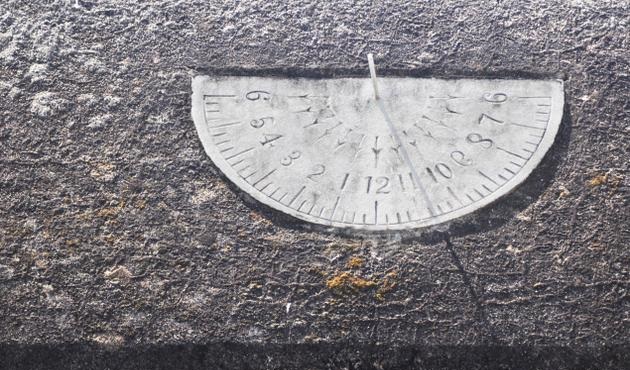
A simple stick in the ground can be used to create a sun dial, but what do you do when there is no sun, such as on a cloudy day. Ancient Indians devised a different type of clock, one that is based on water, called as Ghatika Yantra.
Indians had divided day and night into 60 parts, each of which is called a ghari. Moreover the night and day are each divided into four parts each of which is called pahar.
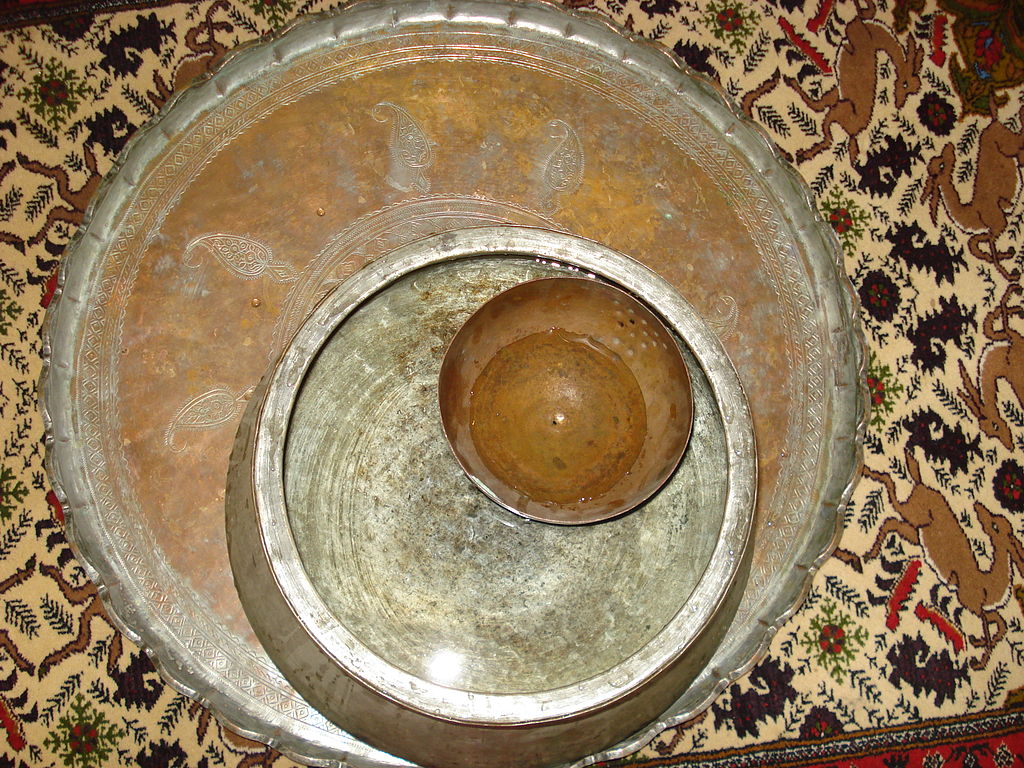
In all important towns, a group of men called ghariyalis were appointed to measure time. To measure time a vessel with a hole at the bottom was place over another big vessel containing water. When the vessel with the hole was filled with water, they used to strike the ghariyal, a thick brass disc hung at a high place with a mallet. This indicated a certain period of time.
Water clocks, along with sundials, are likely to be the oldest time-measuring instruments. Where and when they were first invented is not known, and given their great antiquity it may never be. The bowl-shaped outflow is the simplest form of a water clock and is known to have existed in India, China, Babylon and in Egypt thousands of years ago.
Historians suggest that pots excavated from Mohenjo daro might have been used as water clocks; they are tapered at the bottom, have a hole on the side. The use of the water clock in ancient India is also mentioned in the Atharvaveda from the 2nd millennium BCE.
The Chinese traveler who visited India during the 7th century A.D had given an account of how this water clock worked at Nalanda, a Buddhist university. At Nalanda four hours a day and four hours at night were measured by a water clock, which consisted of a copper bowl holding two large floats in a larger bowl filled with water. The bowl was filled with water from a small hole at its bottom; it sank when completely filled and was marked by the beating of a drum at daytime. The amount of water added varied with the seasons and this clock was operated by the students of the university.
The description of a water clock in astrologer Varahimira’s Pancasiddhantika adds further detail to the account given in the Suryasiddhanta. The description given by mathematician Brahmagupta in his work Brahmasphutasiddhanta matches with that given in the Suryasiddhanta. Astronomer Lallacharya describes this instrument in detail.
The traditional Indian architecture is extremely simple and straightforward. The simple techniques of construction were utilized to build some of the glorious and magnificent buildings that have withstood the test of time. Structural elements like columns and beams were carefully integrated within the buildings to meet the needs of religious and cultural traditions. The vast freedom available to the sthapaka and sthapathi in the design of temples and other spiritual buildings resulted in the development of overwhelming wealth of architectural elements, variety of sculptural forms and decorative exuberances that has become the everlasting symbol of Indian Temple Architecture.
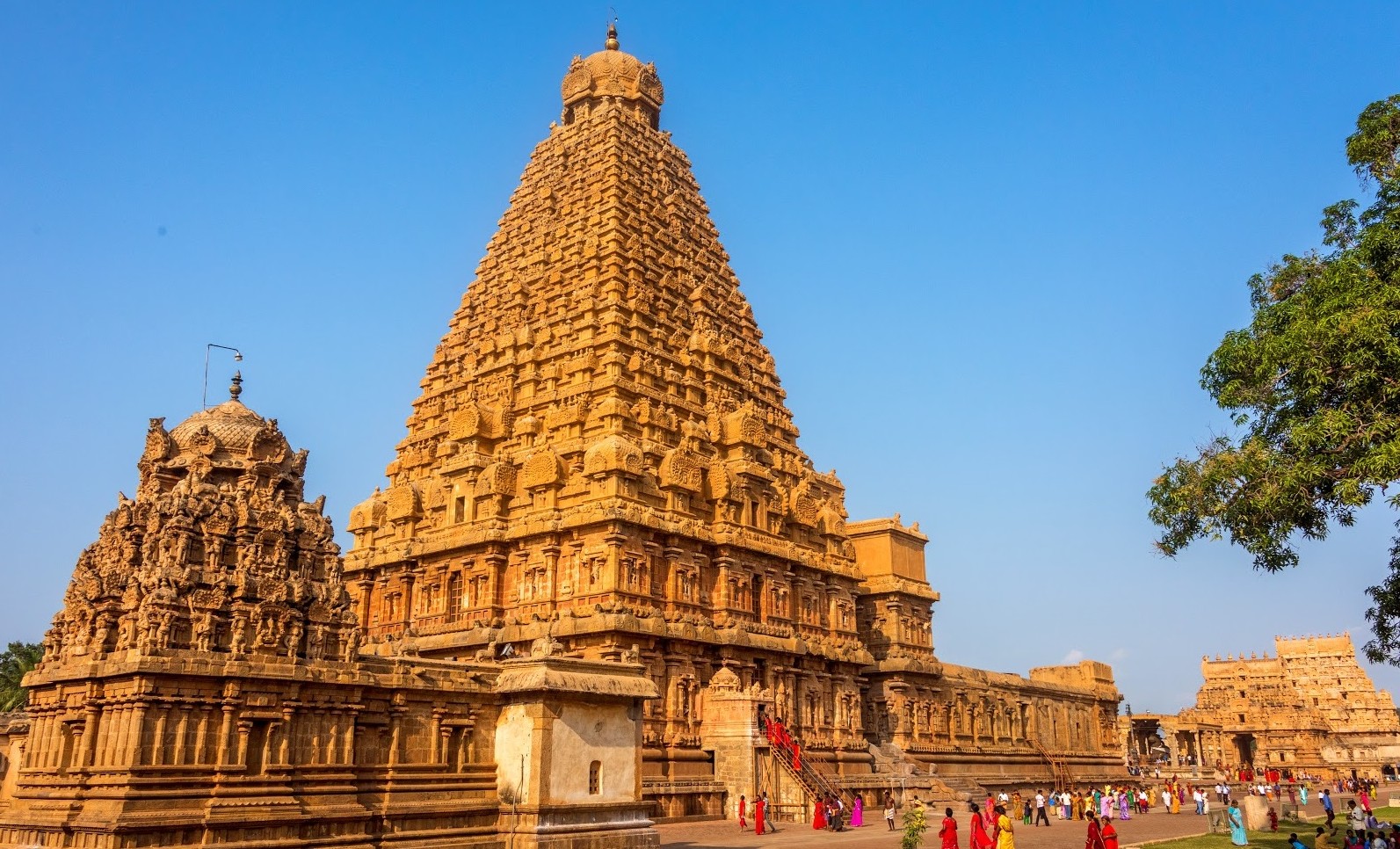
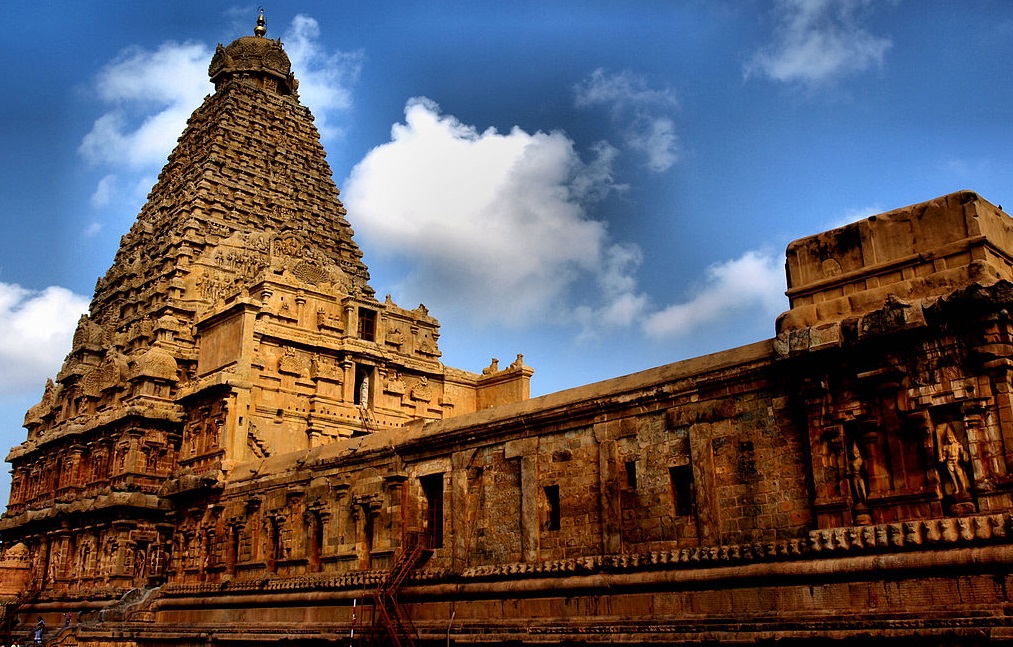
The shikhararemains the most outstanding element of the temple and the gateway is usually modest. The prakaras or the walls surrounding the garbhagriha or sanctum sanctorumwere built around the whole complex and were oriented to the cardinal directions. These enclosures had elaborate and magnificent gateways (gopurams) that led the devotees into the sacred courtyard.
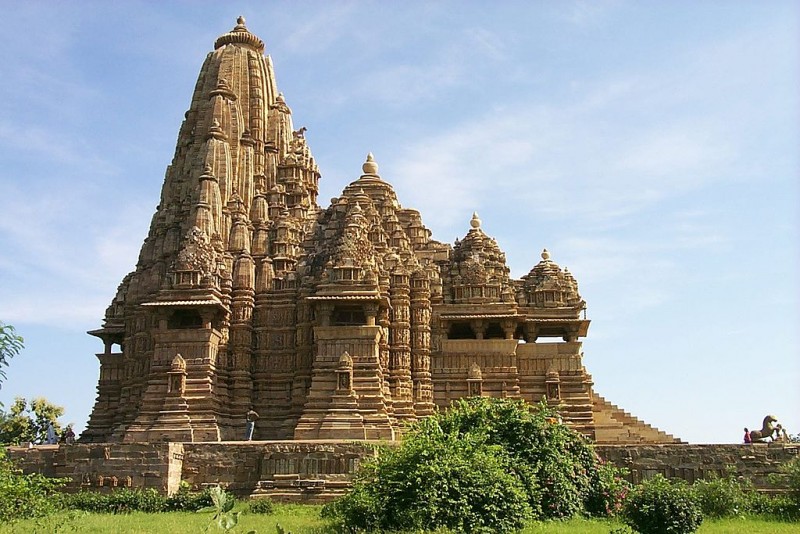
A temple is the seat of divinity and is also a sacred institution that aims at giving mental and physical solace to the devotee. The Garbhagriha or sanctum sanctorum encompasses the center or the nabhi of the superstructure. From the square shape of the Garbhagriha to the finial (which is a point) is the shikhara. This curved form is identified in modern times as the pyramid. The shikhara normally refers to the superstructure of the sanctum sanctorum and is the most important part of the temple. The pyramidal superstructure has a number of storeys. The shikhara can be a square, circular, hexagonal (6 sides) or octagonal (8 sides). The vertical growth of shikhara is also sometimes used to designate the whole superstructure of the temple.
The term shikhara is frequently mentioned at several places in the great epics Ramayana and Mahabharata when referring to the prasad or temple. While the shikhara generally refers to the curvilinear vertical growth of the sanctum sanctorum, the gopurams or gate towers refer to the gateways to the various enclosures and a temple. These are also pyramid shaped and the cross-section is reduced as they go up.
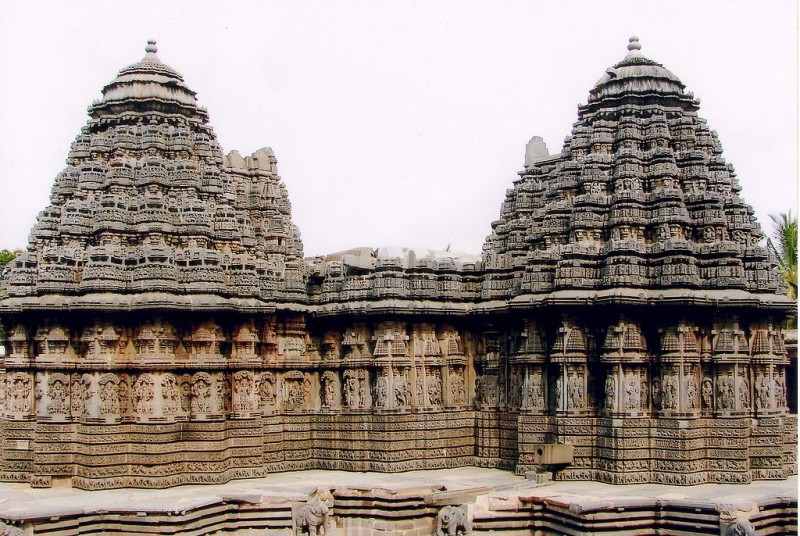
Vesara style of Keshava Temple, Somanathapura. Towers are in 16 pointed star plan.
Generally the pyramidal superstructure has four or eight triangles joined if the garbhagriha was square (or rectangular) and round shaped if the sanctum sanctorum was circular. The superstructure was solid or hollow. The shikhara generally comprises of three parts:
The recessed storeys
Enclosure surrounding each storey.
The dome (stupi or kalasa) rising above the last storey (also called
the Vimana or Harmya)
In certain temples the shikhara is formed by placing a flat roof on four pillars. Another slab is placed over the shikhara. Slab upon slab diminishing in size as they go up are placed one above the other, topped by a perforated ring stone, known as the amalaka, forming a step pyramid. The added weight of the slabs keeps the roof in position. Many a time an upper chamber for the shrine was introduced for greatly reducing mass and weight.
The surrounding walls around the sanctum sanctorum, which have gateways or gopurams, also have pyramid shaped roofs with diminishing tiers as they go up, with the outermost enclosure referred as mahamayada. The immediate enclosure around the garbhagriha, known as the Prasada towers above it like a pyramid with diminishing tiers and is also known as the shikhara.
The celestial power drawn through the shikharas gives the deity effulgence and metaphysical power. The shikhara apart from being a roof for the sanctum sanctorum is also a symbol of divine sanctity giving significant emphasis to the garbhagriha and the principal deity of the central divinity. The top of the shikharatapers to a finial and is known as the kalasa or stupika. One of the learned writers on Temple architecture says that the height of each storey of the pyramidal superstructure diminishes in arithmetical progression, being one-fourth or one-third less than the lower storey, the ground floor not being included.
On the left, the heterogenous Shikhara of the Kandariya Mahadeva Temple in Khajuraho
Pyramids
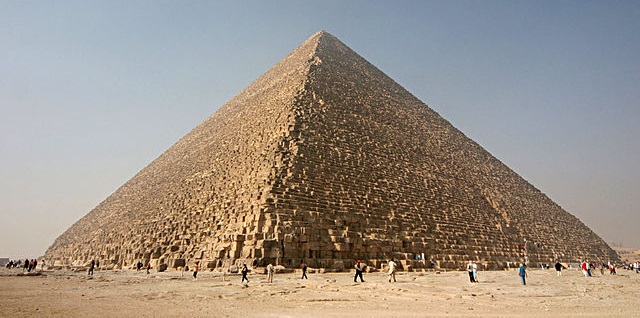
The term pyramid is derived from the Greek words pyra meaning fire, light, or visible, and the word midos meaning measures. It is also translated to mean fire at the center. This word perhaps denotes the great hidden power of these structures with a square base and four triangular sides that rise upwards to a finial.
Great Pyramid of Giza
Egypt is a land of pyramids and we have Egyptologists and pyramidologists doing research and throwing light on the antiquity and mystery surrounding them. Even though Egypt is synonymous with pyramids, we find them in other parts of the world such as China, Mexico, Spain, France, Siberia, Central America, Greece, Cambodia and other countries.
The pyramids of Egypt are traced to at least 4000 years back. The Giza pyramids of Egypt date back to about 2500 B.C. A remarkable feature of the Giza pyramids is that they are aligned with great precision to the cardinal directions.
In recent times these structures with four triangular sides standing over a square base have entered the domain of Vastu and are being prescribed for many of the imbalances of a building – residential or business.
Vastu texts consider the proper orientation to the cardinal directions as of great significance while referring to the Yoni aspect of the Ayadi Shadvargas (building formulae). Ayadi is a group of six formulae Aya, Vyaya, Yoni, Rksha, Vara and Tithi that are used to determine the dimensional conformance of a building.
There are many similarities between the Hindu shikharas and the Egyptian pyramids. We have referred to Step pyramids. In fact, they are similar to the shikharaswith the diminishing storeys that is considered in Vastu Shastra. While the shikharas drew the cosmic energies into the garbagriha to flood the sanctum sanctorum with divinity, the pyramids drew the cosmic energies to preserve the bodies of the Pharoah Kings who were considered divine. In the villages of India, we even find huts that have tops in the shape of pyramids. It is interesting to note that while pyramids are said to keep foodstuff fresh, the prasadams and other offerings in the garbhagriha or sanctum sanctorum of a temple also remain fresh for a long time.
Whether you call it a shikhara or pyramid, it is a fact that the shape of these structures influences the flow of energy from the universe and this energy helps in enhancing the overall quality of our life. The most important thing to recognize is that many of their architectural and construction features are similar to that used in Indian temples built thousands of years ago.
The Mysteries of Asia three-part video series was originally produced for The Learning Channel. During this segment, historians and others examine temples built in India more than 1,000 years ago. They remain quite intriguing, though today’s tourists rarely visit them. Records reveal that trained elephants had to drag millions of stone blocks to help erect these structures.
The program notes that due to the temples’ size, the U.S. Senate, Versailles, the Houses of Parliament, and St. Paul’s Basilica in Rome could all fit within a single one of them.
Michael Bell narrates as footage and animated maps are used to help viewers learn more about what these ancient structures look like and why they were built.
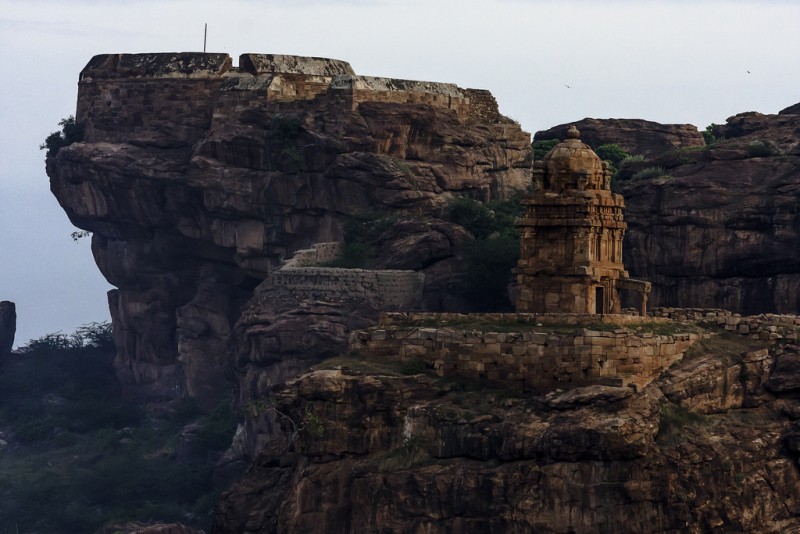
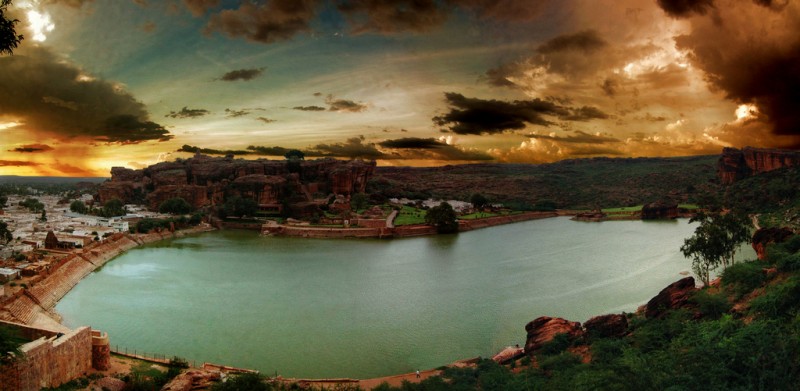
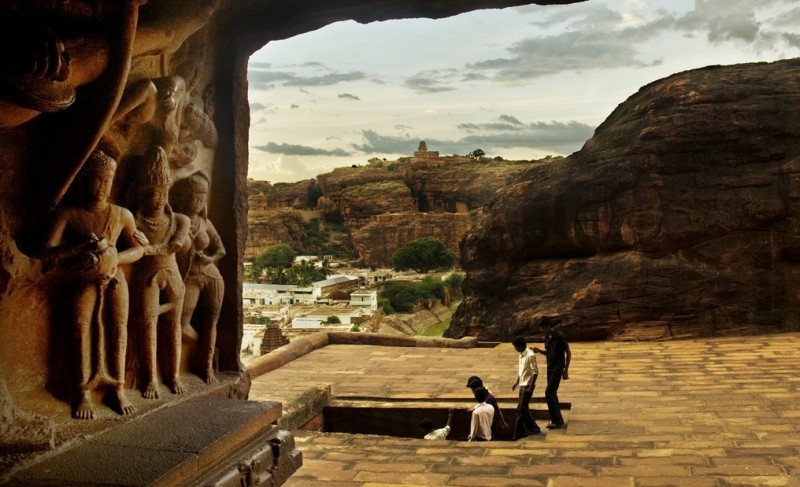
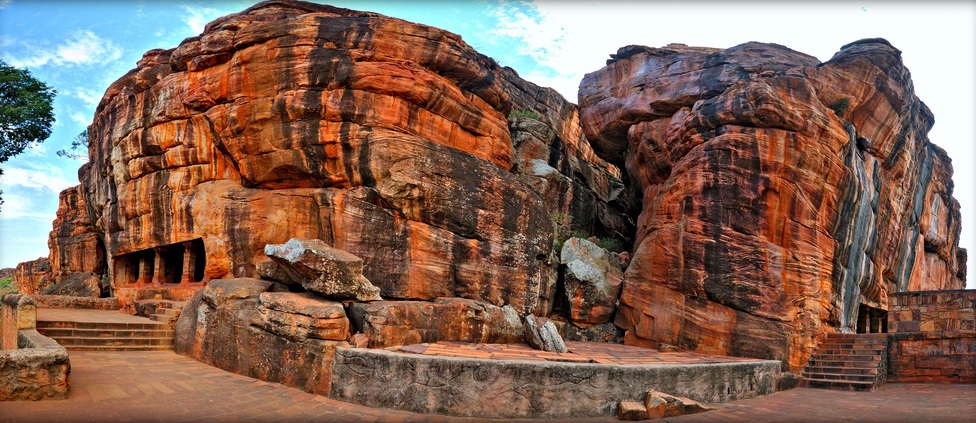
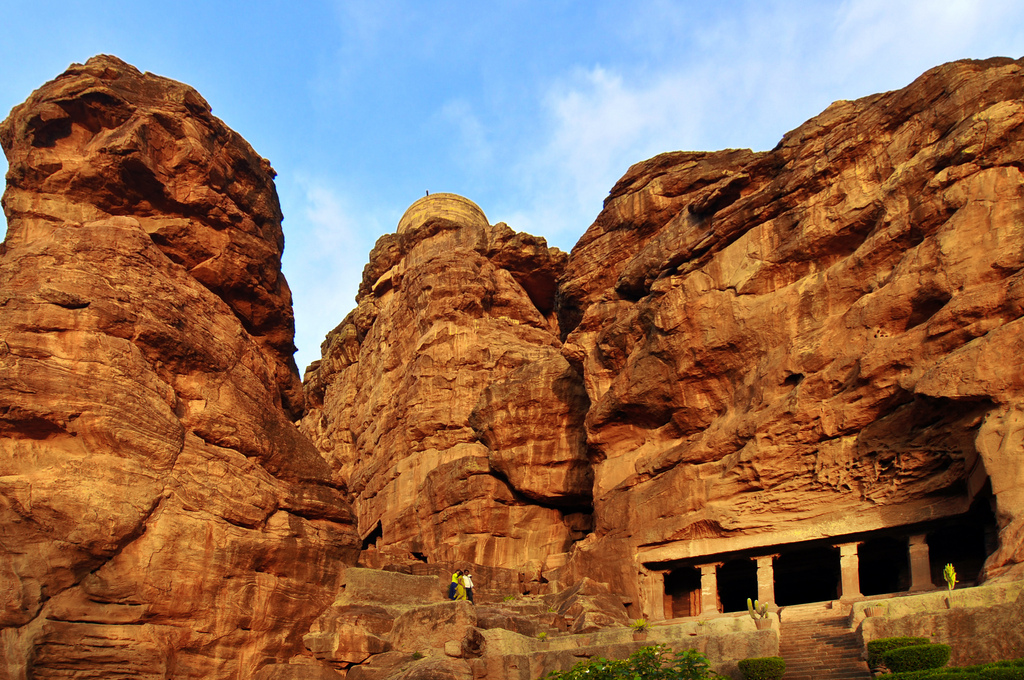
The town of Badami in India lies at the mouth of a ravine with rocky hills on either side. The cave temples are carved out of the soft sandstone of these hill cliffs.
Founded in 540 A.D. by Pulikesi I, Badami served as the capital of the Chalukyas. The Chalukyas ruled most of Karnataka, before the Rashtrakutas. These temples mark the emergence of the Chalukya style of temple architecture, which is a nice blend of the North Indian Nagara style and the South Indian Dravidian style.
The four cave temples of Badami were built by the son of Pulakesi I – Kirthivarman (ruled in 567 – 598 AD) and his brother Mangalesha I (ruled in 598 – 610 AD).
The town was later ruled by the Rashtrakutas, the Hoysalas, the kings of the Vijaynagar empire, the Marathas and was even under the regime of the Adil Shahi Dynasty but it still retains the stamp of the Chalukayas.
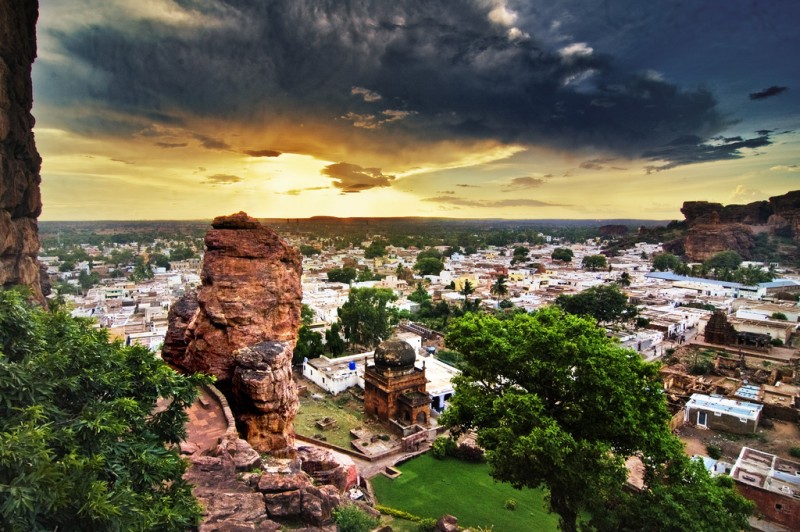
Temple atop the Badami caves.
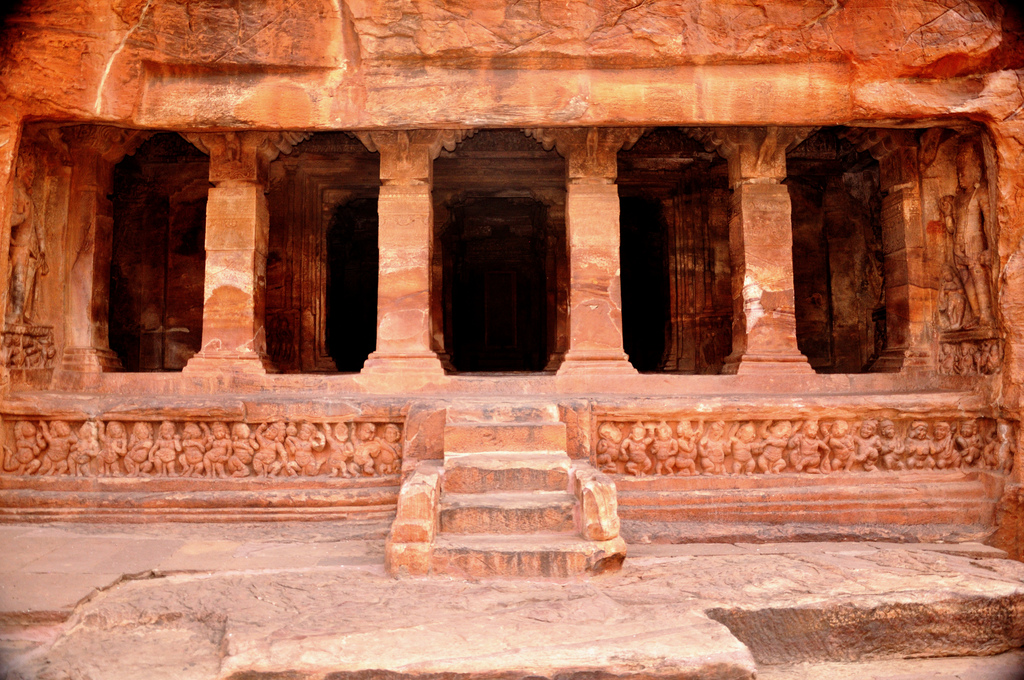
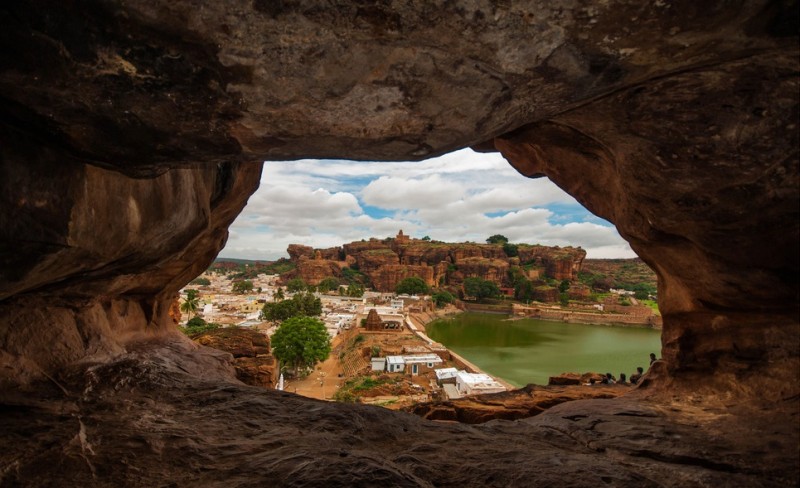
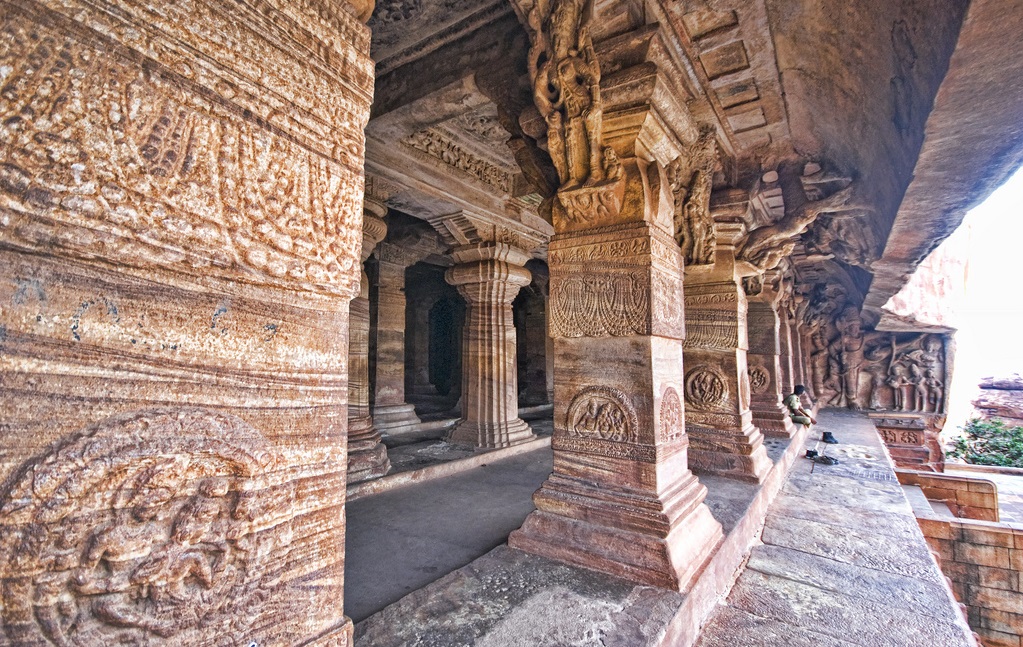
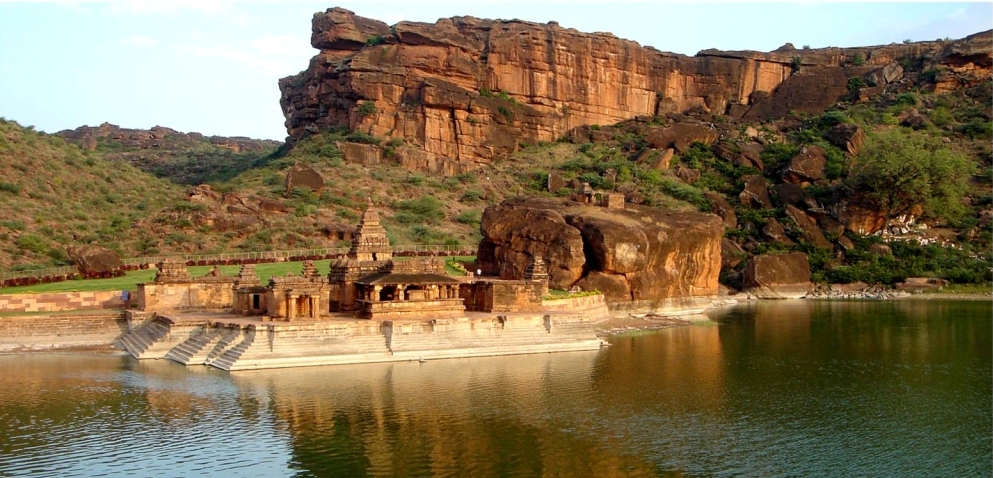
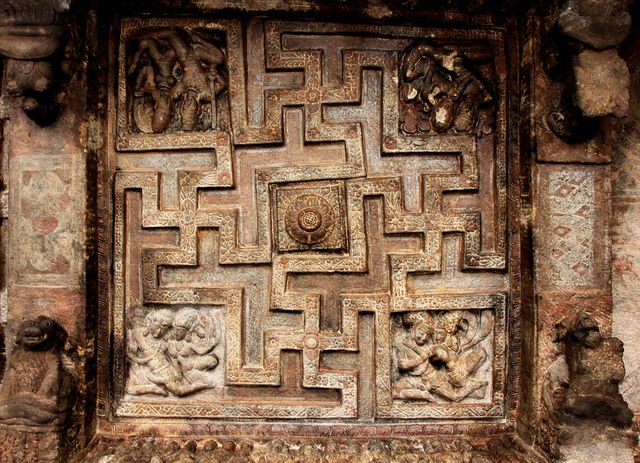
In totality, there are four cave temples in Badami – all carved out of sand stone on the precipice of a hill. They all share the same plan – a veranda with columns and brackets leading to a main hall, the pillared maha mandapa which in turn leads to the small sanctum which houses the sculpture. There are many beautiful murals as well. At the cutting edge, one can see a reservoir that makes a perfect foreground to these architectural structures.
The water flowing from the ravine in Badami is gathered in an ancient artificial lake – Agastya tirtha reservoir. High above the water there are towering cliffs of comparatively soft sandstone. Royal shrines were made in these cliffs with grand view opening over the former capital city.
Important feature of Badami Caves and their surroundings is ancient inscriptions in Kannada and Sanskrit languages. In total in Badami there have been found 18 cliff inscriptions. The oldest is from 543 AD.
Legend has it there were two demon siblings Vatapi and Ilvala, who had a trick by which they could kill and make a meal of mendicants passing by. Their tricks worked until Sage Agastya came by and counter-tricked them and brought an end to Vatapi’s life. Two of the hills in Badami are supposed to represent the demons Ilvalan and Vatapi.
It is believed that name Badami has come from colour of its stone (badam – Almond).
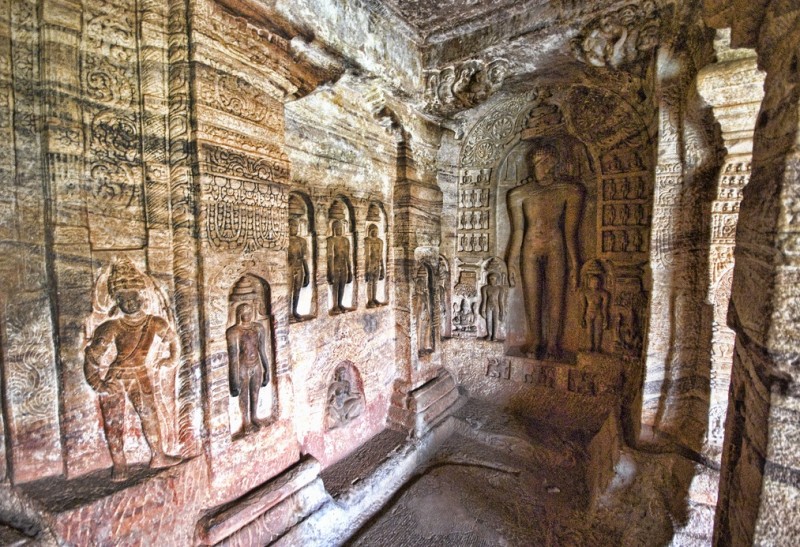
The four cave temples represent the secular nature of the rulers then, with tolerance and a religious following that inclines towards Hinduism, Buddhism and Jainism. Cave 1 is dedicated to Shiva, caves 2 and 3 to Vishnu, and cave 4 is a Jain temple.
The First Cave
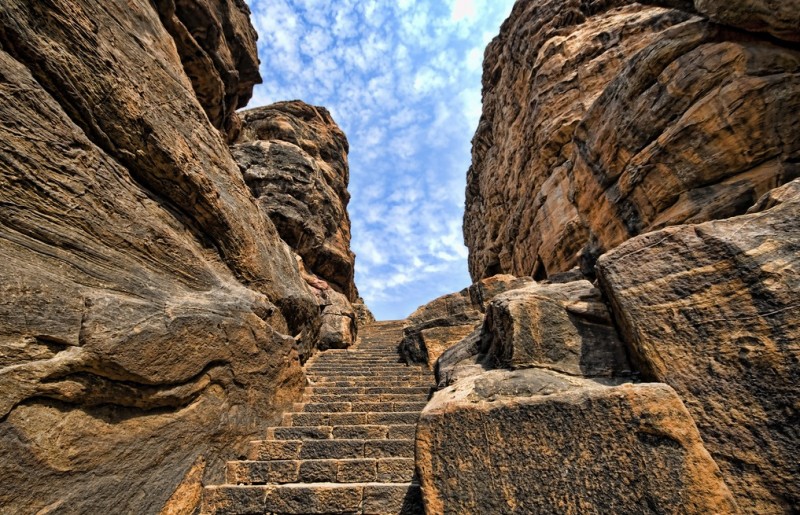
The first temple is dedicated to Lord Shiva. Entrance portal can be reached by 40 steps and contains four freestanding square columns and two semi-columns. Below the columns there is a frieze with ganas – attendants of Shiva.
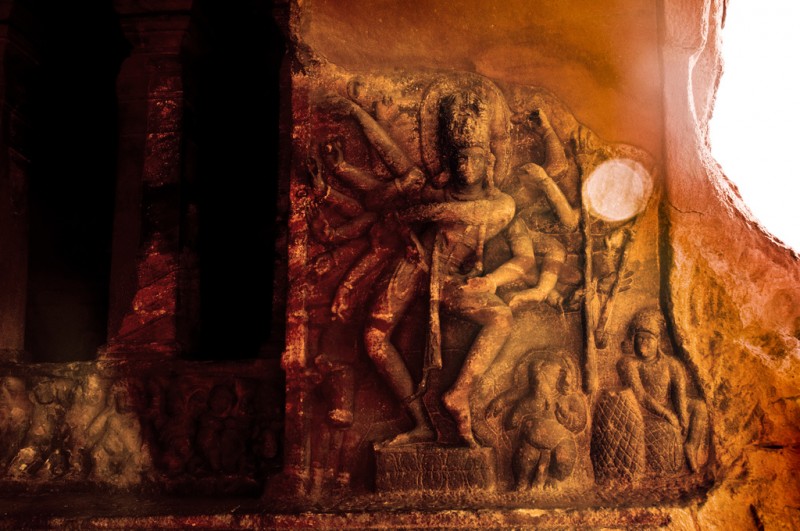
Built around 578 AD, this is believed to be the earliest of the four temples. This cave depicts Shiva in his dancing form – as Nataraja depicted with eighteen arms. There are no less than 81 different dancing poses of Nataraja depicted in this cave.
Shiva in his dancing form – as Nataraja
The first cave has gigantic carvings of Ardhanareeswara and Harira manifestations of Shiva in bas relief. It is made of red sandstone and has a hall with numerous pillars and a square shaped sanctum hollowed in the control back wall.
The Second Cave
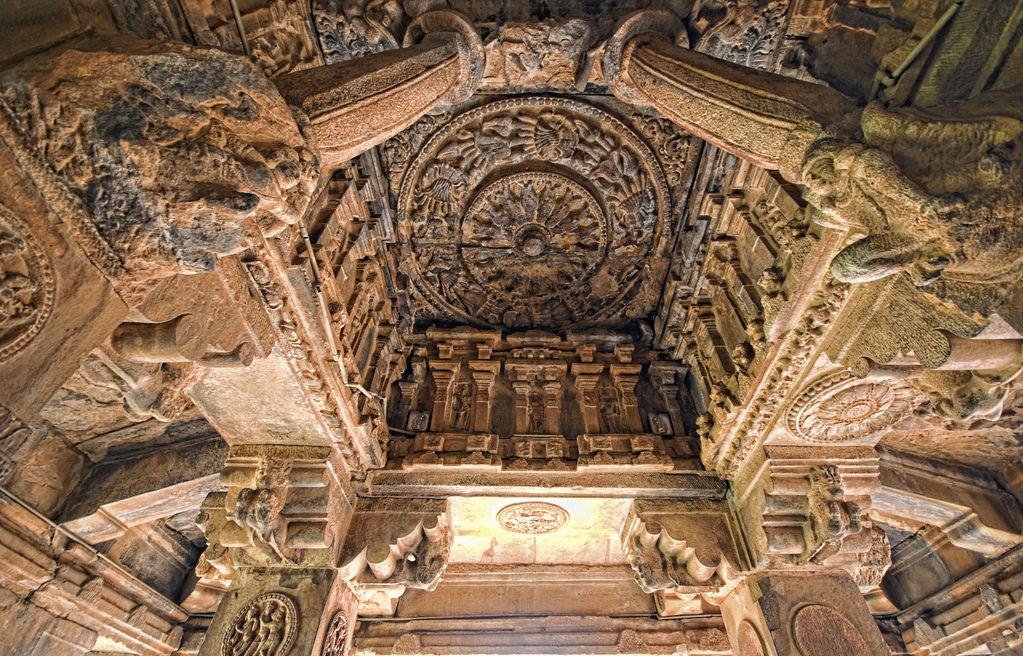
Created in the late 6th century AD and dedicated to Vishnu. Here he is depicted in the magnificent Trivikrama form, where he is measuring the earth with one foot, and the sky with the other, with a third food resting on the head of Mahabali. Vishnu in this temple is represented also as Varaha (boar) and Krishna avatars. On its ceiling, are carvings of Vishnu on Garuda and several other scenes from the puranas.
Cave is reached by climbing 64 steps from the first cave. Entrance is adorned with reliefs of guardians (dvarapalas) with smaller female attendants shown.
The Third Cave
The largest and most renowned cave temple in Badami most likely is created in 578 – 580 AD. It is a 100 feet deep cave, with inscriptions dating this Vishnu temple to 578 CE during, the period of Kiritivarma Chalukya.
Facade of the temple is approximately 21 m wide and is adorned with a row of six massive columns. Whole cave is covered with magnificent adornments, including paintings on ceiling. Centrepiece of these murals is four-armed Brahma on his swan. On the floor below the mural of Brahma there is a lotusmedallion – place where offerings were laid.
Art in cave 3 provides important information about the culture and clothing in this region in the 6th century.
This temple is also dedicated to Lord Vishnu. Here he is represented in various forms – as Vamana, the dwarf, as Trivikrama, an enormous entity measuring the world; as Narasimha, the man-lion; and as Varaha, lifting up Mother Earth from the sea. It also has a wonderful statue of Vishnu sitting on the serpent Adisesha. There are also murals depicting the divine marriage of Shiva and Parvati.
This is the only Jain temple in complex and the newest cave in complex, made in the late 6th century – 7th century AD. It is located higher than other caves. If compared to the three previous caves, this cave is less elaborate and smaller – but still beautiful and rich with adornment. It contains carving of the Tirthankara Parshavnatha with a serpent at his feet. Here is located also sculpture of Jain saint Mahavira in seated pose (often mistaken for Buddha) and standing Gomatesvara with creepers twisted around his legs.
Mahavir Jain Sculptures, Cave Temple 4, Badami
The Fifth Cave
There exists also the fifth cave in Badami. It is a natural cave of small dimensions with a Buddha statue carved inside. Area contains also many other temples.
A beautiful view of Badami town from Badami Cave 1
It is said that the better known caves of Elephantaand Ellorawere modelled on the ones in Badami. The Kailasa Temple at Ellora, has been hewn out of an entire hillock, cut out from the parent hill and combines the best of cave and free-standing temples.
There are more examples of rock-cut architecture in India than anywhere else in the world. The early architects removed any rock that wasn’t part of the structure they meant to leave behind in the excavated interior of the cave. Most Indian rock-cut architecture is religious in nature. The carvings are often ancient Indian deities. There are more than 1,500 rock-cut structures known in India.
View of the Badami town from the top of the red sandstone outcrop which houses the four famous caves.
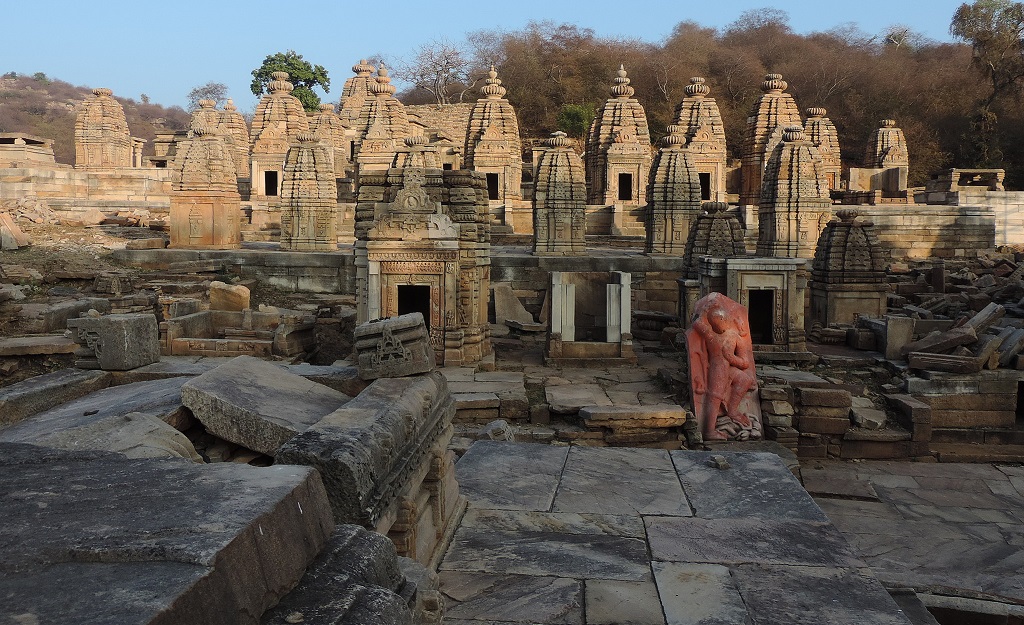
Bateshwar is not home to only a solitary temple but the temples here form a giant jigsaw puzzle with its pieces scattered over 10 acres of a hill slope.
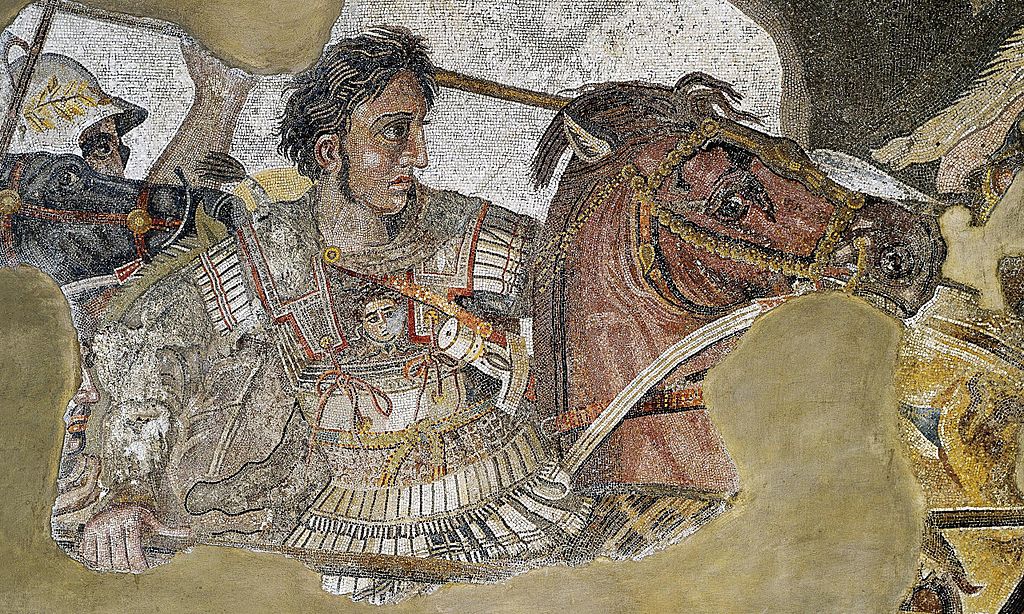
In 326 BCE a formidable European army invaded India. Led by Alexander of Macedon it comprised battle hardened Macedonian soldiers, Greek cavalry, Balkan fighters and Persians allies. The total number of fighting men numbered more than 41,000.
By continuing to use the site, you agree to the use of cookies. more information
The cookie settings on this website are set to "allow cookies" to give you the best browsing experience possible. If you continue to use this website without changing your cookie settings or you click "Accept" below then you are consenting to this.