
The Lost Palace of Amritsar

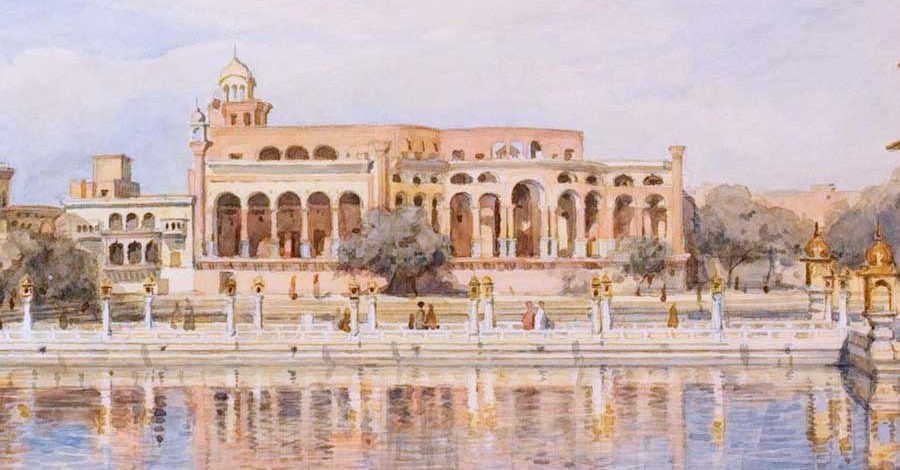
A palace so large that it dwarfed every other structure on the periphery of the holy tank at Golden temple had simply disappeared from the pages of history and memory.

With the end of the Sikh Empire and its annexation by the British in 1849, European artist and then photographers started appearing in Punjab and visiting Golden Temple at Amritsar. The 1850’s would see the very first photographs of Golden Temple by Felice Beato and the popular paintings by artist William Carpenter.

These early images of Golden Temple and early traveller’s accounts, all revealed the remarkable story of the a majestic palace which once glimmered in the waters of the holy tank at Amritsar.
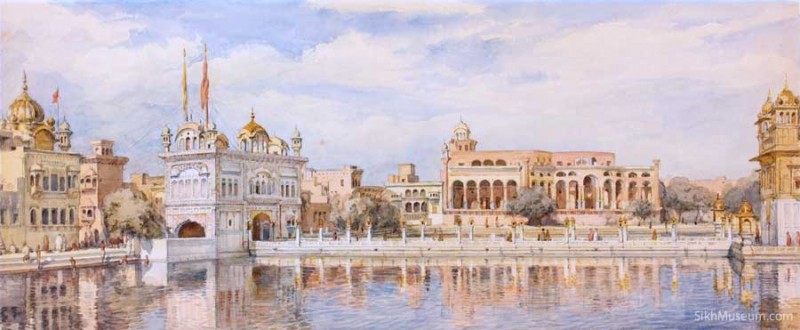
The Lost Palace, Golden Temple
The Lost Palace. Img Source

When was the lost palace built and who did it belong too?

A number of historians and authors have attributed the lost palace to various figures in Sikh history, there does not seem to be any agreement among them or conclusive proof.
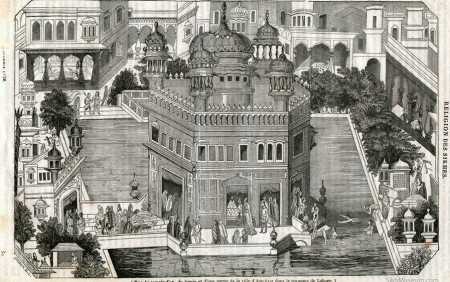
Woodcut engraving, One of the earliest European depictions of the Darbar Sahib complex. The image does not show the lost palace.
Woodcut engraving, One of the earliest European depictions of the Golden Temple complex. The image does not show the lost palace. –Img Source

Evidence from the French engraving of the Darbar Sahib Complex printed in 1836 indicates that the palace did not yet exist in the early 1830’s. The palace would have had to have been constructed in the time frame between the late 1830’s and before the 1841 visit of artist August Schoefft who depicted it in his epic painting of Maharaja Ranjit Singh at Golden Temple.

Being the largest palace on the parkarma surrounding the holy tank, it would be logical to assume that it must have belonged to Maharaja Ranjit Singh. The Maharaja was known to move about from place to place in his vast empire and had numerous residences. Maharaja Sher Singh, the son of Maharaja Ranjit Singh was known to stay in the palace.

From its origins in the last years of Maharaja Ranjit Singh rule to the end of the Sikh Empire, the lost palace continued to serve its intended purpose as a palatial residence. Its occupants would have had a spectacular view of the Golden Temple and the holy tank.
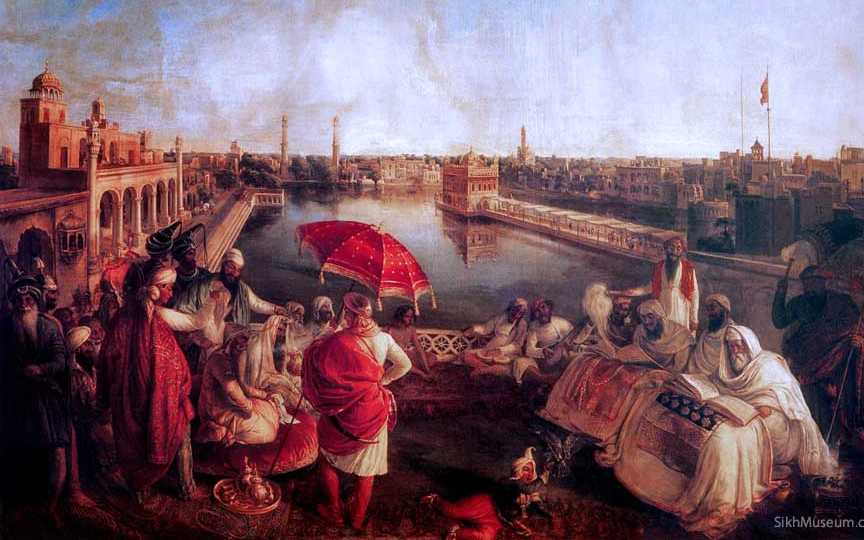
Maharaja Ranjit Singh listening to the Granth being recited near the Golden Temple, Amritsar. The lost palace dominates the background appearing on the left side of the painting.
Maharaja Ranjit Singh listening to the Granth being recited near the Golden Temple, Amritsar. The lost palace dominates the background appearing on the left side of the painting. Img Source

With the rise of Maharaja Ranjit Singhs empire and its prosperity, at their height there were over 84 palaces around the holy tank. Some of these palaces (bungas) were used as centers of religious teaching and education while most served as the residences of some of the powerful and influential families of Punjab.

Over time eventually almost all of the bungas have disappeared, being replaced by new structures; today the only two remaining bungas are the Akal Takht (Akal Bunga) and the twin towers of the Ramgharia Bunga.

Demolition of the palace by British authorities

The loss of influence over Amritsar with British rule also meant that Sikhs lost control over the use of the lost palace and it was occupied by the Christian missionaries of the Amritsar Mission School. The British then converted the building into a prison, a court room, and police station.

The prison remained for many years until the lost palace was demolished by British authorities to make way for gothic style clock tower in its place to dominate over Golden Temple and the Amritsar skyline.
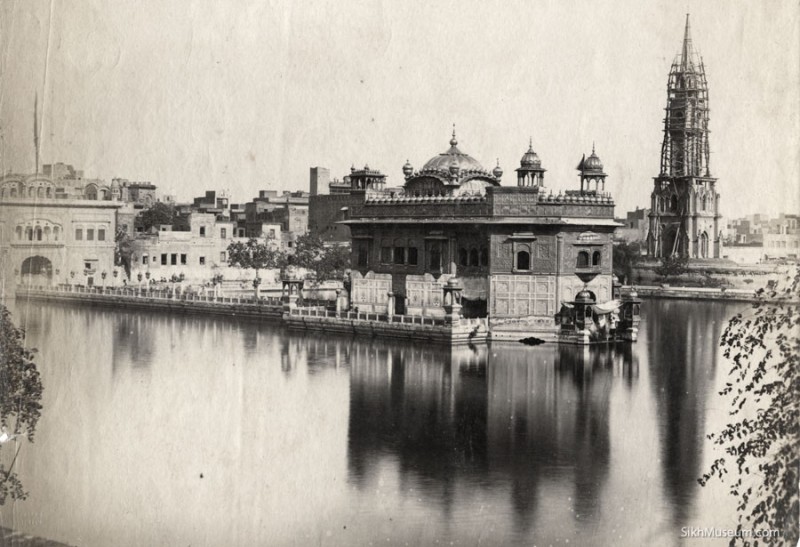
Darbar Sahib with Clock Tower under construction
Golden Temple with Clock Tower under construction. Img Source

Although a clock tower traditionally has a small base, it was decided that the lost palace and all other buildings in the area would be demolished during construction to create a large open courtyard around the new clock tower.

The new clock tower was designed entirely in the traditional European gothic style with red bricks and there have been some suggestions that the clock tower was built by the British as a church.

The British had no regard for the Sikh faith, their mission was to cut the roots of the faith and to convert Sikhs into Christianity.

Source

Sikh Museum

5 Accurate Predictions Of Kali Yuga

In the final section of the Bhagavata Purana, there were several predictions made regarding the dark age of human life with refers to the present day Kali Yuga. In this post, we will look into the 5 predictions that we ourselves witness in our daily life. Written more than 5000 years ago, these predictions serve as tools that increase the credibility of all our spiritual texts penned down by ancient saints.

Srimad Bhagavatam 12.2.1

sri-suka uvaca
tatas canu-dinam dharmah
satyam saucam ksama daya
kalena balina rajan
nanksyaty ayur balam smrtih

Meaning: Religion, truthfulness, cleanliness, tolerance, mercy, duration of human life, physical strength and memory will all diminish substantially because of the powerful influence of the age of Kali.

Srimad Bhagavatam 12.2.6

dūre vāry-ayanaḿ tīrthaḿ
lāvaṇyaḿ keśa-dhāraṇam
udaraḿ-bharatā svārthaḥ
satyatve dhārṣṭyam eva hi
dākṣyaḿ kuṭumba-bharaṇaḿ
yaśo ‘rthe dharma-sevanam

Meaning: A holy place will be viewed to consist of no more than a reservoir of water located at a far off place, and beauty will be determined based on one’s hairstyle. Filling the belly will become the primary goal of life, and one who is audacious and rebellious will be accepted as truthful. He who can maintain a family will be regarded as an expert man, and the principles of religion will be observed only for the sake of reputation.

Srimad Bhagavatam 12.2.7

evaḿ prajābhir duṣṭābhir
ākīrṇe kṣiti-maṇḍale
brahma-viṭ-kṣatra-śūdrāṇāḿ
yo balī bhavitā nṛpaḥ

Meaning: The earth will become crowded with a corrupt population, and among their social classes he who is considered to be the strongest will gain political power.

Srimad Bhagavatam 12.2.5

anāḍhyataivāsādhutve
sādhutve dambha eva tu
svīkāra eva codvāhe
snānam eva prasādhanam

Meaning: A person is considered unsuccessful and unholy if he does not have money, and the society will accept hypocrisy as a virtue. Marriage will be arranged simply by a verbal agreement, and a person will think he is fit to appear in public if he merely takes a bath.

Srimad Bhagavatam 12.3.42

na rakshishyanti manujah
sthavirau pitarav api

Meaning: Men will stop taking care of their elderly parents

https://www.youtube.com/watch?v=jDmSBtRX2Bs

Islamic India – The biggest holocaust in World History

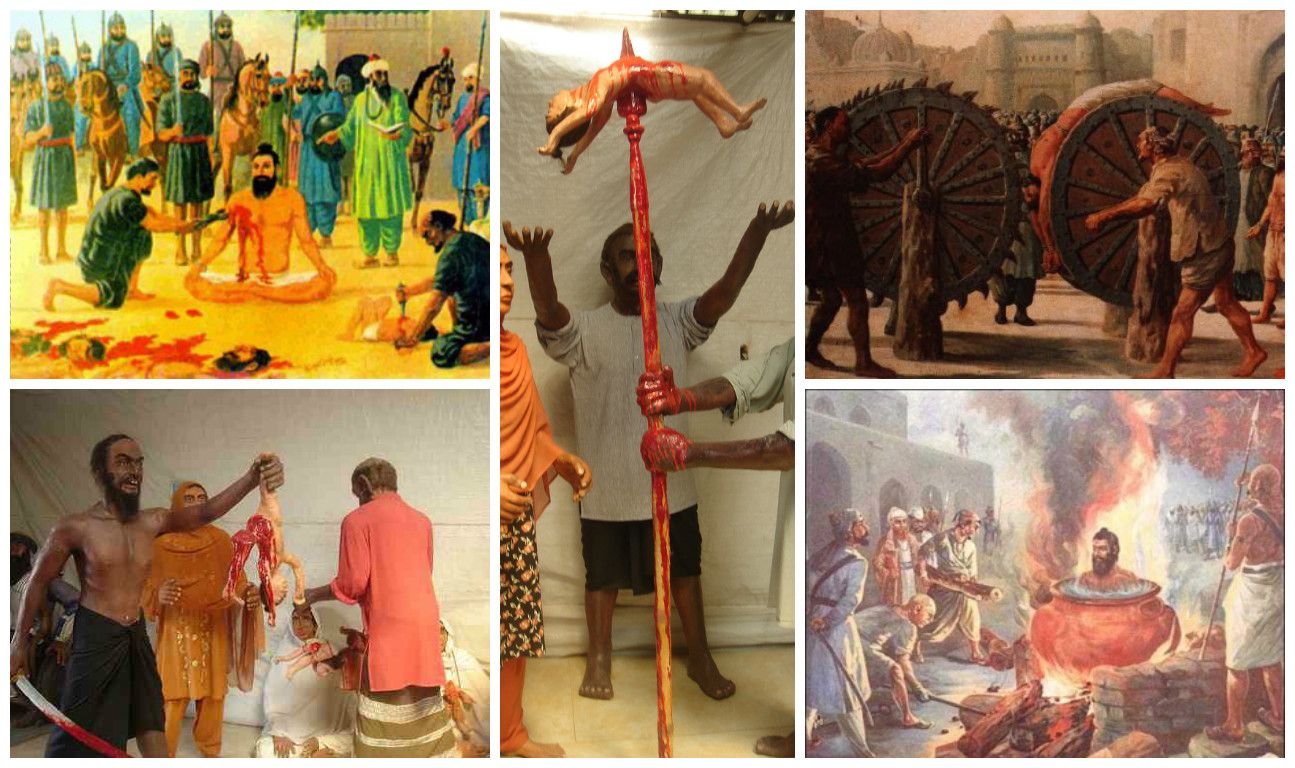
The genocide suffered by the Hindus of India at the hands of Arab, Turkish, Mughal and Afghan occupying forces for a period of 800 years is as yet formally unrecognised by the World.

With the invasion of India by Mahmud Ghazni about 1000 A.D., began the Muslim invasions into the Indian subcontinent and they lasted for several centuries. Nadir Shah made a mountain of the skulls of the Hindus he killed in Delhi alone. Babur raised towers of Hindu skulls at Khanua when he defeated Rana Sanga in 1527 and later he repeated the same horrors after capturing the fort of Chanderi. Akbar ordered a general massacre of 30000 Rajputs after he captured Chithorgarh in 1568. The Bahamani Sultans had an annual agenda of killing a minimum of 100000 Hindus every year. 

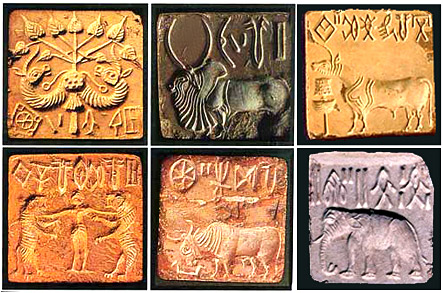
Computing a Rosetta Stone for the Indus script

How would you solve the world’s oldest and most difficult crossword puzzle? Watch this video to learn how one man is approaching this challenge.

Do you love a good mystery and ancient texts? Rajesh Rao sure does. He has devoted much of his professional life to cracking “the mother of all crossword puzzles”: How to decipher the 4000 year old Indus script?

To do this, Dr Rao uses computational modeling to understand the human mind in two ways: first, he develops computer models to describe how human minds think, and then second, he applies these models to the task of deciphering the 4,000-year-old script of the Indus valley civilization. This interesting video provides a glimpse into his methods and logic.

6th-century Ramayana discovered in Kolkata library, stuns scholars

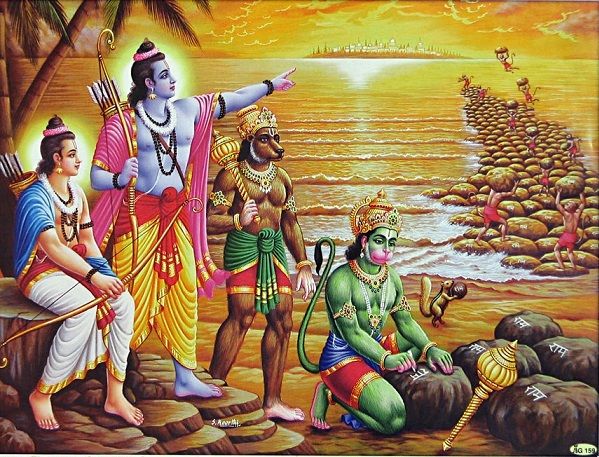
Scholars at the Asiatic Society Kolkata were elated when they stumbled upon a brand new manuscript of Ramayana hidden away in a little known Sanskrit Library in Kolkata. This manuscript, which is from the 6th century, will likely displace the 12th-century rendition by Tamil poet Kamba as the second-oldest version. The widely known 4 BC Ramayana by Valmiki is still the oldest known version.

This version of Ramayana shows both Ram and Sita more as humans and largely deals with their separation.

Scholars discovered the 6th-century Ramayana while they were working on the Vanhi Purana. They began searching for missing manuscript after realising that the Vanhi Purana at the Asiatic Society library was incomplete.

Upon further research, they realised two more manuscripts existed – one at the India Office Library in London and the other at the Samskrita Sahitya Parishad, a 100-year-old research institution.

The scholars scoured the archives and found the complete version of the Vanhi Purana manuscript. When they were analyzing it, they stumbled upon the Dasa Griba Rakshash Charitram Vadha, which did not have any bearing with the Vanhi Purana. Upon analysis, they found that it was a 6th-century version of Ramayana with many interpolations.

The Scholars while analysing the text in the new manuscript noticed some blaring twists in the story line, albiet the main character Rama, Sita and Ravana are the same. The manuscript portrays Rama and Sita  more as humans and focuses more on the separation of the two, reports the Times of India. 

This version does not start with curse that forced Dasarth to send his son to exile, instead, it begins with a curse that fell on Goddess Lakshmi. It excludes the Balkanda the portion focused on  Rama’s childhood and Uttrakanda. The new manuscript ends with Rama’s return from exile and his ascension to the throne.

“Interestingly in this version, there are just five kandas (sections) instead of the accepted seven. There is no Balakanda – the part that deals with Rama’s childhood – or Uttarkanda. This Ramayana ends with the return of Rama and Sita from exile and his ascension to the Ayodhya throne,” said Anasuya Bhowmick, lead scholar of the Asiatic Society, who is working with the manuscript. This Ramayana does not begin with the curse that drove Dasarath to send his son to exile.

The scholars will take nearly a year to complete reading and interpreting this new version of the Ramayana and later the Asiatic Society plans to publish it as a book.

“Ram here is more human than God, with follies like anger and failure. Some interesting details – like the ages of Sita and Rama at the time of marriage and the date when Sita was abducted by Ravana -are in this version,” said scholar Manabendu Bandyopadhyay.

The Science Behind OM Mantra

Om is a mantra, or vibration, that is traditionally chanted during any Hindu Ritual. Originated from the Hindu scriptures, the mantra is considered to have high spiritual and creative power but despite this, it is a mantra that can be recited by anyone. It’s both a sound and a symbol rich in meaning and depth and when pronounced correctly it is actually AUM.

The syllable is also referred to as omkara (ओंकार, oṃkāra), aumkara (औंकार, auṃkāra), and pranava (प्रणव, praṇava).

One of the most popular misconception about “OM” is that it is religious. On the contrary, it is the most universal syllable because it neither refers to any particular religion nor God. The ancient Indians arrived at this tone through meditation, it was given to them intuitively and contemplatively by “opening up to the cosmos”.

It is in all the religions in some or the other form. OM has been lifted by other religions as AMEN, SHALOM, OMKAR etc. It is the origin of the universe. There is a beautiful verse in the Guru Granth Sahib, which begins with ‘Ek Omkar Sat Naam, Karta Purakh’ – From Om everything has come, in Om everything dwells, and into Om everything will dissolve; both matter and consciousness.

Why do we chant it?

As with most of the traditional practices followed in India, this also has a scientific and practical explanation (based on the physics of sound, vibrations & resonance) with some long term benefit.

The frequency of Om is exactly the same as the frequency of earth’s rotation around its own axis. So, in some sense, earth is saying Om. 

OM is considered to be the sound of the universe. It is the frequency of energy that connects and joins all things together and it is believed that by chanting the mantra, we are physically and spiritually in sync with the various elements of nature and the universe.

Om is the eternal sound; Om is the sound which is there in the universe all the time.

One can reap positive benefits by chanting the mantra. For example, by chanting “aaaaaaa”, one can feel the sensation and hence resonance of nervous system in the stomach and chest region. Chanting “ooooo” creates sensations in throat & chest region and resonates with them. Similarly, chanting/humming “mmmm” resonates with the nasal cavity as well as skull/brain region.

What happens when we concatenate (join together) the above syllables into one mantra? We get the OM mantra which when chanted sequentially activates the stomach, spinal cord, throat, nasal and brain regions. While chanting the OM, the body’s nervous system slows down and creates a calming effect on the mind which is also caused by meditation. By doing so, the condition of the heart improves as a direct result of a relaxed mind and decreasing blood pressure.

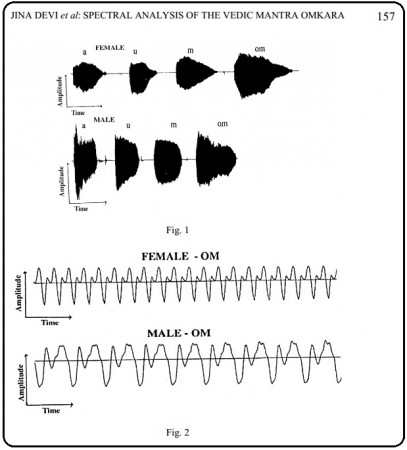
OM Waveforms
An excerpt from a research paper which shows the waveform of A-U-M mantra made up of 3 syllables.

One of the most popular claims made by Yogis is that chanting Om mantra improves our concentration, gives peace and steadiness to our mind, reduces mental stress and clears all worldly thoughts. Although those who practice it regularly would have experienced it first hand and affirm the same, scientists were curious to find out more about it and verify such claims with the help of science & technology.

Few years ago, scientists conducted an experiment in which participants who had never chanted Om mantra were asked to chant it for few minutes and each of their chants were recorded. The time frequency analysis of it showed irregular waveform which indicated unsteadiness in the mind. They were asked to chant the mantra on a regular basis and after few days, the experiment was repeated. The time-frequency analysis this time had some startling revelations. The waveforms were improved with regular spacing, had almost perfect symmetry and harmony. Not only had these participants witnessed dramatic improvements in focus, concentration & steadiness, but found themselves to be in peace, witnessed reduction in mental stress & could remain calm all the time.

Om has many variations. In a study published in the International Journal of Computer Science and Network Security, the researchers explain: “It may be very fast, several cycles per second. Or it may be slower, several seconds for each cycling of [the] Om mantra. Or it might become extremely slow, with the mmmmmm sound continuing in the mind for much longer periods but still pulsing at that slow rate. It is somewhat like one of these vibrations:

‘OMmmOMmmOMmm…

‘OMmmmmOMmmmmOMmmmm…

‘OMmmmmmmmOMmmmmmmmOMmm’.”

Spirtuality

The important technical fact is that no matter what form of Om one chants at whatever speed, there is always a basic Omness to it.

Only one who has meditated to this tone may have an idea, how deep the relaxing effect of this vibration is and how it calms the soul when one attunes oneself regularly to it.

“If you want to find the secrets of the universe, think in terms of energy, frequency and vibration” – Nikola Tesla

Source: GuruPrasad.com | Huffinton Post | The Gaurdian | IshtaDevanta