
Bhadwa Mata- the Goddess who cures

Bhadwa Mata- the Goddess who cures

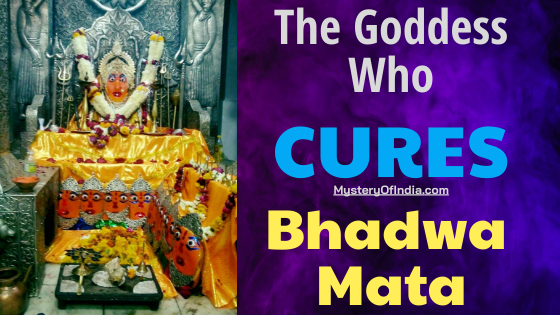
During the night, Mother Goddess Shakti, who is praised and worshipped at the Bhadwa Mata Temple near Neemuch, looms around the hill, and it also looks lovely from the look of it. Everyone was mesmerized out of her sanctum sanctorum, the faith in goddesses. She goes for a walk around the temple. If her gaze falls on a devotee, the devotee will be healed of all ailments. Bhadwa Mata Temple is located in Bhadwa Village, Madhya Pradesh, about 18 kilometers east of Neemuch. Another destination for visitors is a holy site well-known throughout the state. For the locals, this temple holds great religious significance. You may encounter large crowds on weekends or religious holidays, so plan your journey accordingly. To go to the temple, you must travel 19 kilometers from town. Locals strongly believe in Bhadwa Mata, believing that bathing in a well near the temple can cure them of paralysis and Polio. The main celebration of this temple is Navaratri when priests dress Mata Idol in magnificent clothing and jewels.

Bhadwa Mata Temple History

The temple’s beginnings are unknown in antiquity. The shrine was built in its current shape during the 10th and 11th centuries AD, during the reign of the Parmar monarchs. Additions and deletions were made during the 7th, 14th, and 15th centuries. The shrine fell under the authority of Gwalior emperors in the 17th century. Bhils have been doing puja here since the 7th century. During the 15th century, the current murti of the Goddess adored in the temple was placed. The current temple tower was built in portions throughout the 14th century.

Story of Bhadwa Mata Temple

The original murti of Bhadwa Mata venerated in the temple is Ashtabhuja Mahasaraswati — Goddess Saraswati with eight arms. Later, this figure experienced a transformation, and she is now known as Goddess Bhagavati. The Mother Goddess has come here to heal her worshippers of different ailments. Mother Goddess Shakti, in this form, is kind and compassionate. The temple pond is related to the temple’s tale here. Mother Goddess has arrived here, together with the pond, to aid worshippers suffering from different incurable diseases such as smallpox and leprosy.

Bhadwa Mata Murti

The Bhadwa Mata murti is swayambhu, which means it appeared spontaneously. A gigantic crown adorns her head. The murti’s large eyes are its most noticeable feature. Murtis of nine Mother Goddesses, Brahmi, Maheshwari, Kaumari, Vaishnavi, Varahi, Narsimhi, Indrani, Shivdatti, and Chamunda, may be found in the sanctum sanctorum, at the base of the main murti of Bhadwa Mata. Ganesha, Shiva-Parvati, and Vishnu are the temple’s secondary deities venerated under the Sheshnag canopy.

Miracle Pond – Bhadwa Mata Mandir Baawdi

Bhadwa Mata Mandir ki Baawdi is a miraculous pond in the temple complex. The water from the pond, according to common belief, heals a variety of ailments, particularly skin disorders. Thousands of followers have reported that taking a dip in the pond’s water has entirely healed their illnesses. The temple is also known as Arogya Teerth because of its miraculous pond. The holy pond is positioned on the temple’s left side. Devotees use water to take spiritual baths. The most crucial day in the temple is Sunday. Pilgrims come from Madhya Pradesh, Chhattisgarh, Gujarat, Maharashtra, and Rajasthan to visit the shrine. The temple celebrates the Chaitra Navratri (March – April) and Ashwin Navratri (September – October) festivals. During these times, a nine-day fair is held.

Significance of Bhadwa Mata

Brahmi, Maheswari, Kaumari, Vaishnavi, Varahi, Narsinhi, Laundry, Shivdatti, and Chamunda are the nine Nabhdurga idols that surround the Bhadwamata statue. The Bhadwa Mata Temple is one of India’s most significant Shakti temples. Bhadwa Mata Temple worshippers receive ultimate peace of mind and spiritual strength after visiting this temple. Aarogya Theerth is the name given to the holy water Baawdi located within the temple grounds. This holy water is well-known since bathing in it is said to be a magical cure for a variety of skin ailments. This temple has a lot of religious value. Thus it gets a lot of visitors on weekends and religious festivals. Locals strongly believe in Bhadva Mata, believing that bathing in the temple’s well may heal paralyzing diseases like Polio. The main celebration of this temple is Navaratri, during which priests dress Mata Idol in gorgeous clothing and jewels.

Conclusion

Like the origins of most heavenly figures, Kali’s beginnings are believed to originate with tribal tradition firmly anchored in human history. The Atharva Veda, a compilation of hymns and mantras produced between 1200 and 1000 BCE, is where Kl first occurs. She is, however, not a deity but a ferocious black tongue, one of seven belonging to Agni, the god of fire. Kali does not debut as a person for another 450 years when the deity appears in the Devimahatmya approximately 650 CE as a warrior goddess personifying Durga’s anger. Her image at the moment is dreadful: a skeleton and terrifying crone dressed in animal hides and wielding a khatvanga, a skull-topped rod associated with tribal shamans.
Shrinathji Temple, Nathdwara – Lord Krishn’s Chosen Spot

Rajasthan is one of those states in India that owns the pride of being the most visited destination by domestic as well as international tourists. But apart from the beautiful spots, the state is also known for its traditional values and regional sentiments. One such location that surely reflects the religious cultures of the region is Nathdwara.

Where is Nathdwara Temple and How to Reach There?

Nathdwara temple is located in the city of Nathdwara in the Rajsamand district. This scenic city is situated on the banks of the Banas River and is surrounded by the Aravalli hills. 

While this place is open throughout the year but the best option is to skip the summer season to avoid the scorching heat and sun. 

In order to reach this place, the best route is via Udaipur. Tourists from different parts of the country or even outside the country can land at the City of Lakes, Udaipur, and then can have a road trip to cover 45 km to reach Nathdwara. 

Nathdwara Temple Rituals:

The specialty of Nathdwara Temple is that there are 8 different darshans of Shrinathji Maharaj at different times of the day.

Following are the tentative darshan timings of Shrinathji in the temple:

Mangla Darshan – 5:45 am to 6:30 am

Shringar  – 7:15 am to 7:45 am

Gwal Darshan – 9:15 am to 9:30 am

Rajbhog  – 11:15 am to 12 noon

Utthapan  – 3:45 pm to 4 pm

Bhog – 4:45 pm to 5 pm

Aarti –  5:15 pm to 6 pm

Shayan – 6:15 pm to 7:15 pm


The timings of all the darshans are subject to changes as per the management of the temple. 

The special thing about all these darshans is that the idol of Shrinathji is dressed up differently for all the darshans. If you wish to experience the religious atmosphere of the temple at its best, you should visit at night after the Shayan Darshan to enjoy bhajans and keerthans that are organized within the temple. 


The temple management is quite strict with security and thus they do not allow a number of things in the temple such as mobile phones and cameras.

The Ancient Story of Shrinathji Maharaj

The locals of Nathdwara often narrate a very interesting story about how Shrinathji Maharaj became an inseparable part of this city. They mention that Shrinathji evolved from a small stone of the Govardhan hills when Lord Krishna held up the hill on his smallest finger in order to safeguard his villagers from the torment of Indra. Soon a temple was raised by the devotees in Mathura for the worship of Shrinathji. 

7th Century was the time when Aurangazeb was in his highest rage to destroy all the Hindu temples and idols in India. When he heard about the popularity of Shrinathji Maharaj, he sent his army to Mathura to destroy this temple also in the year 1672. 

But the then purohit of the temple, Damodar Gosai took the initiative to carry the idol of Shrinathji on a horse cart and headed towards Mewar, considering it a safe place. The king of Mewar, Maharana Raj Singh not only welcomed Shrinathji with great respect but also promised Damodar Gosai that the entire Rajput clan of Mewar will protect Shrinathji till their last drop of blood. 

The locals of Mewar also have an interesting story about the connection between the princess of Mewar Ajab Juwar and Shrinathji. Often Ajab Kuwar is also compared to Meera Bai due to this story of hers. They say that Ajab Kuwar was a great devotee of Shrinathji and it was because of her devotion that even Shrinathji used to travel from Brij to Mewar to play Chausar with the princess. 

One day, Ajab Kuwar requested Shrinathji to stay in Mewar and this is when Shrinathji promised her that he will definitely fulfill her wish in the future. 

Nathdwara Temple Construction

After the episodes of protecting the idol of Shrinathji, finally, the construction of the temple started in Nathdwara city. Sisodia Rajputs took the responsibility of building the Shrinathji Palace. As the locals consider Shrinathji as a 7-year-old baby in place of a god, the temple is also called Shrinathji ki Haveli. 

The main area of the temple has displayed a beautifully decorated Kalash and the Sudarshan Chakra of Shrinathji. As it is a haveli, there are different rooms here for different purposes such as kitchen, locker room, bedroom, storage room, and many others. 7 flags always adorn the peak of the temple that are changed from time to time.

Nathdwara Shrinathji Maharaj

Usually, all Hindus travel from distant lands to have a view of Nathdwara Maharaji, but it is said that the people from the Vaishnav clan are the main devotees of Shrinathji. 

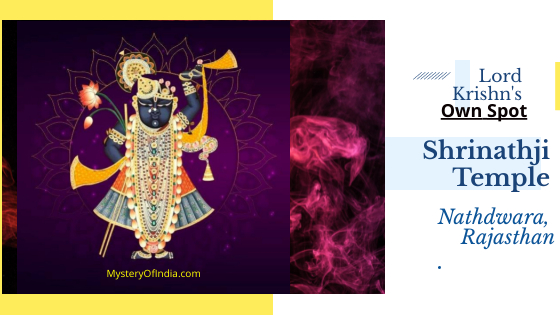
The idol of Shrinathji is in a standing position with his right hand up in the air like he is still holding the Govardhan hill on his little finger, while his left hand is on his waist. The idol is made up of rare black marble and it has a diamond on the chin that sparkles day and night. There are several carvings of birds and animals surrounding the idol because the locals mention that the birds and animals always felt safe near Shrinathji. 

Apart from receiving blessings from Shrinathji, visitors also visit the temples of Navneet Priya, Vitthalnath Ji, and Lord Madan Mohan. 

Visting Nathdwara

While you can visit Nathdwara temple any time at your convenience, it is always a great idea to visit the temple during any festive season to see the real colours of the place. The locals celebrate Holi, Diwali, and most importantly Janmashtami with great pomp and show. 

After you have visited the Nathdwara temple, do not forget to get the famous prasad of Shrinathji that is a combination of different items such as laddoo, mathri, and others. When you are here in Nathdwara, you will also love to carry back home some souvenirs for which the portrait of Shrinathji in the local Pichai Painting, or rice miniature art are some of the ideal options. Tourists also carry laddoo gopal statues from Nathdwara that are extremely popular here. 

Buddhist & Hindu related Kadri Manjunath Temple – Coastal Karnataka

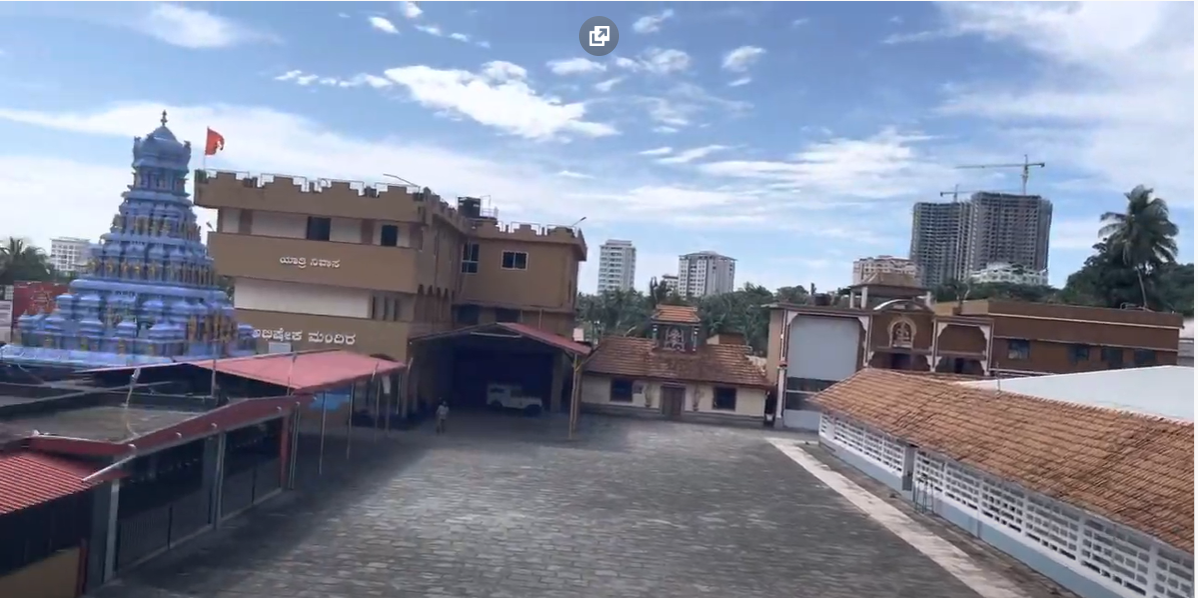
Kadri Manjunath Temple is situated in the hillocks of Kadri Hills in Mangalore (Mengaluru) district and is very near to the coast.

This ancient temple of Kadri Manjunath dates back to 10-11th centuries. It was a time when India was predominantly a Buddhist country with majority population following the middle path of Lord Buddha.  The temple was a prominent spiritual place for Buddhists across the country and specially in the southern India. 

But when Buddhism started to decline in the sub continent, many followers started worshipping Hindu Deities. Nath tribe came into predominance in this area. The temple was a center of Buddhist as well as Hindu worship for centuries but eventually it came under the Hindu fold. 

The Nath prantha followers were Shiv devotees who are also sometimes associated with tantric practices. Earlier in 10-11 century it was like a monarchy but in 12th century the king of the time gave land to build the temple. The temple got renovation again in the 14th century. 

This temple has a long history and is associated with Lord Parashuram as well. Once after killing Kshtriyas and donating his land to Kashyaps, Parashuram prayed to Lord Shiv and asked for a place to live. Lord Shiv suggested him to do penance. Parashuram threw his axe into the sea and created the place for penance. Love Shiv as committed appeared there with Goddess Parvati and stayed at Kadri. Due to this, the temple found a lot of significance in devotees of Shiv. 

One of our readers, Namrata,  visited the temple and shared her experience and knowledge via a YouTube video below. 


Kamakhya’s unique tradition of the vagina worshipping

Kamakhya’s unique tradition of the vagina worshipping

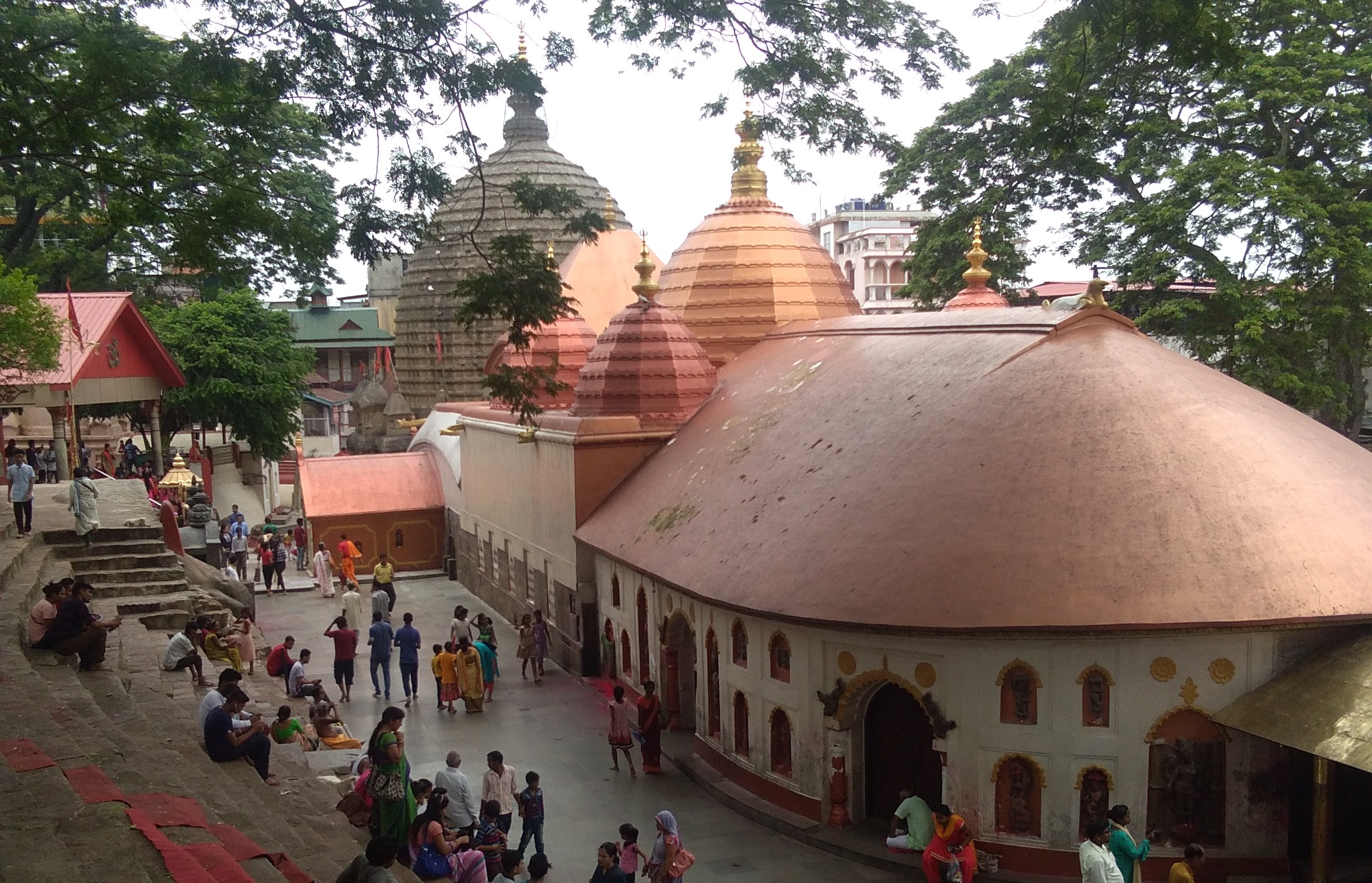
There is a total of 51 Shakti Peethas that exist in different corners of  India. But among all these 51 Peethas, the Kamakhya Shakti peetha is considered the most important and powerful one.

Now maybe a question arises in your mind that why Kamakhya Dham is so powerful than others and what makes it different from the rest 50?

We will answer all these questions in this article.

So the first question is…


Is it the vagina worshipping tradition at Kamakhya temple, true? – Chapter 1

Believe it or not but the vagina worshipping tradition at Kamakhya temple is true.

The root of this fact belongs to a mythological story from two Hindu Puranas. They are Kalika Purana and Yogini Tantra.

According to Kalika Purana and Yogini Tantra, when Lord Vishnu separated Devi Sati’s dead body with his Sudarshan Chakra then it got divided into 51 parts.

And all those 51 parts dropped down into different corners of India.

Somewhere dropped Sati’s hand, somewhere feet and somewhere breast. But most importantly, a part of her body, which was her vagina fallen down at a place called Kamgiri, near Nelachal hills, Guwahati.

Later in the 8th century, the ruling Mlechchha dynasty built a temple at this place and they named it ‘Kamakhya temple’ or ‘Kamakhya Dham’.


Chapter 2

At present, this temple is considered to be a replica of the goddess Sati’s vagina. Inside, on the main part, there is a vagina-shaped idol also vested.

They believe it as Devi Sati’s elytron.

People from all over India come here to see and worship this vagina idol around the whole year. Almost all the time, the priests of the temple keep worshiping it.

Most of the Sakta creed believes that praying this idol will fulfill their desires.


Why this Shakti Peetha is perused as the most powerful?

Women’s vagina is the entrance and start of human life. In Hinduism, it is considered a sacred natural phenomenon.

On the other hand, it stands for goddess Sati’s elytron; this is why its significance is much higher than the other 50 Shakti Peethas.


Who was goddess Sati and why did she die? –

Chapter 1

Goddess Sati was the wife of Lord Shiva and the daughter of Asurraj Daksh (devil king).  The story begins with the love between Lord Shiva and Sati.

Sati started loving and considering Shiva as her husband for the whole life; but Daksh, her father did not like it as she does.

He thought Shiva as poor and one of the gods from the lowest groups. All in all, Daksh hated him a lot.

One day contrary to her father’s desire she married Shiva through the Gandharva rites. When Daksh came to know about this fact, he went furious and immediately ended all his relationship with Sati.


Chapter 2

After passing a few years from this incident, one day Daksh organized a grand worship program at his palace. There he invited almost all the gods and deities, except Sati and Shiva.

Sati also had a desire to go to that program and meet her family again, but Shiva knew that they were uninvited and it was wrong visiting there. He also explained to her a lot, but due to Sati’s insistence, he obliged to go there to participate.

Finally, they went to attend the event; but seeing them both together, Daksh got very angry. Immediately, in front of the large crowd, he started insulting them very badly.

Sati gets a huge shock from this incident. Somehow she managed to bear the humiliation happened to her, but she could not bear the insult that happened to her husband.

In deep misery, she gave up her life in the fire of the Yagya.


Chapter 3

This time, due to Sati left her body Lord Shiva gets highly furious on Daksh. Now Lord Shiva wanted to take revenge from the all, for whom his wife had to sacrifice her body.

Due to sorrow and fury, Shiva started ‘Tandav Nritya’ around the whole world by carrying her dead body on his shoulder.

Seeing and feeling the wrath of God, the deities including Indra also started getting scared. They knew that if Shiva did not calm down, the whole world would end completely.

Therefore, finally, they went for requesting Lord Vishnu to find out a way to clam his anger down.

Vishnu tried many times but all failed. At the very end, as a way to control Shiva, he cut the goddess Sati’s dead body by his Sudarshan Chakra.

And as we mentioned, it went into 51 parts.


What is the secret behind the unique festival ‘Ambubasi mela’?

Every woman has menstruation every month. This is a natural law. But people of Hinduism believe that contrary to this monthly menstruation period, goddess Sati or Kamakhya has to follow her menstruation pain for only once every year.

They believe, this goddess gets menstruated in the mid of every year’s June month. Hindu people celebrate Ambubasi mela in these days.

Because of this temple is a representation of the goddess vagina therefore a belief has also been running that it gets menstruated too.

I don’t have any deep knowledge about this phenomenon but during these days the Brahmaputra River’s water near itself gets red-colored.

Most of the people believe this happens due to mother Kamakhya’s menstruation. 


The verdant Valleys of Chikmagalur

0


They say great ideas start with coffee. I say a great vacation also starts with coffee. But what if you start your vacation in the heart of the coffee land of the country? Waking up amidst the fresh, warm, aroma of Arabica plants and the dewy weather, is sure to drive incredible, creative thoughts and welcome you to a great vacation ahead. Just like it did to me, on the very first day when I arrived here, at my friend’s homestay, tucked within a small plantation.

Reaching Chikmagalur

Unable to resist the temptation of spending a weekend in luxurious natural surroundings, I packed for a few days, booked a reliable and licensed cab in Bangalore, and five hours and 245 Km later, I landed here. This would be my first tryst with the Coffee land of Karnataka and I came with no expectations. Perhaps, that’s why everything came as a pleasant surprise. The road leading to the plantation stay, where I would be staying for the next few days, was flanked by mist-laden valleys and rolling hills, with the mountains of Kudremukh peeping out occasionally, behind the floating clouds. It was a sheer treat for my sore urban eyes, which got more generous as I landed at the homestay.

The best part about living within a plantation is that along with fresh, organic coffee every day, you also get to indulge in farm-grown food, home-cooked meals, and coffee-based desserts. It couldn’t have been more appropriate of a vacation for a coffeephile like me!

Plantation tour

Next morning, I accompanied my friend at work at the plantation. Chikmagalur grows at least 80 varieties of coffee. I took a walk through the shaded trails through thick shrubs, bearing red and white fruits. They were well guarded by the foliage of tall trees, which kept the sunlight and rain away. Some shrubs were even partnered with a spice shrub that lends its flavor to the coffee. Farmers were busy trimming, plucking, and tending to the plants, while I walked past them. It was after the rainy season, and the musty smell of the damp soil, mixed with the smoky aroma of the raw beans and spices.

As my friend got busy with her morning chores, I carried on with my walk and found myself at the end of the groves and at the beginning of a trail that led uphill somewhere. I ended up at a mountain ridge which opened up to a panorama of the hills against the endless horizon.

The best of Chikmagalur in a day

With the idea of making the most of this exquisite locale, I planned to explore the wonders of Chikmagalur. While the town is surrounded by imposing mountains, its real charm lies in the valleys, where one can discover the most scenic waterfalls, sparkling lakes, and quaint villages, clustered around the plantations and foothills. Also, since I had the car rental with me, it made exploring much easier. The Bangalore to Chikmagalur taxi fare was reasonable enough to use for the entire weekend and also do local tours.

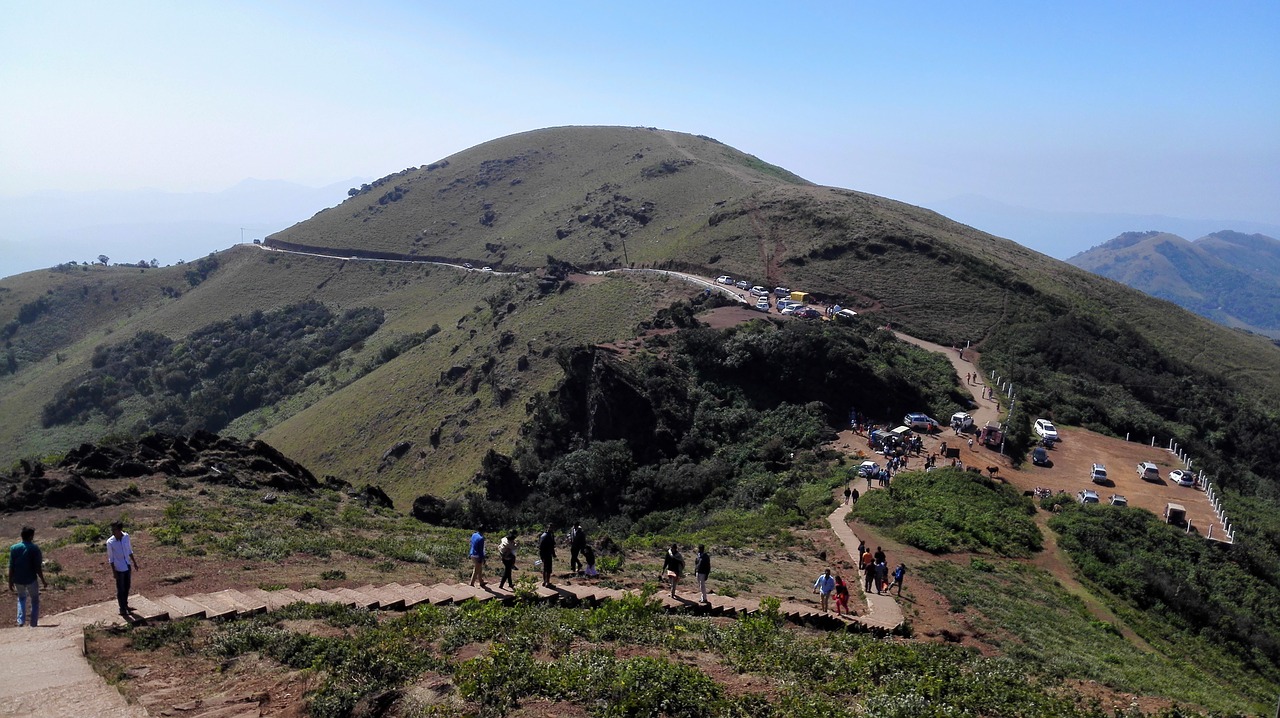
My cabbie was well-versed with the town, and knew some interesting places around. I first stopped at the Kemmanagundi Hills, at about an hour drive from my homestay. The rolling, green hills of Kemmanagundi against the blue horizon and the golden sunshine, will remind you of a piece of work by any classic artist. I had no words for the perfection of beauty rendered by the verdure of the grassy hills and azure sky, with patches of white clouds filling up the valleys below.  It was not just soothing for the eyes, but all my senses, as I felt the soft grass on my feet, smelled the air, while the morning breeze whistled past my ears. I spend almost half the day, walking around, soaking the atmosphere, writing, and reading.

Later in the day, on my way back, I stopped by the Hebbe Falls, around the edges of a valley. Chikmagalur boasts some of the most beautiful cascades one can ever find, and Hebbe Falls is one of them. It was a two-layered cascade, separated by a rocky landing. It says deep inside a forested area and I had to take a long walk through a narrow trail to reach the falls. The spring water was as clear and sparkling as crystal, wanting me to take a plunge. But its craggy base and steep edges said otherwise. However, the stunning views of the falls, enveloped by plantations and forests, were more than overwhelming.

…

The two days of the weekend went by like a dream, although I would wake up and smell the coffee, every day, in the literal sense! Today, as I bid adieu to this heavenly place, I promise myself to come back soon and discover more of this paradise and treat my mind, body, and soul.


As submitted by a user


A Guide to the temples on the way from Pune to Shirdi

1

A Guide to the temples on the way from Pune to Shirdi

Like any other journey, a pilgrimage is also not just about reaching a destination but also about what you discover along the way. If the purpose of a pilgrimage is to have a divine experience, then why not have more such experiences en route? Because that is when your entire pilgrimage becomes wholesome. Take the trip from Pune to Shirdi, for example. While most pilgrims would look at Shirdi as their ultimate holy destination, there are numerous temples between these two cities which one can visit.

Temples in Rajgurunagar

The first major stop after Pune is Rajgurunagar at 44 KM. A historic town named after the great freedom fighter Shivaram Rajguru, Rajgurunagar hosts several old temples like –

Siddheshwar Temple – Sitting near the Bhima River, this is an ancient temple dedicated to Shiva. The temple structure has been restored and renovated with contemporary constructions, but its old stone pillars still speak of its heritage. There is a small pond or ‘kund’ in the center, around which the main shrines are built. The pond is fed by the underground inlet of Bhima River and is said to be holy. Stone steps lead to the pond from all sides, where you might find pilgrims taking a dip or practicing a ritual.

Ekveera Devi Temple – As you continue on NH 60, you will come across this other famous temple of Rajgurunagar. The temple houses the shrine of local deity Khandoba and is highly revered by the local communities.

For a little adventure, you can also head to the Kundeshwar Temple on the road that leads to the Shingheshwar Mountain (the highest point of Rajgurunagar). A dirt road from Pait village takes you halfway through, after which, you have to walk the rest of the way. The temple sits against the Kundeshwar Mountain and makes for a great view, especially during the monsoon. If you take a short trek from the rear side of the temple, you can also catch a glimpse of the Shingeshwar peak.

Apart from these two places, Rajgurunagar boasts many other temples within the town. You can take a quick detour from the highway and visit the Kedareshwar Temple, Khandoba Temple, Vishnu Temple at Chandiram Maharaj Math, Chinmaya Ganapati Temple, or the Shingeshwar Temple near Kude Budruk village.

Temples in Narayangaon

Another 30 to 40 Km from Rajgurunagar will take you to Narayangaon. Mostly known to travelers for its scenic natural beauty, this town is also steeped in religious history. Some of the most popular places of worship, which you can visit on your trip –

Ram Mandir – A historic temple, the Ram Mandir of Narayangaon was built by the Peshwa rulers as a gift to the Brahmins of the society. The temple celebrates Ram Navami every year, with grand rituals and hundreds of devotees from all neighboring towns and villages.

Muktabai Temple – Goddess Muktabai or Muktaai is the reigning deity of Narayangaon and this temple sitting on the banks of the Meena River, is dedicated to her. The temple is famous for the yatra of Muktai Utsav, an annual religious festival held during Ekadashi. During the yatra, the deity is carried around and her divinity is celebrated with great devotion and zeal through prayers, rituals, and music, and is one of its kind in entire Maharashtra.

Vighneshwar Temple – Also called the Vignahar Ganapati Temple, this famous religious site is located in Ozar, 17 Km from the main town of Narayangaon. It represents one of the Ashtavinayaka, or eight significant shrines of Ganesha. Besides being a revered and a popular pilgrimage site, the Vigneshwar Temple is also an architectural marvel. The colorful façade boasts murals and sculpture work. The entrance is flanked by huge statues of two gatekeepers on either side. The massive temple premise houses multiple shrines, a courtyard for religious festivals, and prayer halls.

Apart from these, you can also take a detour towards the west of the highway and explore the temples in the interiors of Narayangaon, like the Shambhu Mahadev Temple, Khandoba Temple, Temple of Kapardikeshwar in Otur, or the Girijamata Temple in Lenyadri.

Temples of Sangamner

Another 70 to 80 Km from Narayangaon, as you take the Sangamner- Kopargaon Road, you will reach Sangamner. The Shani Dev Temple is the most popular shrine of this town. To make the most of your journey, book a reliable taxi in Pune.

You can also visit the Devgad Khandoba Mandir, which sits on a small hill. There are local folklore and legends associated with the temple, making it a historic site of the town. It is dedicated to a patron saint who is the resident deity of the local community. Every year a grand fair is held on the temple premise to celebrate the saint and his miracles.

…

Along with these old and famous temples along your way, the road from Pune to Shirdi is also visually delightful. The interior countryside of Maharashtra with red dirt roads and hilly terrain, do make for a great view on the drive. And if you are traveling in monsoon, you would be in for a more delightful visual treat with ample greenery and the fresh smell of the rain, which is divine in its own way. Book Savaari’s air-conditioned Pune to Shirdi cab and make your pilgrimage a fulfilling one!   

Â