

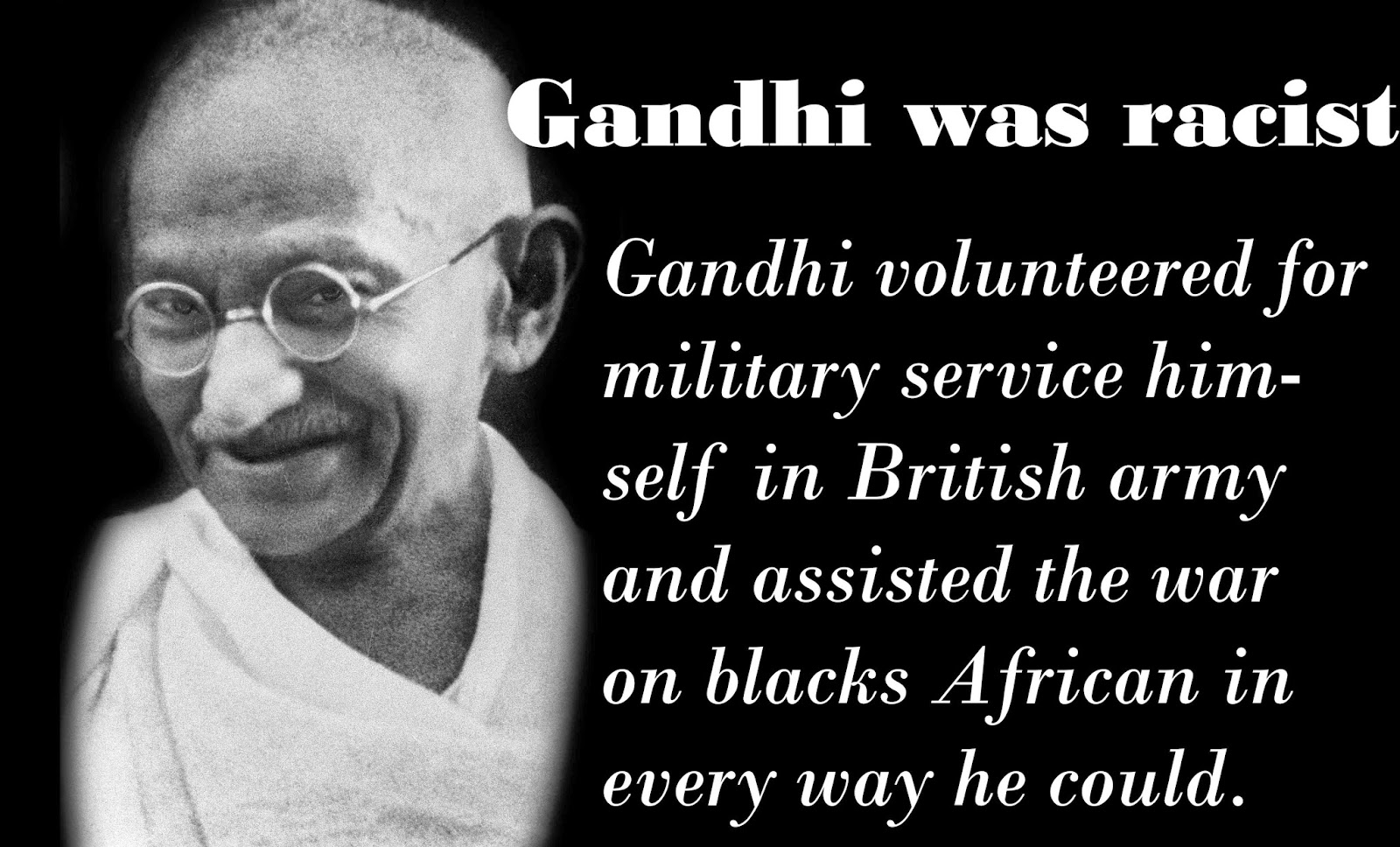
In 1906, Gandhi cheered on the British as they waged a war on the black Zulus. He then volunteered for military service himself, attaining the rank of Sgt. Major in the British Army and assisting the war on blacks in every way he could.
Real face of Gandhi Part 1
Gandhi is idolized worldwide as a prophet, a visionary, even a messiah. Earl Mountatten, the last Viceroy of India, said, “Mahatma Gandhi will go down in history on a par with Buddha and Jesus Christ.” The accuracy of his statement can be seen in modern Hindu temples, such as the “Gandhi Temple” of Bhatra village, Sambalpur District, where Gandhi is worshiped as a deity.
Gandhi is to India what George Washington, Thomas Jefferson, and James Madison were to the United States. He was a primary leader in Indian political movements in both South African and India and his political philosophy prevails in India. All politicians there acknowledge him as their political, philosophical, and spiritual for bearer, even worshiping at his tomb, Raj Ghat. He is even worshiped as a god by many Hindus. Even the United Nations honored him, choosing his birthday as an “International Day of Non-Violence.”
Gandhi was a first-class racist.
Many years ago, the lack of efficient methods of communication and documentation allowed Gandhi to effortlessly create a convincing but false image of himself. People had no way to adequately investigate his past or properly track his present activities, so the truth remained hidden for decades.
The popular image of Gandhi is a myth. Gandhi was deeply prejudiced against all minorities, from black Africans to low-caste Hindus. He also demonstrated a shocking lack of morality, from sleeping naked with young girls to employing nonviolence merely as a tool of political expedience.
Gandhi’s writing, compiled in an uncensored series of volumes by the Government of India, is liberally sprinkled with verbal violence against the black South African natives, who he termed “Kaffirs.” His animosity towards black people is almost tangible and his racism is undeniable. A brief but shocking example illustrates Gandhi’s racism.
Gandhi was hired to work as an attorney for wealthy Indian traders in South Africa. He moved there in 1893 and soon helped establish the Natal Indian Congress. The Natal Indian Congress was founded in 1894 by Mohandas Gandhi to further the causes of caste Hindus and campaign against equal treatment for Indians and black South African natives. The major achievement of the Congress was the successful attempt, spear-headed by Gandhi, to fix the Durban post office “problem.”
The Durban Post office
The first major accomplishment of the Natal Indian Congress was to further entrench racial segregation into South African society during a time of massive racial strife. In the city of Durban, there was a post office with two doors – one for blacks and Indians and another for whites. Gandhi, of course, was required to use the door for blacks and Indians. This deeply offended him, not because of the segregation, but because he was “forced” to share a door with blacks, which he felt was beneath him. Gandhi successfully lobbied to correct this “problem” by building a third entrance for Indians, thus further entrenching the South African policy of segregation.
This achievement is shocking but very well-documented in Gandhi’s writings. In his Collected Works (CWMG), Vol. I, pp. 367-368, Gandhi wrote: “For the present our efforts are concentrated towards preventing and getting repealed fresh legislation. Before referring to that, I may further illustrate the proposition that the Indian is put on the same level with the native in many other ways also. Lavatories are marked ‘natives and Asiatics’ at the railway stations. In the Durban Post and telegraph offices there were separate entrances for natives and Asiatics and Europeans. We felt the indignity too much and many respectable Indians were insulted and called all sorts of names by the clerks at the counter. We petitioned the authorities to do away with the invidious distinction and they have now provided three separate entrances for natives, Asiatics, and Europeans.”
This achievement is shocking but very well-documented in Gandhi’s writings. In his Collected Works (CWMG), Vol. I, pp. 367-368, Gandhi wrote: “For the present our efforts are concentrated towards preventing and getting repealed fresh legislation. Before referring to that, I may further illustrate the proposition that the Indian is put on the same level with the native in many other ways also. Lavatories are marked ‘natives and Asiatics’ at the railway stations. In the Durban Post and telegraph offices there were separate entrances for natives and Asiatics and Europeans. We felt the indignity too much and many respectable Indians were insulted and called all sorts of names by the clerks at the counter. We petitioned the authorities to do away with the invidious distinction and they have now provided three separate entrances for natives, Asiatics, and Europeans.”
Gandhi Refuses to Share Door With Blacks
Gandhi first referenced this issue in an August, 1895 letter titled “Report of the Natal Indian Congress.” He wrote: “A correspondence was carried on by the late President with the Government in connection with the separate entrances for the Europeans and Natives and Asiatics at the Post Office.”
Gandhi Achieves Post Office Segregation
In his 1895 “Report,” Gandhi boasted about the government response to his petition for segregation from the blacks. He wrote: “The result has not been altogether unsatisfactory. Separate entrances will now be provided for the three communities.” Again, in his 1896 “Grievances,” he bragged about this victory, writing: “We petitioned the authorities to do away with the invidious distinction and they have now provided three separate entrances for natives, Asiatics and Europeans.”
A year later, after the issue had already been resolved, Gandhi chose to expound upon his reasons for raising it in the first place. In his August 14, 1896 letter, “The Grievances of the British Indians in South Africa: An Appeal to the Indian Public,” he called being “put on the same level with the native” a “disability.” He did not complain that Indians were refused the same rights as whites, but rather that Indians were not treated as legally superior to the black natives.
Gandhi’s “Grievances” letter continues: “Lavatories are marked ‘natives and Asiatics’ at the railway stations. In the Durban Post and Telegraph Offices, there were separate entrances for natives and Asiatics and Europeans. We felt the indignity too much and many respectable Indians were insulted and called all sorts of names by the clerks at the counter.”
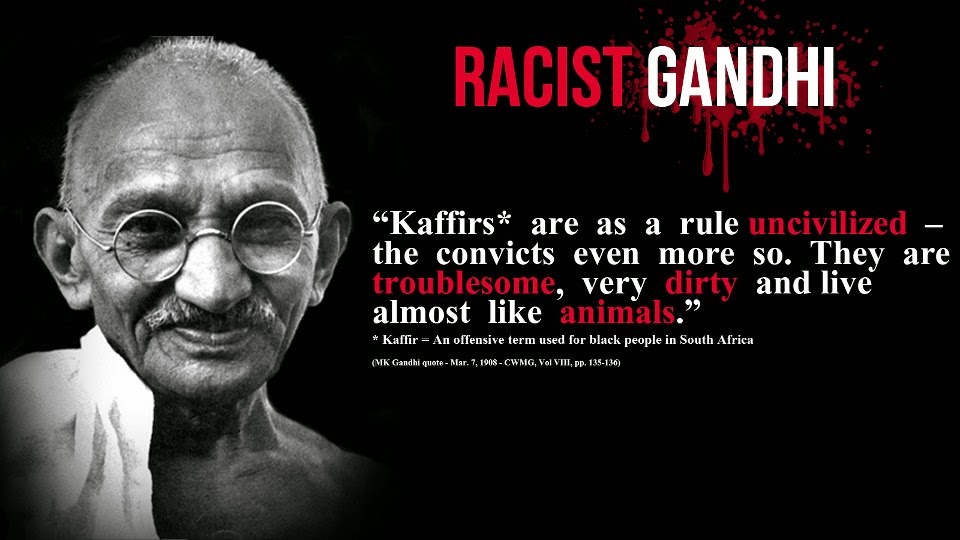
Obviously, Gandhi was infuriated by the idea of integration with the black natives. He didn’t mind that Indians were segregated from whites as long as the Indian was not “dragged down to the position of a raw Kaffir.”
Gandhi Seeks Further Segregation
He was not satisfied, however, and in 1896 raised the “problem” of other integrated locations. The integrated railway station lavatories displeased him, for instance, and in “Grievances” he wrote that “our efforts are concentrated towards preventing and getting repealed fresh legislation.” His efforts to increase racial segregation continued for many years. In an 1894 Indian Opinion article, for instance, he again protested integration with the blacks, writing: “Why, of all places in Johannesburg, the Indian location should be chosen for dumping down all Kaffirs of the town, passes my comprehension. Of course, under my suggestion, the Town Council must withdraw the Kaffirs from the Location. About this mixing of the Kaffirs with the Indians I must confess I feel most strongly. I think it is very unfair to the Indian population, and it is an undue tax on even the proverbial patience of my countrymen.”
Indeed, Gandhi felt Indian segregation was something worth boasting about. In a March, 1903 Indian Opinion article, he wrote: “The petition dwells upon `the co-mingling of the colored and white races.’ May we inform the members of the Conference that so far as British Indians are concerned, such a thing is particularly unknown. If there is one thing which the Indian cherishes more than any other, it is the purity of type.”
Read More : Gandhi was a Racist Part 2
Source:
http://www.independent.co.uk/arts-entertainment/books/features/thrill-of-the-chaste-the-truth-about-gandhis-sex-life-1937411.html
http://www.gandhism.net
http://www.theguardian.com/world/2003/oct/17/southafrica.india
http://www.theguardian.com/commentisfree/belief/2011/may/02/mahatma-gandhi-biography-banned-india
http://www.theatlantic.com/magazine/archive/2011/07/the-real-mahatma-gandhi/308550/
Anti-black quotes of Gandhi
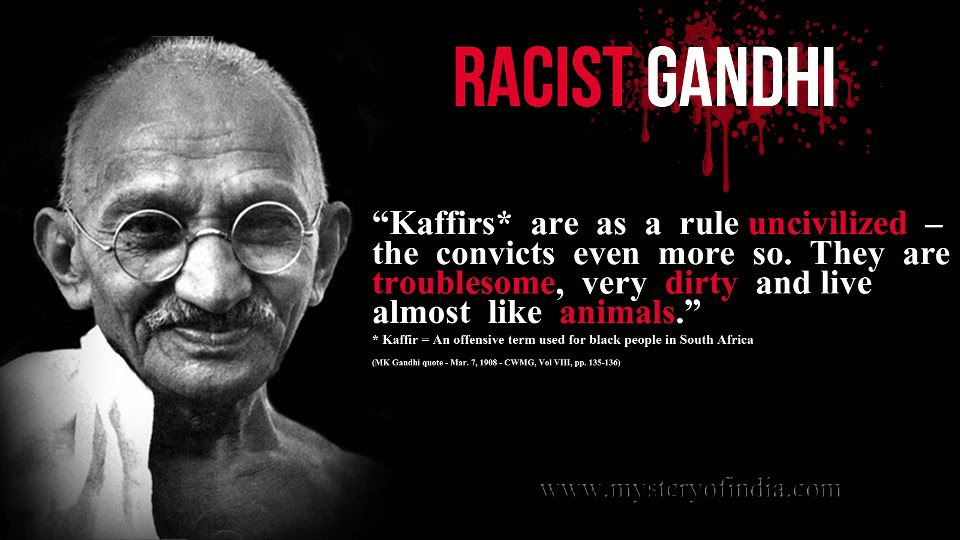
In 1904, Gandhi founded The Indian Opinion, a newspaper which he used as a political tool to promote his personal views. It is in this paper, which Gandhi edited until 1914, that we find a record of his extensive anti-black activism and opinions. A list of anti-black quotes from his writings, in which he invariably refers to the South African natives as “Kaffirs. Gandhi’s opinion of the native is best summarized when he calls them people “whose occupation is hunting, and whose sole ambition is to collect a certain number of cattle to buy a wife with and, then, pass his life in indolence and nakedness.”
Kumari Kandam – The Lost Continent
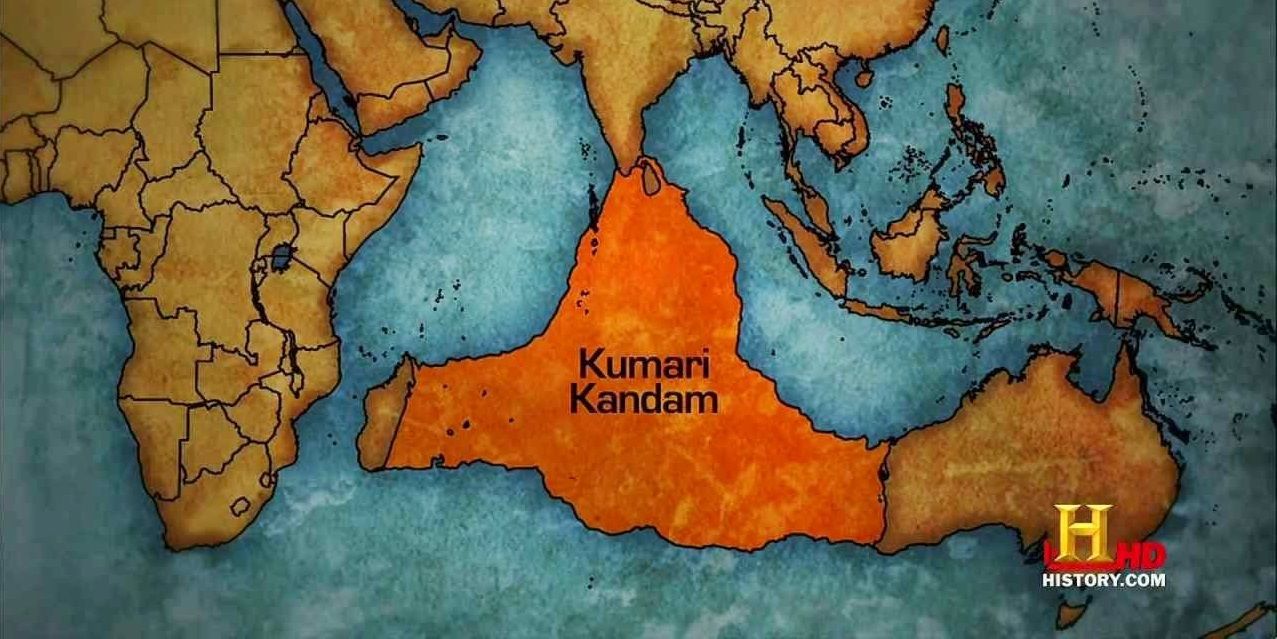
Kumari Kandam is the legendary sunken continent, according to many of the ancient extant Tamil literatures and some of the Sanskrit literatures. Almost 100 years back tamil nationalists came to identify and associate Kumari Kandam with Lemuria, a hypothetical “lost continent” posited in the 19th century to account for discontinuities in biogeography.
Located in the Indian and Pacific Oceans but now sunken, this sunked continent is believed to be the connections between Africa to South India, through Madagascar.
Many of the earliest extant Tamil literary works and their commentaries, mentions a Tamil continent called Kumari Kandam, which was ruled by Pandiyan Kings for 10,000 years, before getting submerged in the Indian Ocean, south of present-day Kanyakumari district at the southern tip of India.
References of Kumari Kandam from some of the Tamil literary sources
According to Silappadhikaram, one of the Five Great Epics of Tamil Literature written in 2nd century CE, states that the cruel sea took the Pandiyan’s land, part of which was present between the rivers Pahruli and the mountainous banks of the Kumari. These rivers are said to have flowed in a now-submerged land.
Adiyarkkunallar, a 12th-century CE commentator on the epic, explains this reference by saying that there was once a land to the south of the present-day Kanyakumari, which stretched for 700 kāvatam from the Pahruli river in the north to the Kumari river in the south. The modern equivalent of the measurement kāvatam, which is also known as kātam in Tamil, is a distance of 6.25 miles (10.06 km).
Kanakkathikaram, a 15th century Tamil Mathematical literary work which is in the form of poems, defines the length of 1 kāvatam(1 kātam) as 24,000 muzham (33,000 feet, 6¼ miles) and it also defines the time taken to cover it which is the distance that can be covered by normal walk in 7½ Nāzhigai or 1 Sāmam (equivalent to 3 hours). So, the distance of 700 kāvatam is equivalent to 4,375 miles (7,041 km) in modern day measurements.
This land was divided into 49 territories, which he names as Seven coconut territories (elutenga natu), Seven Madurai territories (elumaturai natu), Seven old sandy territories (elumunpalai natu), Seven new sandy territories (elupinpalai natu), Seven mountain territories (elukunra natu), Seven eastern coastal territories (elukunakarai natu) and Seven dwarf-palm territories (elukurumpanai natu). All these lands, he says, together with the many-mountained land that began with KumariKollam, with forests and habitations, were submerged by the sea. Two of these territories were supposedly parts of present-day Kollam and Kanyakumari districts.
The 7th century CE commentary written by Nakkīranār for the Tamil literary work Iraiyanar Akapporul, gives the list of Pandiyan kings who ruled the Kumari Kandam. It also gives information about the three Tamil Sangams (assemblies of Tamil scholars and poets who do research on Tamil language and also creates literary works) which spans about 10,000 years.
According to th Kumari Kandam tradition, over a period of about just 11,000 years, the Pandyans, a historical dynasty of Tamil kings, formed three Tamil Sangams, in order to foster among their subjects the love of knowledge, literature and poetry. These Sangams were the fountain head of Tamil culture and their principal concern was the perfection of the Tamil language and literature. The first two Sangams were not located in what is now South India but in antediluvian Tamil land to the south which in ancient times bore the name of Kumari Kandam, literally the Land of the Virgin or Virgin Continent.
The First Sangam (Mutaṟcaṅkam) is described as having been held at the Pandiyan King’s capital city, Madurai (Kadal Konda Then Madurai – which means Southern Madurai which was submerged in the sea. The old Madurai was called as Southern Madurai to differentiate it with the capital city of Madurai of third Sangam), which lasted a total of 4440 years, and had 549 members, which supposedly included some gods of the Hindu pantheon such as Siva, Kubera and Murugan. A total of 4449 poets are described as having composed songs for this Sangam. There were 89 Pandiyan kings starting from Kaysina valudi to Kadungon were decedents and rulers of that period.
If credence is given to this commentary, then the beginning of first Sangam should be placed somewhere in 9000 B.C.
Most of the lands of Kumari Kandam were submerged in the sea during first devouring of the land by the sea. Then, the Pandiyan King and the remaining people migrated to the remaining land of Kumari Kandam and the king moved his capital to Kapatapuram. At the same time, the present location of Tamil Nadu was ruled by Chera, Chola, and 46 other small kingdoms.
The Second Sangam (Irandaam Caṅkam, Iṭaicaṅkam) was convened in Kapatapuram, the then capital city of Pandiyan King. This Sangam lasted for 3700 years and had 59 members, with 3700 poets participating. There were 59 Pandiyan kings starting from Vendercceliyan to Mudattirumaran were decedents and rulers of that period.
This city was also submerged in sea. Ramayana and Arthasastra of Kautalya corroborates the existence of a city named kavatapuram. There is a reference to a south Indian place called kavata by sugriva in a verse which runs something like ‘having reached Kavata suitable for Pandiya‘. The place kavata is also mentioned by Kautalya (also known as Acharya Chanakya) in Arthasastra.
Having lost the complete Kumari Kandam, the Pandiyan King conquered the part of lands belonging to the Chola and Chera kings (Silapathikaram, Maturaikkandam, verses 17-22) and made Korkai, a seaport on the southernmost tip of the Indian Peninsula, as his capital and in later times moved his capital to the current city of Madurai.
The Third Sangam (Moondraam Caṅkam, Kaṭaicaṅkam) was purportedly located in the current city of Madurai, the then capital city of Pandiyan King, and lasted for 1850 years. There were 49 Pandiyan kings starting from Mudattirumaran (who came away from Kabadapuram to present Madurai) to Ukkirapperu valudi were decedents and rulers of that period.
The academy had 49 members, and 449 poets are described as having participated in the Sangam.

References of Kumari Kandam in Puranas and Ancient Tamil Literature

- In Tamil literary works Aintiram, Silappadhikaram, Manimekhalai and SaivamPaayanam and in Sanskrit literary work Bhagavatha Purana, there are information about Tamil sage Mayan, who wrote one of the Tamil Sangam literary works Aintiram, and was part of Tamil Sangams and lived in Kumari Kandam.This sage also wrote other Tamil literature Pranava Vedham (which is called by Vyasa as the predecessor of four Vedas in Bhagavatha Purana), MayaMatham (Book about Architecture, Sculptures and Vasthu) and SuriyaNool (Book about Astronomy and Astrology), one Tamil grammatical work, etc. According to Aintiram, Kumari Kandam was a land which has huge area and the PalThuli river (PalThuli – Divided grammatical form of Pahruli according to Tamil grammar which means many drops), one of the Kumari Kandam rivers, originated from PeruMalai(means big mountain – represents MeruMalai – Meru Mountain). It also tells that there were 49 lands in Kumari Kandam.Tamil literary work SaivamPaayanam gives information about Kumari Kandam and its territories. It also mentions the existence of PeruMalai (MeruMalai – Meru Mountain) in Kumari Kandam.
- The Tamil literary work Manimekhalai, mentions about multiple Tsunamis in the ancient city of Poompuhar and was swallowed up by the sea. This event is supported by archeological finds of submerged ruins off the coast of modern Poompuhar.
- The Tamil poetic literature Tamil vidu thoothu describes the Topography of Kumari Kandam. It is also said that the Pahruli river was excavated to irrigate the mountain valley by the Pandiyan King Nediyon.
The third Sangam literary work Purananooru talks about Kumari Kandam and the river Pahruli which was there in Kumari Kandam. - The Tamil Grammar work Nannool talks about the sunken country Kumari Kandam.
- The Tamil literature SiruKakkaip Paadiniyaar talks about the Kumari Kandam.
- There are references for Kumari Kandam present in Kantapuranam, which mentions it as one of the nine continents of old times, or one of the nine divisions of India and the only region not to be inhabited by barbarians.
- According to the Matsya Purana, Manu was the king of Dravidadesa (South Indian country) in Kumari Kandam.
- There are references for Kumari Kandam present in Garuda Puranam. Also, There are scattered references in Sangam literature, such as Kalittokai 104, to how the sea took the land of the Pandiyan Kings, after which they conquered new lands to replace those they had lost.
References of Kumari Kandam (Lemuria) in Chinese & Greek Literature
In some of the ancient Chinese chronicles, there are references to Pahruli river, Peru river and Meru Mountain (with 49 peaks) from where the Kumari River, Peru river and Pahruli river were originated (according to Tamil literature). It is said that Chinese laborers were employed by the Pandiyan King and when they went down the mines they appeared like a huge army of small ants. Therefore, they were called pon thondi erumbukal (Gold mining ants). This is also confirmed by ancient Chinese chronicles.
Megasthenes (ca. 350 – 290 BCE), a Greek ethnographer and explorer in the Hellenistic period, authored the work Indika, the account of his travels in India. In this work, he says that Taprobane (old name of Sri Lanka) was separated from the mainland (Indian Peninsula) by a river, which means that during the period of Megasthenes, Sri Lanka could have been connected to Indian Peninsula by a small landmass in between them and was divided by Thamirabarani River (Porunai River).
The current Thamirabarani River in Tamil Nadu flows into the sea suggests that the Thamirabarani River would have reached Sri Lanka through a now-submerged landmass existed between Indian Peninsula and Sri Lanka during the period of Megasthenes.
Archaeological Data supporting existence of Kumari Kandam

- The marine archeological findings at Poompuhar (Tamil Nadu) by marine archeological research conducted by the National Institute of Marine Archeology (Goa) reveals that much of the town of Poompugar (Tamil Nadu) was washed away by progressive erosion and a Tsunami around 300 BC.
- Ancient Pottery dating back to the 4th century BC have been discovered off shore by marine archeologists east of this town. The timeline of this Tsunami also coincides with the timeline (after the period of Megasthenes visit to India) of the submergence of landmass which was claimed to be existed between Indian Peninsula and Sri Lanka according to Megasthenes accounts.
- The geological survey reveals that most of the places in the land under the sea, where Kumari Kandam is claimed to be existed, has the maximum depth of the sea of 200 meters. In some of the places, the maximum depth of the sea is 2000 meters. Since, these areas has low sea depth, there are more possibilities to exists a now-submerged land in which people lived.
- Languages spoken by Australian tribes, African tribes, Andaman and Nicobar tribes and Lakshadweep tribes are identical to Tamil language. So, there are high possibilities that there might be a connecting land which exists in between India, Australia and Madagascar
- Types of plants, trees and animals present in Africa and Madagascar are identical with that of in India. So, there might be a connecting land which exists in between India and Madagascar.
Expedition to Poompuhar – Remains of Kumari Kandam
The Lost temple of India
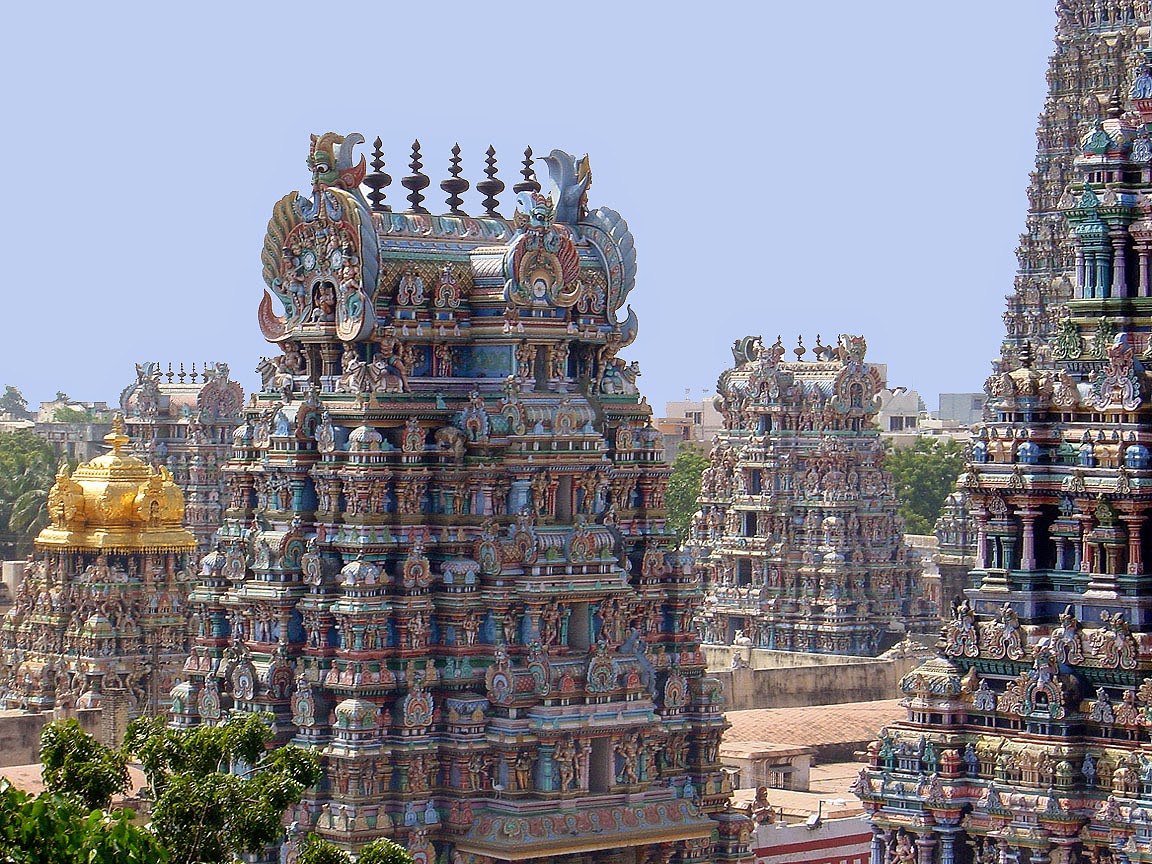
The Mysteries of Asia three-part video series was originally produced for the Learning Channel. During this segment, historians and others examine temples built in India more than 1,000 years ago. They remain quite intriguing, though today’s tourists rarely visit them. Records reveal that trained elephants had to drag millions of stone blocks to help erect these structures.
Science behind Indian traditions

India is considered a country, which is a culturally and traditionally diverse. We, Indians, hold dear our customs and traditions. Traditions in Hinduism were considered mainly as superstitions, but with the advent of science, it is becoming evident that these traditions are based on some scientific knowledge and moved from generations to generations as traditions. Though the common people did not know science in it, they were following it very faithfully over the years.
Let us look at some of these curious and amazing scientific explanations: