
Awe Inspiring Shiva Temple of Kakanmath

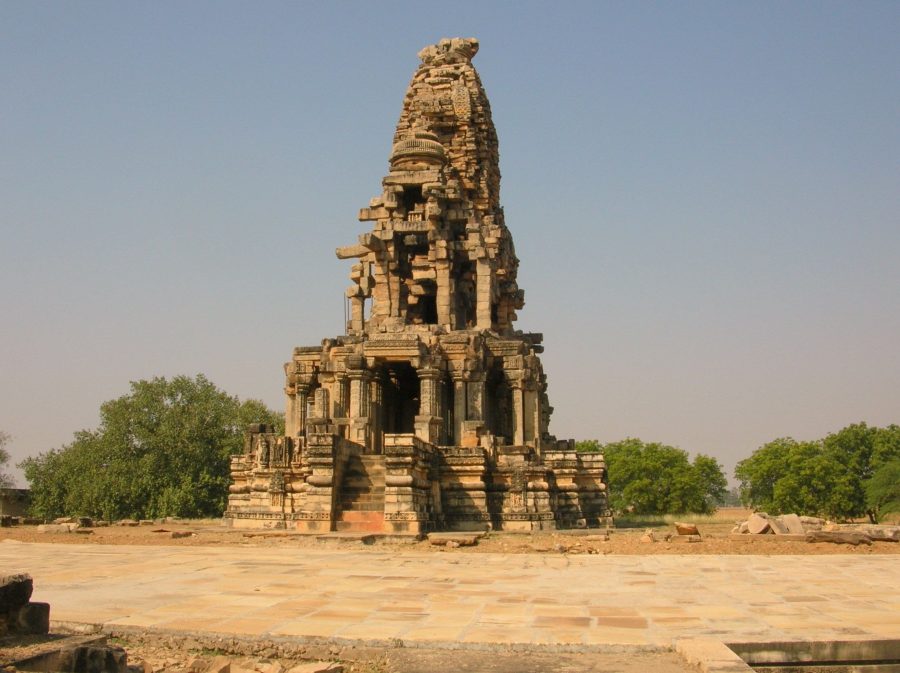
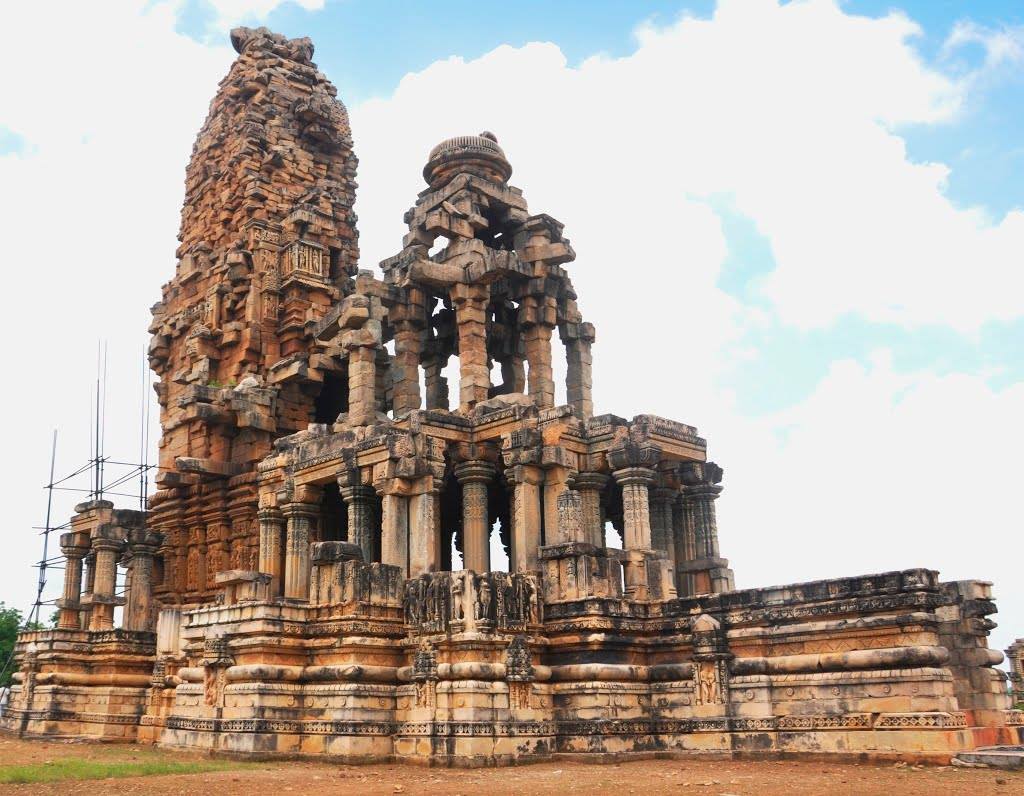
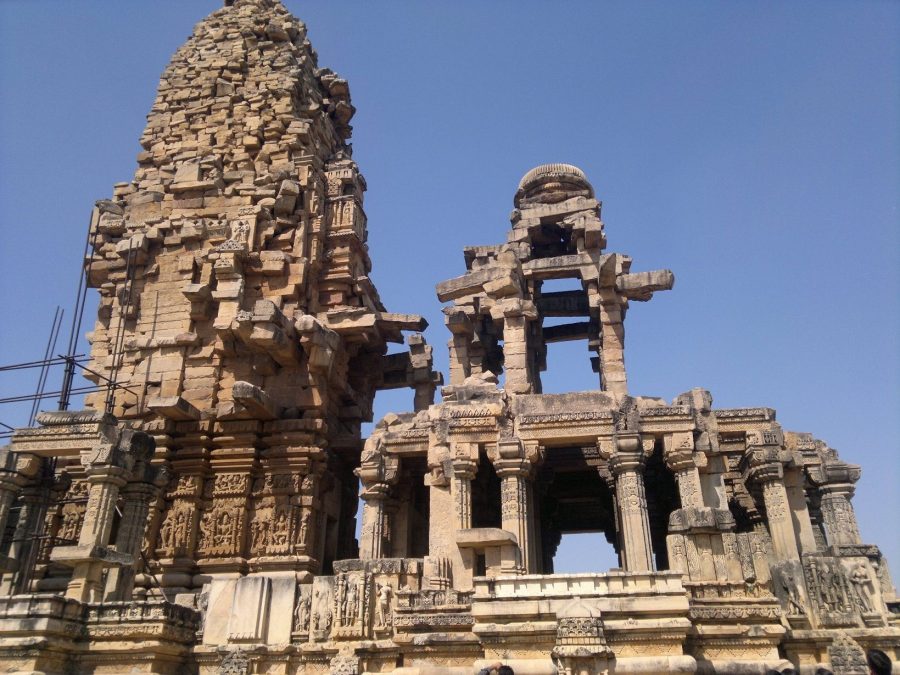
Kakanmath Temple is one of the prominent Shiva temples located near the village of Sihonia in Morena district of Madhya Pradesh. Although in ruins today, the temple is notable for its amazing sculptural wealth.

Sihoniya (also Suhoniya) was known to be the capital of the Kushwahas. The Kushwaha kingdom was established in 11th century within 1015 to 1035 AD. The general belief is that the temple was built by Kushwahas ruler Kirtiraj in 1015 AD to fulfill the wish of Queen Kakanwati. The local lore also goes that the historical Tomar rulers had built the Kakanmath temple.
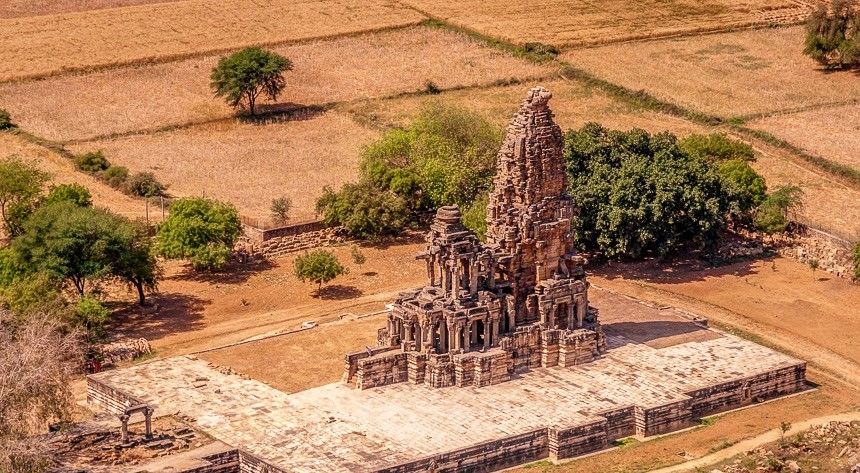
Kakanmath Temple, Sihoniya, Morena, Madhya Pradesh
img source

Kakanmath, in terms of structure and design, is similar to the temples at Khajuraho.The overall structure of the temple is pyramid-like and it has a pillared corridor leading to a central shrine. The temple is originally encircled by subsidiary shrines.

To the right of the temple are the remains of other, smaller shrines including a Shiva linga standing by itself. The overall effect of the towering structure standing in the middle of fields is stunning and would never cease to startle a chance visitor to Sihoniya.
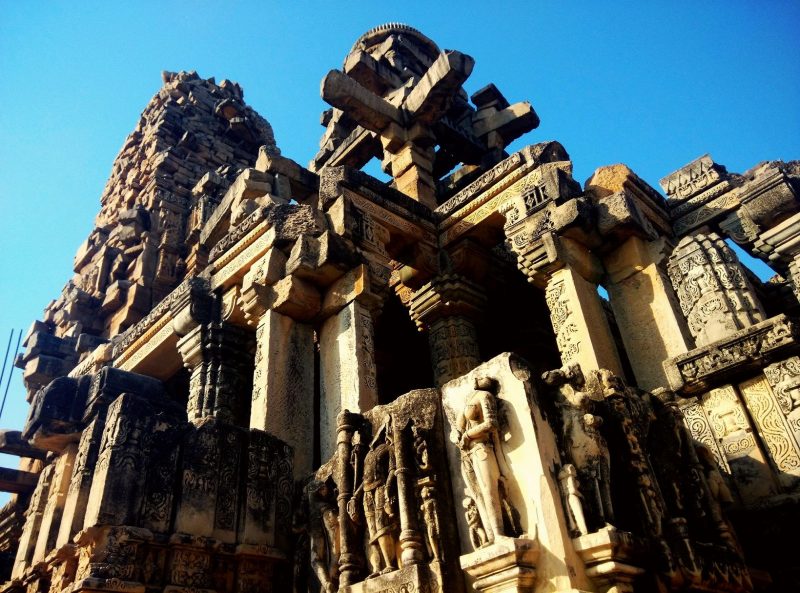
Kakanmath Temple, Sihoniya, Morena, Madhya Pradesh
img source

The temple is more than 150 feet in height; and its mandapa has two stories.

The temple which looks like it is about to fall, when viewed from a distance, gets more and more sturdy and amazing as you get closer.

It has some of most beautiful statues carved on its exterior walls, with dancing, joyful figures, along with various Hindu Gods and Goddesses.
Kakanmath Temple, Sihoniya, Morena, Madhya Pradesh
img source

Even in its ruined condition, it reflects the majesty it must have exuded before it was destroyed by the Islamic invaders.

Kakanmath was destroyed by the armies of Aibak and Iltutmish in the 13th century and since than it fell to neglect and obscurity. It was only in the 20th century that it was reclaimed as Indian heritage.

The Kakanmath is under the supervision of the Archaeological Survey of India, Gwalior Region.
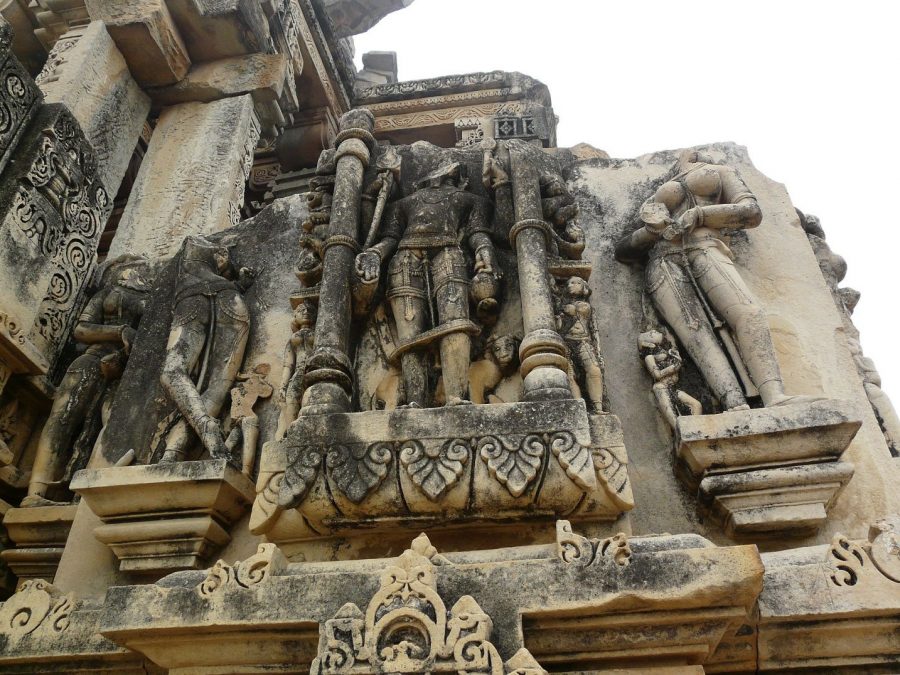
Kakanmath Temple, Sihoniya, Morena, Madhya Pradesh
img Source
Kakanmath Temple, Sihoniya, Morena, Madhya Pradesh
img source

Source: AsiBhopal & IndiaNetZone
INDIA: The first Civilisation (Documentary)

A somewhat melodramatic recreation of the discovery of Harappa and Mohenjo-daro. The work of archaeologists who discovered the remains of the ancient Indus civilisation, a sophisticated culture that existed 4,000 years ago.

As Indian independence approached in the first half of the 20th century, British archaeologists John Hubert Marshall and Sir Mortimer Wheeler worked at breakneck speed to understand the great ancient civilisations of the subcontinent, which the British Empire had ruled for a mere 200 years.

The British archaeologists and their Indian colleagues succeeded in identifying the Indus civilisation, a sophisticated culture up to 4000 years old whose towns and cities built of clay bricks extended over a vast area – apparently without the use of a written language. But as they worked on, in peace and then in war, the archaeologists found themselves faced with a familiar question. Was this advanced Indus civilisation peaceful, or was it forged and maintained through cruel wars?

How India forgot about Pakistani Hindus

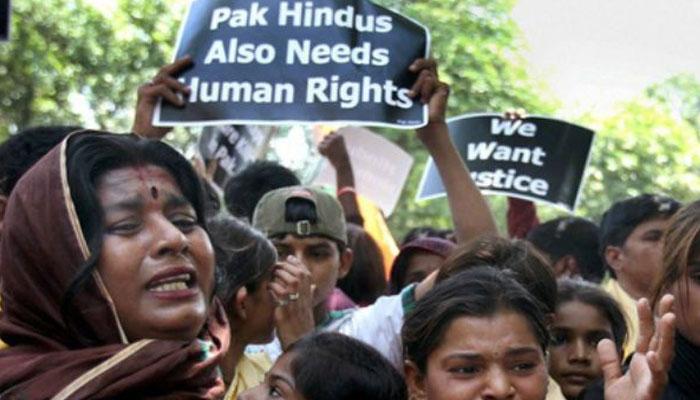
Which religious group has the least amount of human rights in South Asia? The probable answer, perhaps surprisingly, is a group that few think about or recognize as existing – Pakistani Hindus.

The plight of Pakistani Hindus is among the direst of any community in the world and has been so for decades. Yet not many in the world are aware of, much less have any concern for them, even in India.

Hindus in Pakistan are a targeted community and losing their numbers, unlike Muslims in India who are increasing. While there were similar percentages of Hindus in Pakistan and Muslims in India at the time of Partition, Pakistani Hindus have been continually oppressed, marginalised, converted or simply eliminated. The result is that only two per cent of Pakistan is Hindu today.

Pakistani Hindus are among the poorest of the poor and do only the most menial jobs. The most basic human rights are not given to them. Pakistani Hindus cannot register their marriages. Their women are commonly abducted and there is little they can do about it. Pakistani courts seldom hear their pleas, or if they do, seldom rule in their favor. Sometimes paying of high ransoms may work to bring their daughters back, but overall Pakistani Hindus are too poor to afford these. A Pakistan Hindu Marriage Act has been in the courts for years but has not yet been approved, though Pakistan has continued a Christian Marriage Act from the British era.

Pakistan Hospital says Toilet and Bathroom cleaners ONLY for Hindus Christians and Sikhs
Pakistan Hospital says Toilet and Bathroom cleaners ONLY for Hindus Christians and Sikhs. Img source

Hinduism is denigrated in Pakistan textbooks as unholy and the Hindu past of Pakistan is almost eradicated from the record. Pakistanis are taught to distrust and look down upon Hindus, as kafirs, if not subhuman. The result is that Pakistani Hindus often face fierce religious hatred by people who do not even know them.

Also read: These temples in Pakistan are now madrasas

You will not see any thriving Hindu temples left in Pakistan comparable to the great mosques that have continued in India. Hindu temples are neglected, occupied or destroyed. There are no Hindu religious schools of any size or any group funding them like the Saudi-funded madrasas in India. There are no government honored Hindu holidays in Pakistan, such as Islamic holidays in India.

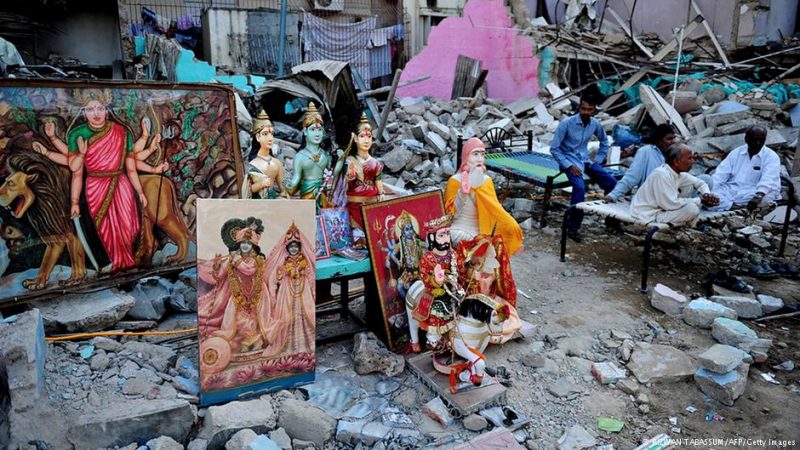
Pakistani Hindus sit next to the demolished temple in Karachi
Pakistani Hindus sit next to a temple demolished by the Pakistani authorities in Karachi

There has never been any major Pakistan political leader who was a Hindu. Hindus have no real representation in government and are afraid to even try to vote. There are certainly no comparable Hindu actors lauded in Pakistan movies as there are Muslim actors like the Khans in India. In fact, Hindus have no presence in the media or any social influence. The Hindu organisations that do exist often come under vandalism or outright attack, and try to function in secrecy.

Where is the outrage from any corner?

Ignoring the plight of Pakistani Hindus began with the government of India after 1947, perhaps fearing that highlighting their plight might inflame anti-Muslim sentiments among Hindus in India. It has continued ever since, almost without any question as to its consequences.

The Indian media and academia followed suit after the government, and the foreign media and academia naturally followed their examples. Well-funded pro-Muslim lobbies have naturally not wanted to have the issue addressed, and the large pro-Pakistan lobby in America has invested heavily in trying to show that Pakistan is much more tolerant than it is.

The Left in India has been averse to addressing the cause of Pakistani Hindus, probably because it considers Hinduism to be Right wing and the enemy. Human rights and NGO groups afford them little attention as little funding is available to favor their cause. Even feminists have ignored the plight of Pakistani Hindu women, though Pakistani Hindu women are among the most ill-treated in the world.

Hindus in India do not give adequate attention to the plight of Pakistani Hindus, either. Yet should they raise the issue of mistreatment of Hindus in Pakistan, they are criticised as communal or disturbing social harmony. The negation of Pakistani Hindus has been so successful that if one raises the issue, many people think that one is exaggerating or making up their plight.

The need for action

Should not all groups in India insist that Pakistani Hindus be afforded the same rights as Indian Muslims? After all, they are both human beings.

Fortunately, the Narendra Modi government is beginning to address the plight of Pakistani Hindus and a few India media groups are making better efforts as well. Yet so far they are only scraping the tip of a massive iceberg of oppression and abuse that will require persistent and determined struggles to effectively correct.

Source: DailyO

Ancient Instrument described in Vaimanika shastra

In the Vedic literature of India, there are many descriptions of flying machines that are generally called Vimanas. There are no physical remains of ancient Indian aircraft technology but references to ancient flying machines are commonplace in the ancient Indian texts. Several popular ancient epics describe their use in warfare.

According to the Vaimanika shastra, the vimanas of the ancient texts were actually true aerodynamic flying machines, propelled by what some claim were “mercury vortex engines.”

During the past few years some scientists have studied the Vaimanika shastra to know whether it’s a figment of imagination or if concrete verification can be found.

Chumbak Mani

Maharshi Bhardwaj in his book Vaimanika shastra has given the recipes for making many instruments. In one chapter he describes an instrument called Chumbak Mani, which helps to detect any arsenal hidden underground.

In Mumbai professor Sharon, an expert in nanotechnology analyzing the Vaimanika shastra has discovered something incredible. The formula to make a material called Chumbak Mani. Rather than a chemical formula this looks like a magic potion. The components they used in these ingredients have been understood. Using these, they were able to realize two electrodes and the liquid that composed the Chumbak Mani, an ancestor of the modern solar panels.

As per the description, Chumbak Mani is component which emits some kind of electrical signals. Through that electrical power they can be able to detect any material which is hidden underground while the airplane is on its flight.

To melt together the ingredients that make the Chumbak Mani it is necessary to use a technique called flux technology that reaches the fusion point at 1250 degrees. So this is also interesting to know that the flux tech was known to us about 50 years ago. But this tech was known to maharishi Bharadwaj 1000 years ago.

Vakra Prasarana Yantra

Another validation comes from the research by Dr. Prabhu, an Indian scientist who was able to find out and study the original manuscripts of Shastri. Through the analysis of the text he could synthesize and patent five completely new alloys. He also realized the model of a mechanical element of a Machine called Vakra Prasarana Yantra. This machine is described as a mechanism to take sharp turns or reverse gear what is called in Sanskrit as the sarpa (snake like motion) or tiriyak (Reverse).

Vakra Prasarana Yantra or diversion enabling mechanism should be installed in the vimana and then as we are being chased by another enemy aircraft evasive tactics how to avoid it like what they call as sarpa gamana i.e flying like a serpent.

The manuscript on the vimanas is not only the one dictated by Rishi Subbaraya shastri. Professor Nene and Dr. Dongre discovered and translated another manuscript which are also linked to the mysterious sage Bharadwaj. Hence they date back to more than 2000 years ago. The very evolution in the universe started from the sun in the same way the creation of the galaxies took place from the primal atom these are the opening words of the Amshubodhi, a very ancient treatise of cosmology and physics of nuclear particles. The slokas describe elaborately the evolution of universe from the big bang till the creation of universe.  It is strikingly surprising that all the description given in these three steps are same to the one by Hans Stephane given in his book of general relativity but the Amsubhodini is not just a theory book.

Dhvantapramapaka Yantra

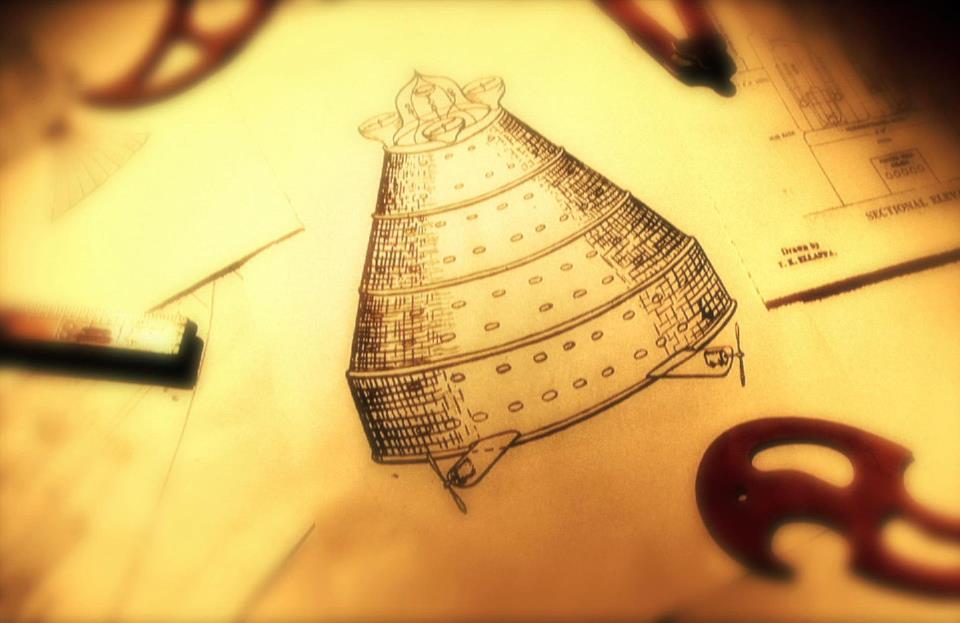
In Varanasi a faculty of physics reconstructed the Dhvantapramapaka Yantra (a spectrometer) an instrument used to study the light of the stars. The source of light, point source is located at the focus of convex lens and when light goes into the lens it becomes a parallel beam and it falls on the prism which is located inside this.

The special component of this spectrometer is a crystal prism, it is conical shaped very different from those that are used today and it forms spectrum which is focused on the screen by means of a convex lens and the spectrum comes in the form of a ring of different colors depending upon the source of light. When switched on the machine it starts to work just as we see the spectrum of the arc in the form of coloured circles. So thousand years ago our ancestors saw similar circles coming from the light of the sun and also from the stars and on the basis of that they characterized the spectrum of sun and stars into different categories much earlier than the modern classification of these stars.

Watch Documentary: Vimana – The Flying Chariots Of The Gods

In the Vaimanika shastra we find the description of a TV, radar, missile and even an AC along with many other devices that didn’t exist at that time. An airplane must have existed, they must’ve known how to make it, they must’ve known the ingredients which is all written there cannot be just fiction or imagination of Bharadwaj.

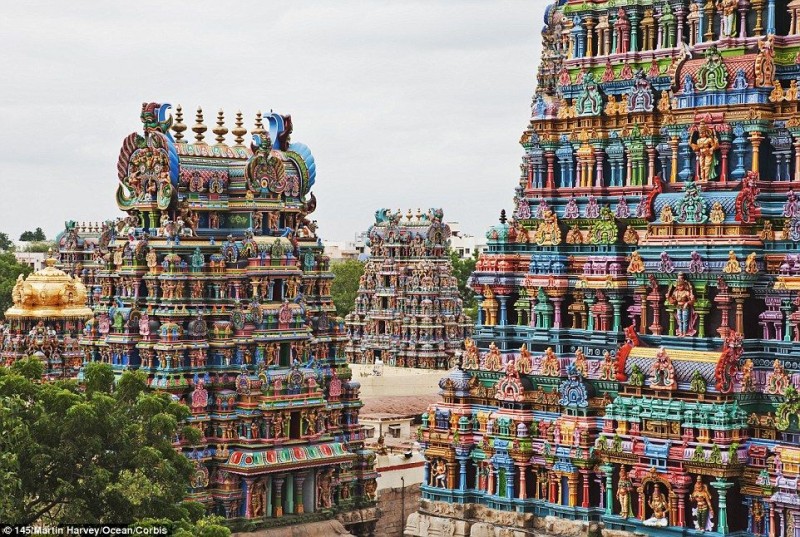
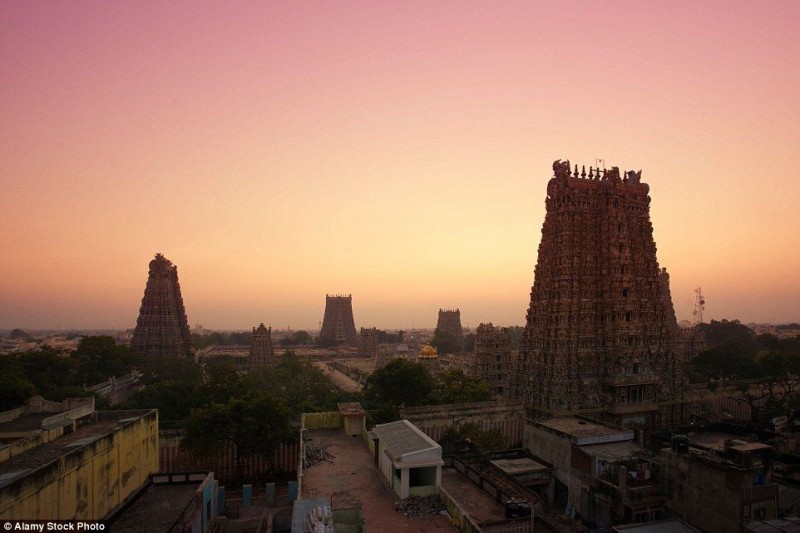
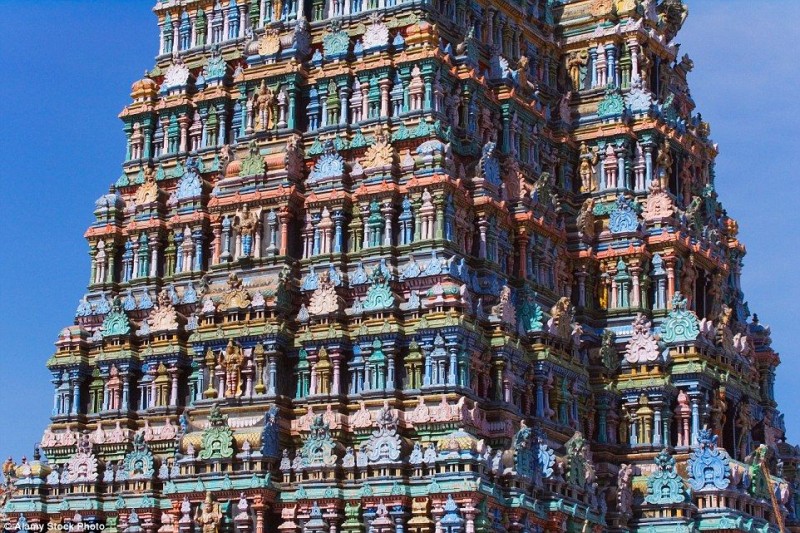
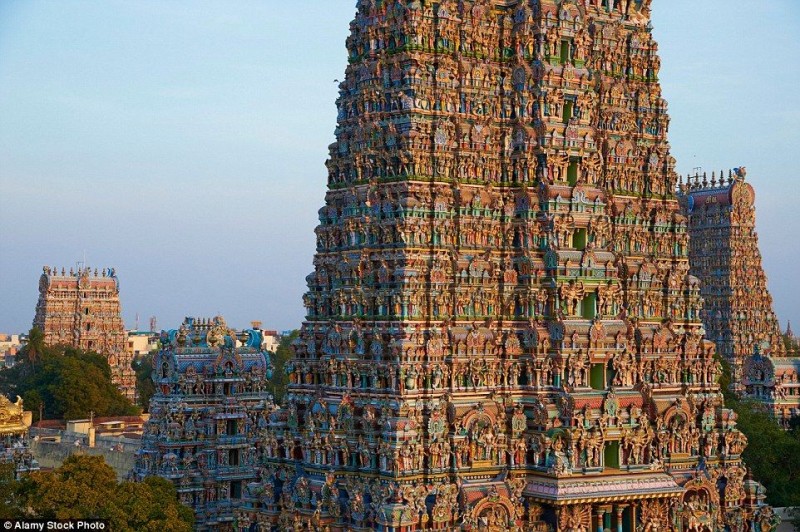
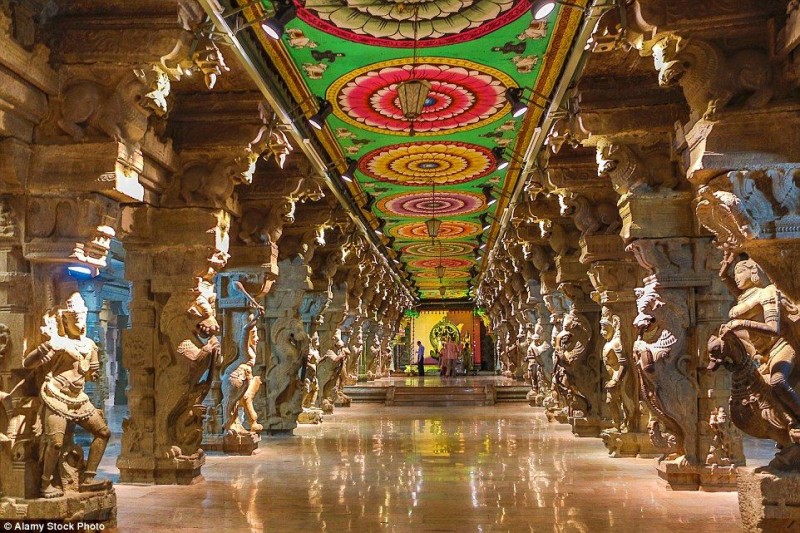
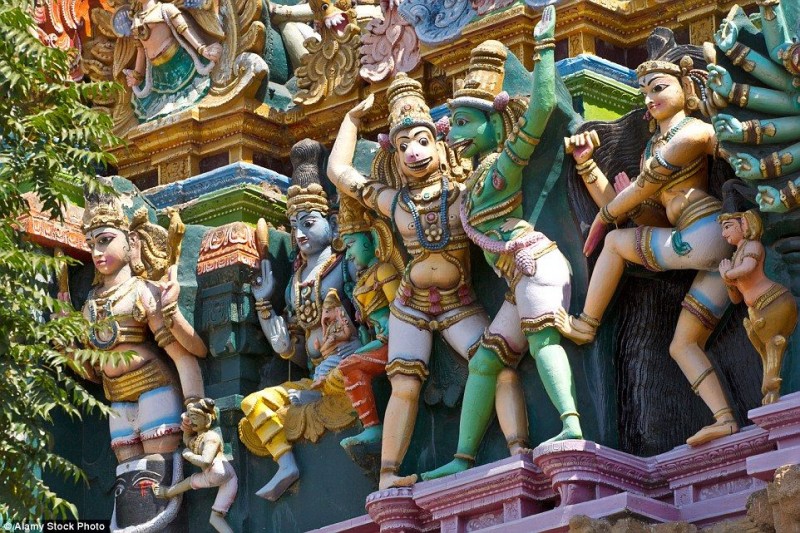
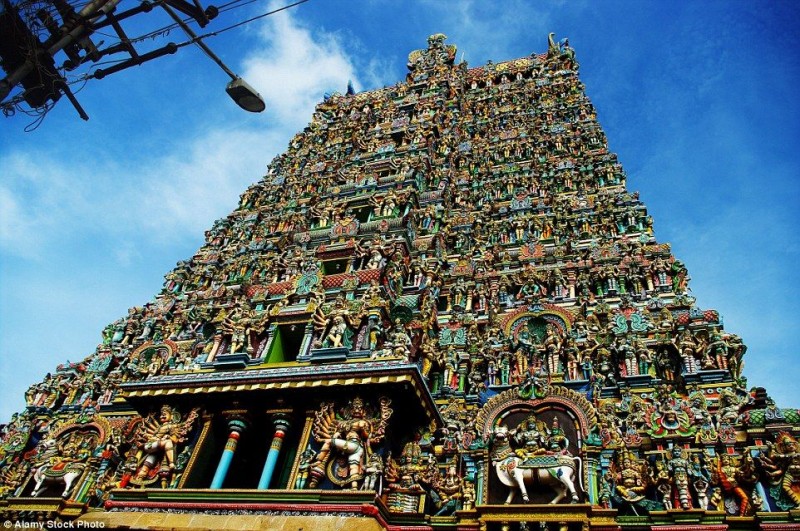
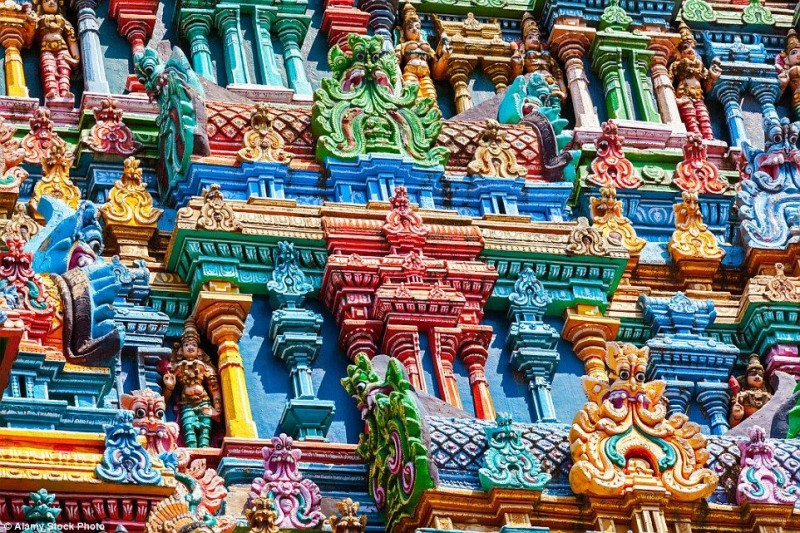
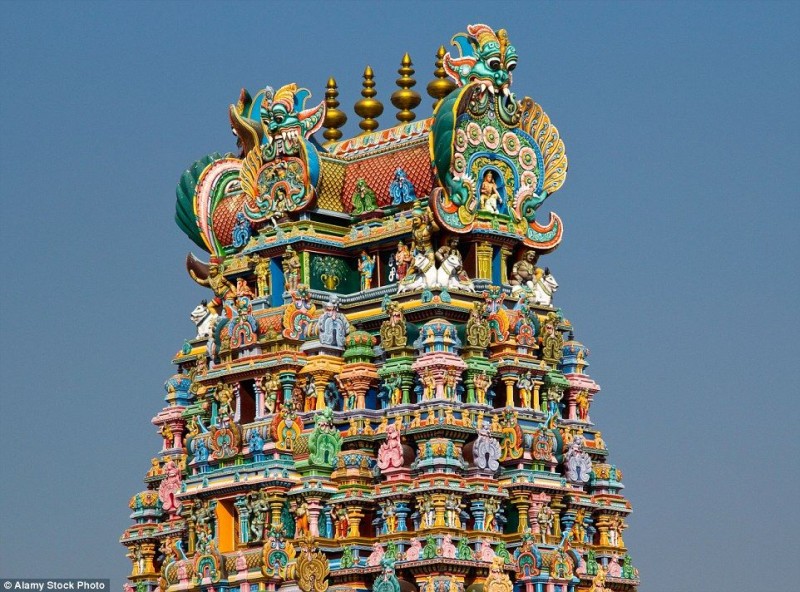
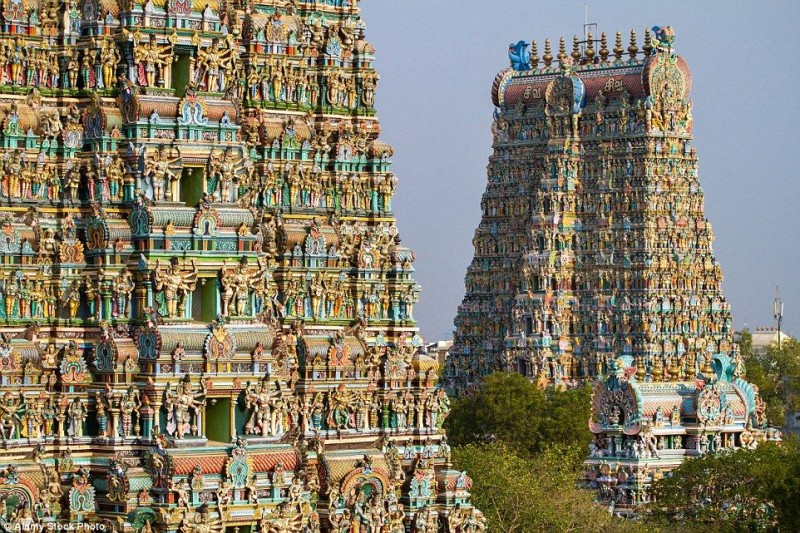
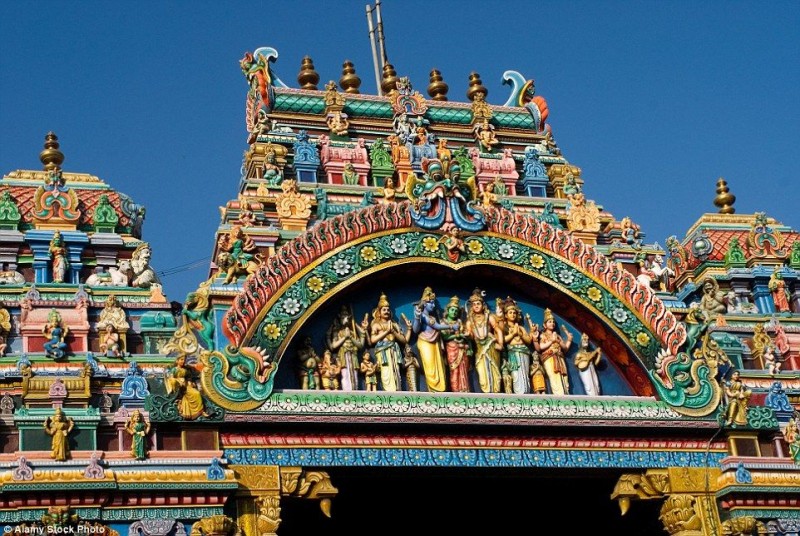
The colorful Meenakshi Temple

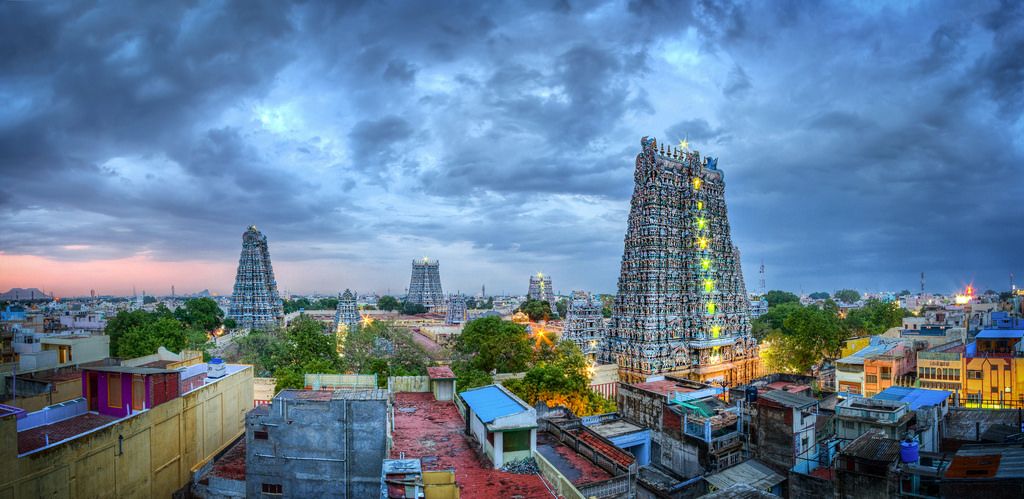
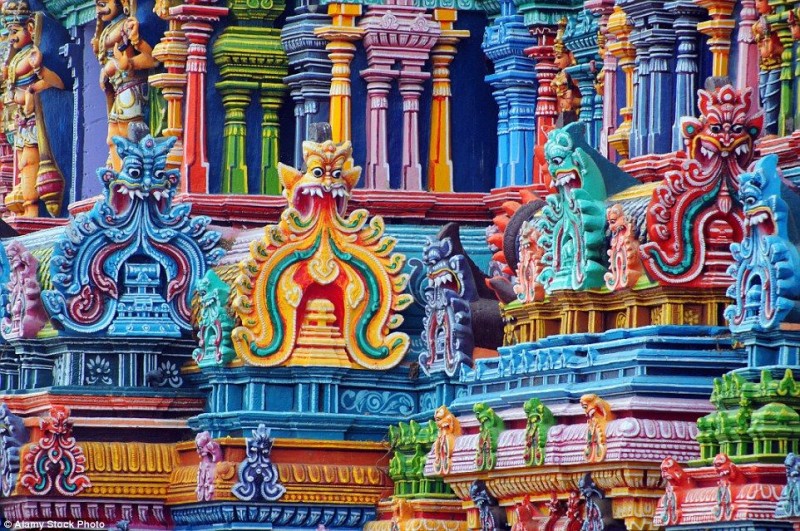
There is no chance of missing these colorful temples in India as they’re painted every shade of the rainbow.

The Meenakshi Temple of MaduraiThe Meenakshi Temple of Madurai

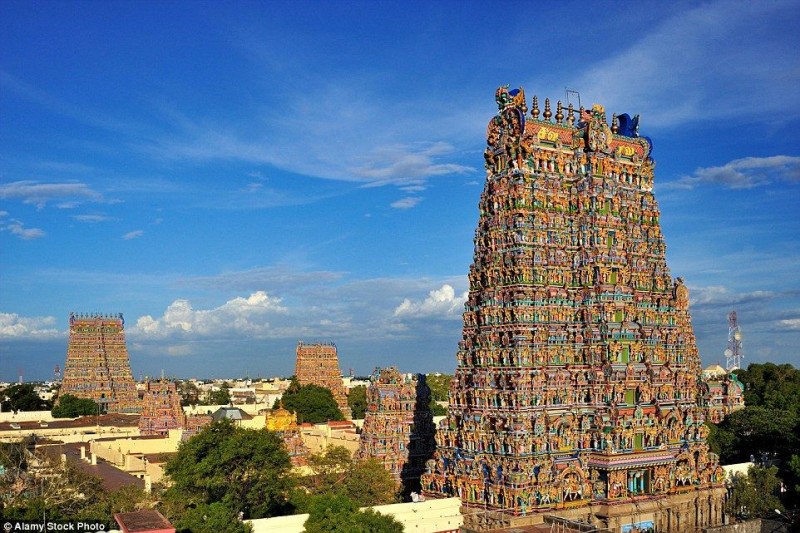
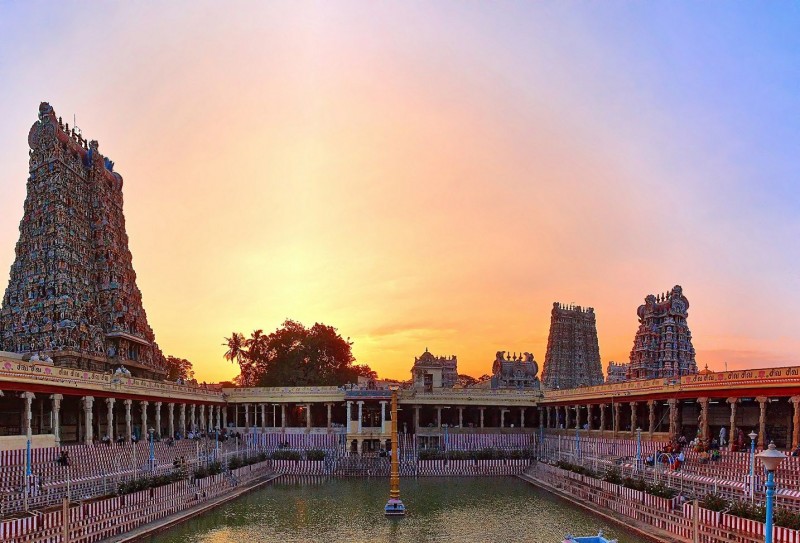
Meenakshi Temple is a master piece and was the center of activity for the promotion of art and culture in Madurai. The temple complex covers 15 acres, and has 4,500 pillars and 12 towers — it’s massive!
The Meenakshi Temple of Madurai

The tallest tower rises to 170ft and attracts around 15,000 visitors a day, who flock to the temple for blessings.The Meenakshi Temple of Madurai The Meenakshi Temple of Madurai

The temple forms the heart and lifeline of the 2500-year-old city of Madurai. The Meenakshi temple was almost completely destroyed in the year 1310 following the invasion of the Islamic conqueror Malikkapur. The Meenakshi Temple of Madurai The Meenakshi Temple of Madurai

The present structure was built between 1623 and 1655 CE by Nayakas, who ruled Madurai from 16th to 18th century. The Meenakshi Temple of Madurai

Read More: The Meenakshi Temple of Madurai

The Meenakshi Temple of Madurai

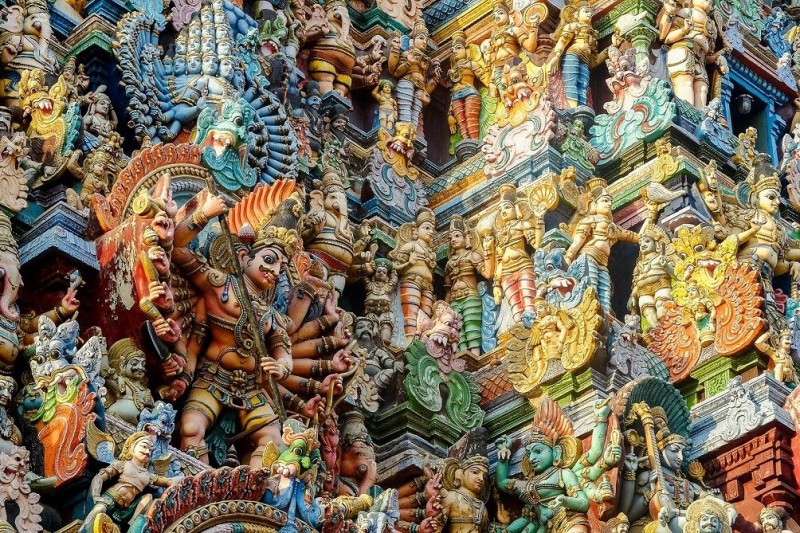
The thick layers of enamel paint that can be seen today have been applied to the gateway towers, or gopurams, in celebration of big events and festivals over recent years. The Meenakshi Temple of Madurai The Meenakshi Temple of Madurai The Meenakshi Temple of Madurai

Each gopuram forms a pyramid shape, with the stone figures of gods, goddesses, demons and animals covering the multi-storied structures. The Meenakshi Temple of Madurai The Meenakshi Temple of Madurai The Meenakshi Temple of Madurai

It was on the list of top 30 nominees for the “New Seven Wonders of the World”.

Cannabis preserved India’s ancient Ellora caves from decay for 1,500 years

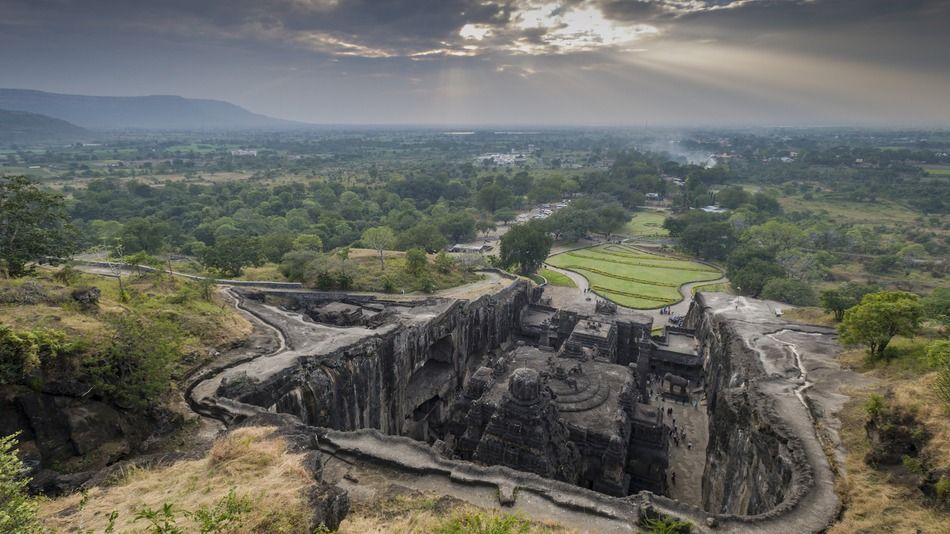
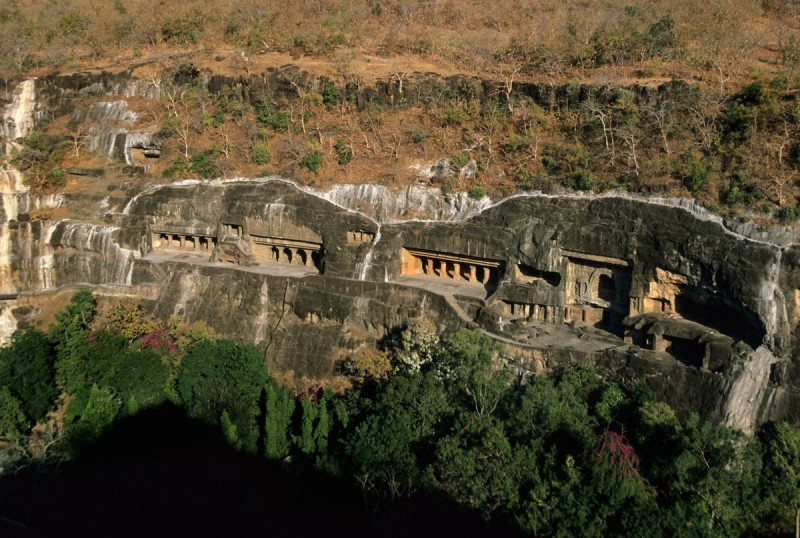
For years, the famous Ellora caves in the city of Aurangabad of Maharashtra have evoked curiosity as to just how in the world they have been immune to decay. For 1,500 years!

Scientists seem to have an answer, and it’s the most unlikely one.

They say it’s cannabis. Or Ganja.

Indian archaeologists have discovered that hemp played a key role in preserving the ancient Ellora caves in the western state of Maharashtra. New findings have revealed that a mixture of hemp, clay and lime plaster prevented the UNESCO World Heritage site from decaying.

Hemp, locally known as ganja or bhang, played a key role in keeping the paintings at the sixth-century archaeological site intact, according to a new study by archaeologist Rajdeo Singh and botanist MM Desai.

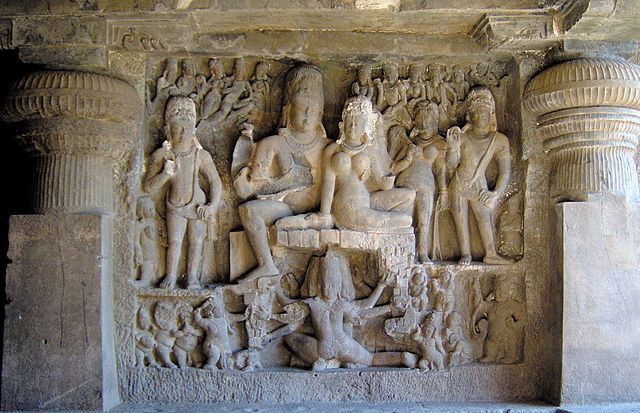
Ellora Caves, India
Img Source

The duo collected a sample of plaster from Cave 12 of the complex and isolated cannabis sativa, or ganja, before examining it under a scanning electron microscope, according to the study, published in the journal Current Science.

Other techniques, such as Fouriter transform infrared spectroscopy, confirmed the presence of cannabis sativa in the building material.

Dr Singh told the Times of India:

In the sample collected from the Ellora cave, we found 10 per cent share of cannabis sativa in the mix of mud or clay plaster. This is the reason why no insect activity is found at Ellora.

Ellora has proved that only 10% of cannabis mixed with clay or lime in the plaster could last for over 1,500 years,” he added.

Image Source
Image Source

The remains of Cannabis from the sample of clay plaster of Ellora suggest that it was used with clay/lime binder as insulating agent as well as to provide a degree of strength to the plaster,‘ the researchers wrote.

The study also hints at how Indians knew many valuable properties of hemp even in the 6th century.

Built between the fifth and the tenth centuries, Ellora has a series of 34 Hindu, Buddhist and Jain caves, which represent the epitome of Indian rock-cut architecture. These include temples, monasteries as well as residential viharas and mathas, which have been carved out of solid rock from the region’s Charanandri Hills. Many of the caves have rich paintings which are still protected.

Studies also show that Hemp was not used in the neighboring Ajanta caves, which are about 30 rock-cut Buddhist structures dating back to the 2nd century BC. Rampant insect activity has damaged at least 25% of the paintings at Ajanta.

Studies in Europe have estimated 600 to 800 years of life span to the hempcrete wall system, but hemp in the clay plaster of Ellora has survived more than 1,500 years.

Cannabis sativa plant
img source

Cannabis In India

In India, hemp domestication dates back to 5,000 BC, when the plant’s stem was used for fibre, its achene or fruit for food and oil, and its resin for medicine.

Medicinal use of cannabis was first recorded in India in the medical work ‘Sushrita’ compiled in around 1,000 BC as well as in the texts Tajnighuntu and Rajbulubha, where it s described as being used to clear phlegm, treat flatulence, sharpening memory, increasing eloquence and stimulating appetite.

The Hindus consider Cannabis as a holy plant and it is used in Hindu festivals like Shivratri even today.

Despite the interesting discovery, the use of cannabis in construction in India may still be a long way off as cultivation, transport, possession and consumption of marijuana is banned under Indian law.

Archaeologists Stumble across ruins of a Forgotten Civilization in Mizoram

In an incredible discovery, archaeologists from India have come across ruins of a ‘Great Forgotten Civilization’ in Mizoram.

A team of archaeologists from Archaeological Survey Of India has excavated structures at Vangchhia, in the Champai district of Mizoram that they believe are from an older civilization which might have once existed there, The North East Today reported.

Vangchhia is the only ASI protected location in Mizoram.

The site held the key to hitherto-unknown facts about Mizoram and the northeast, Sujeet Nayan, the assistant superintending archaeologist at ASI Delhi and director of the excavation at Vangchhia, told Northeast Live. He also told the newspaper that it might be one of the most significant finds in recent times.

The team documented more than 50 structures at Vangchhai and will return soon for further research and study. Fragments of charcoal and pottery have been collected which will be sent to specialized laboratories for carbon dating and other scientific analysis.

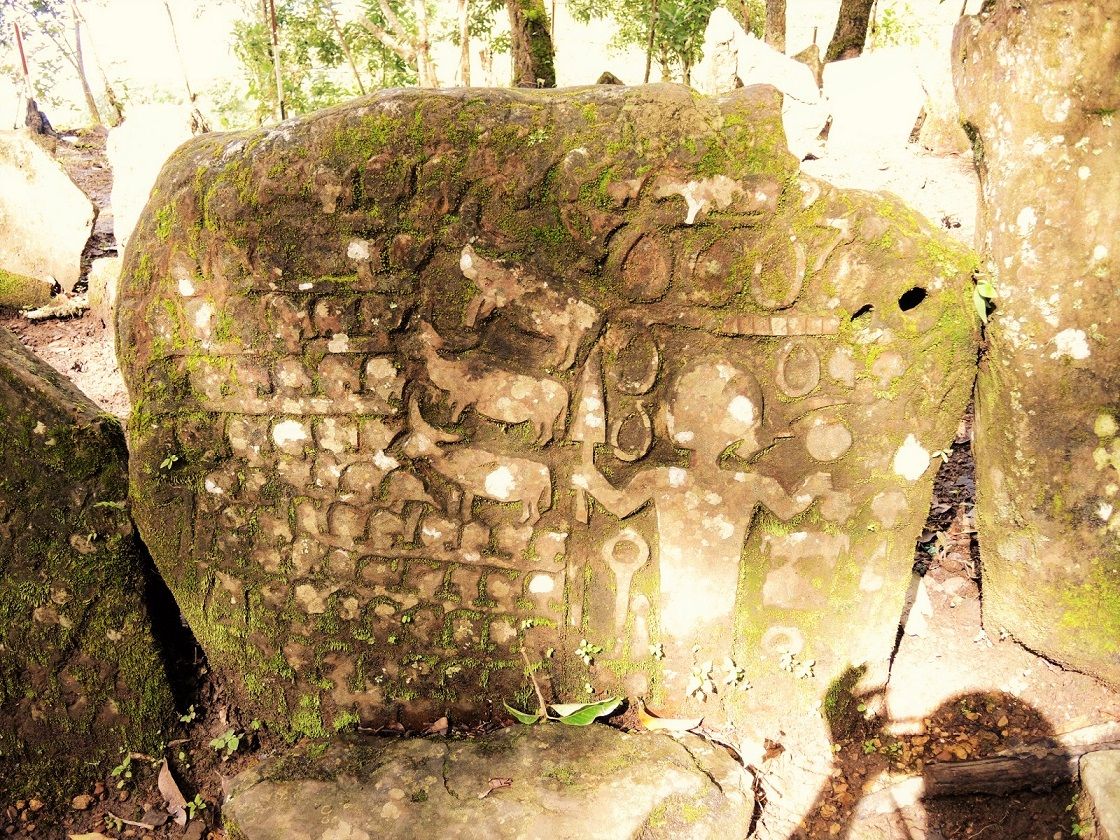
 Archeologists Stumble across ruins of a Forgotten Civilization in Mizoram
img source

We were exploring what lay beneath the bushes and thick foliage. The entire site could hold traces of a lost city or a greater lost civilization. It is amazing to stumble upon so many things. We need more time and research to reach a final conclusion,” said Nayan.

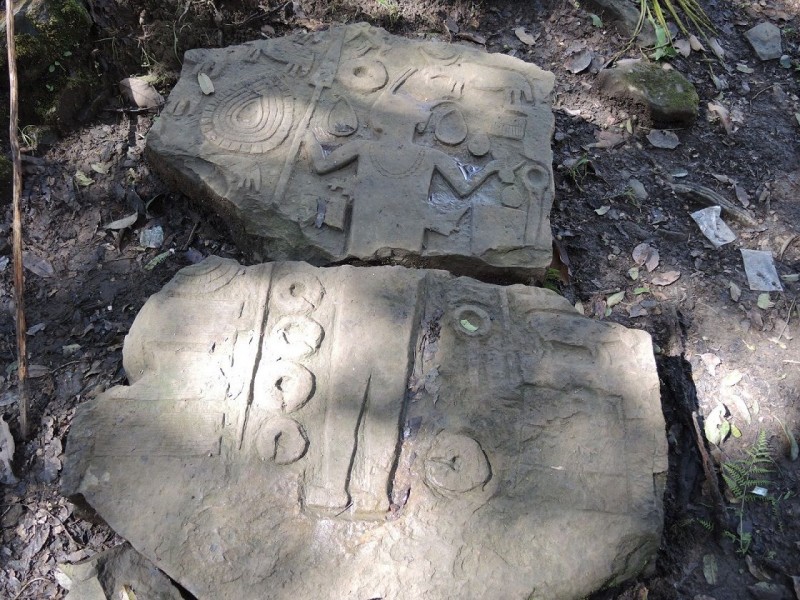
The team came across burial sites that seemed like water pavilion and terraces that were reminiscent of palatial buildings. The retaining walls or terraces were made of big stones and the average height of each terrace ranged from 10 to 25 feet.

The terraces might have served as burial sites, but this can’t be ascertained as of now,” Nayan said. “There are nine terraces. We explored around eight. We also found evidence of what seems to be a water pavilion. We presume people here liked their environment and the water pavilion is comparable to those found in Mughal structures,” he added.

Members of the Archaeological Survey of India agree that this ancient site once belonged to a great ‘Lost Civilization’ which ruled the region in the distant past.

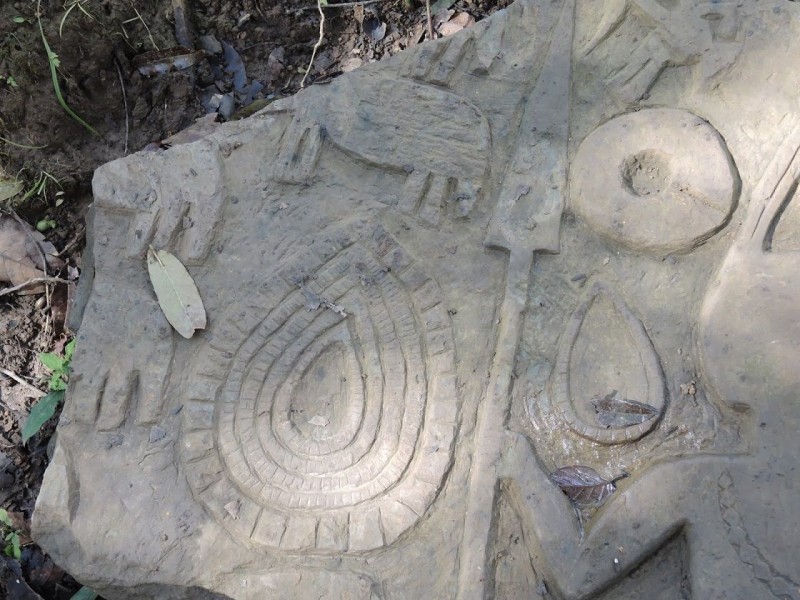
The excavation was conducted after the director general of ASI visited the site in November 2015 with the objective to study the structures that have floral, animal and human depictions on them.

Further studies will be conducted on the site and researchers hope to have more information about the mysterious civilization after lab results provide an approximate age of the structures.

 Archeologists Stumble across ruins of a Forgotten Civilization in Mizoram
img source

Mizoram is located in northeastern India, and is bordered by Myanmar to the east and south, Bangladesh to the west, and the states Tripura, Assam, and Manipur to the north.

Mizoram is also known as “Land of the Mizos.”  It is a hilly area with many forests and a great deal of foliage.  Modern Mizoram is populated by Scheduled Tribes, although it is one of the more sparsely populated states in India. The discovery of the lost city in Mizoram may reveal significant information about the ancient civilizations that lived there and in surrounding areas, which would have been influenced by the topography of the area and the climate, as well as provide insight into the origins of the modern-day tribes in Mizoram. –

Often referred to as a paradise unexplored, northeast India is indeed a culturally and historically rich territory, a treasure trove for explorers, nature lovers, trekkers and wildlife enthusiasts alike.

Caste System originated during Gupta dynasty: Study

When did caste become the dominant norm for ethnic communities of a region? 70 generations ago, or nearly 1,500 years ago.

Over 1,500 years ago, the Gupta emperors ruled large parts of India. They helped consolidate the nation, but they also popularized India’s caste system, making it socially unacceptable for people to marry outside their castes. This ancient history hinted at in various linguistic, archaeological and genetic studies has been confirmed by a path-breaking genetic study recently published.

Researchers from the National Institute of Biomedical Genomics (NIBMG) at Kalyani, West Bengal, analysed DNA samples of 367 unrelated Indians belonging to 20 population groups. These covered castes from different parts of India, and most large tribal populations from central and Northeastern India. Also included were samples from two Andaman & Nicobar tribes.

India’s present diverse population arose from five types of ancient populations that freely mixed and interbred for thousands of years.

It was earlier believed based on similar studies that Indian ancestors were from only two populations – Indo-European (ANI), Dravidian (ASI). But this study has been able to provide evidence that four ancestral stocks contributed to the genetic diversity of present-day Indians – Indo-European (ANI), Dravidian (ASI), Tibeto-Burman (north-east India) and Austro-Asiatic (fragmented in east and central India; spoken exclusively by the tribals). A fifth ancestral lineage that is dominant among the Negrito tribals (Jarawa and Onge) of Andaman and Nicobar Islands was also identified by the scientists.

The study compared genetic sequences from Indian samples with those from Central Asia, West Asia, China and adjacent regions to trace how humans first arrived in India.

What the study also unearthed was the deep imprint of a significant social cultural process in Indian society. It found that interbreeding between communities `abruptly’ ended around 70 generations ago, which translates to about 1,575 years ago, sometime in the 6th century. It coincided with the period when the Gupta Empire ruled India. This period had seen the consolidation and supremacy of the caste system, entrenched through the sanction of scriptures as well as enforcing mechanisms of the rulers.

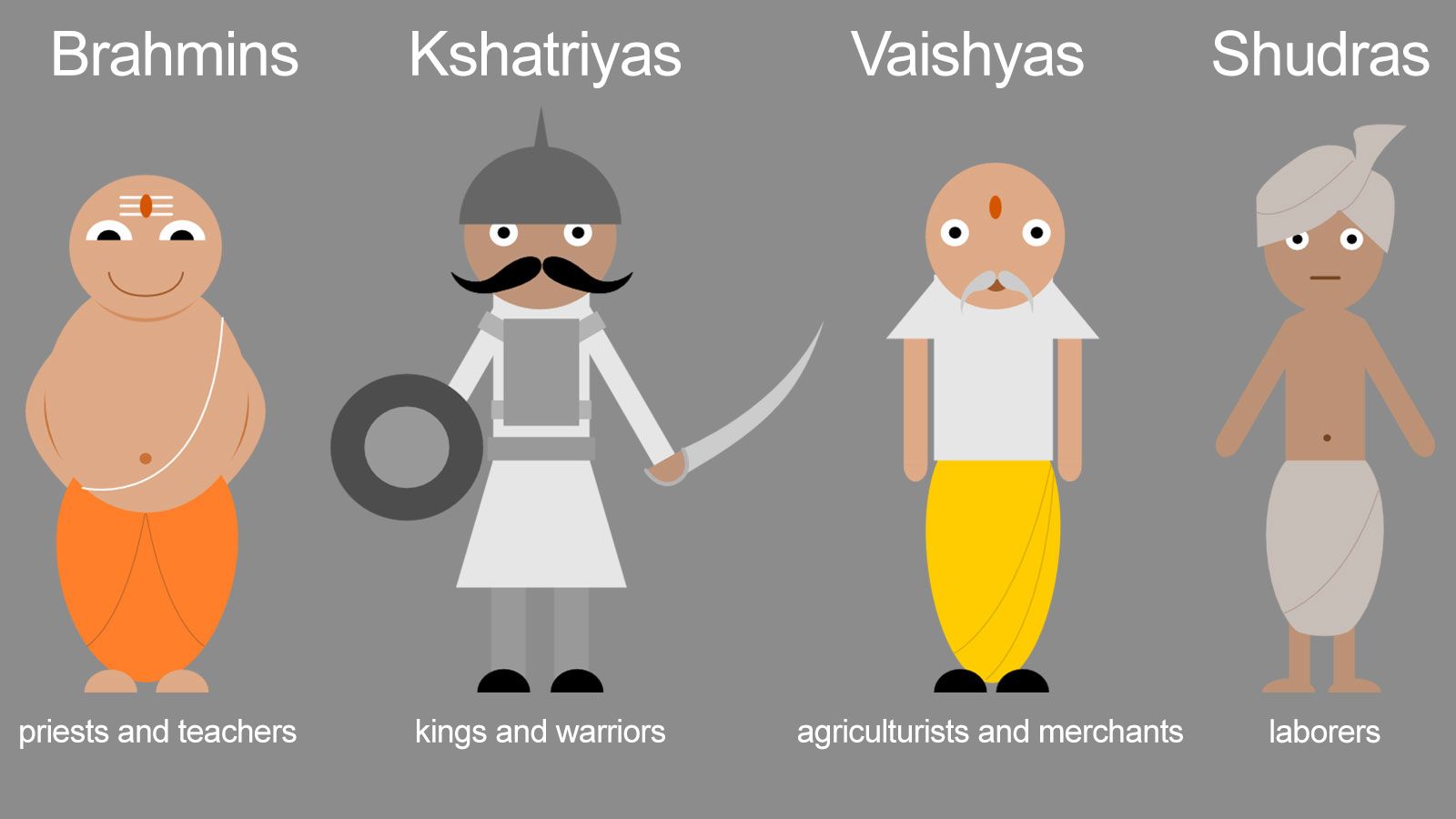
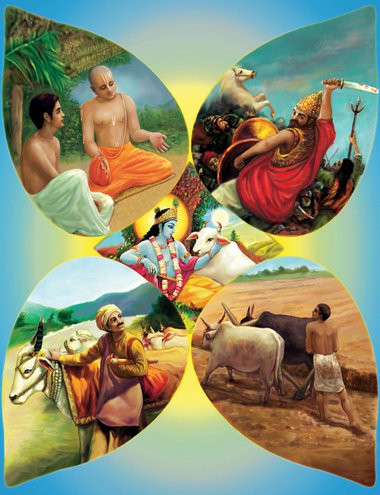
The reign of the ardent Gupta rulers, known as the age of Vedic Brahminism, was marked by strictures laid down in Dharmasastra—the ancient compendium of moral laws and principles for religious duty and righteous conduct to be followed by a Hindu—and enforced through the powerful state machinery of a developing political economy.

Caste System in IndiaGenetic analysis also revealed that in many parts interbreeding across caste rigidities continued for some time, as in Bengal and Maharashtra. The establishment of endogamy among tribal populations was less uniform.  In the case of West Bengal Brahmins, marriages with the northeastern communities continued until the arrival of the 8th century Pala dynasty which cut off these regions.
By identifying five ancestral populations among contemporary Indians, the researchers have revealed that Indians today are more genetically diverse than we’ve realized. But they have also shown that social shifts can dramatically affect a nation’s genomes. The caste system has consequences that affect people all the way down to their DNA.

The caste system originated in Vedic times, perhaps 1500 BCE or earlier. It must have slowly spread and got entrenched over centuries. Its impact on genetic material becomes evident around 1600 years ago.

1,000-year-old Stolen Indian statues recovered from New York auction house

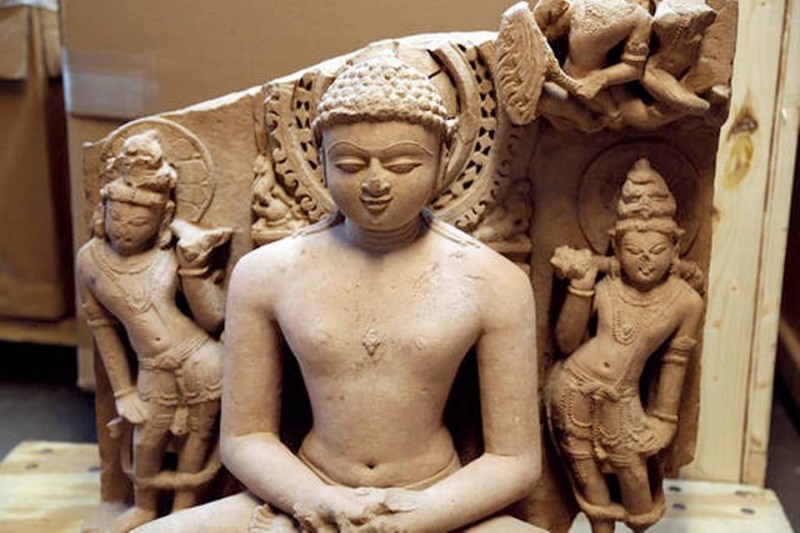
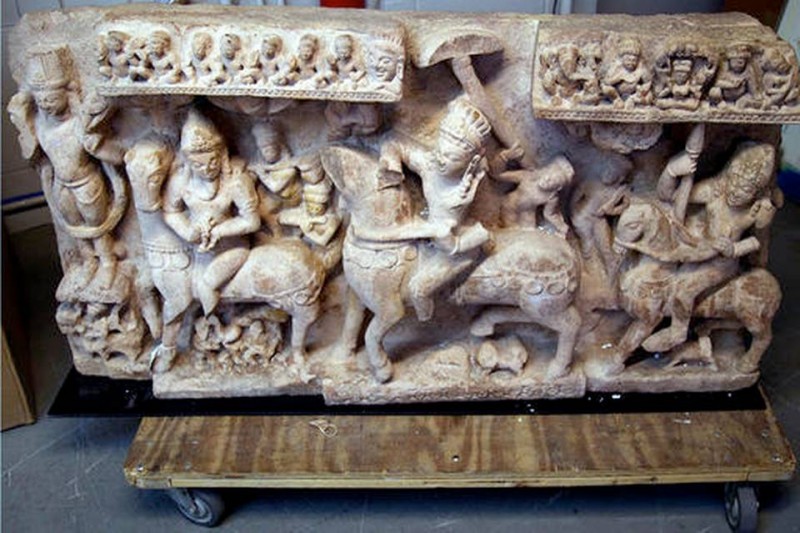
The two sandstone statues—Stele of Rishabhanata and Revanta—are valued at about $150,000 and $300,000 respectively.

Two Indian statues that are more than 1,000 years old were seized from Christie’s auction house after investigators discovered they had been smuggled out of the country, eventually landing in New York.

The artifacts made from sandstone were recovered from the auction house following an international investigation with assistance from the Indian government and the Interpol.

The seizure occurred on Friday. The antiquities were to be part of an auction next week called “The Lahiri Collection: Indian and Himalayan Art, Ancient and Modern.”

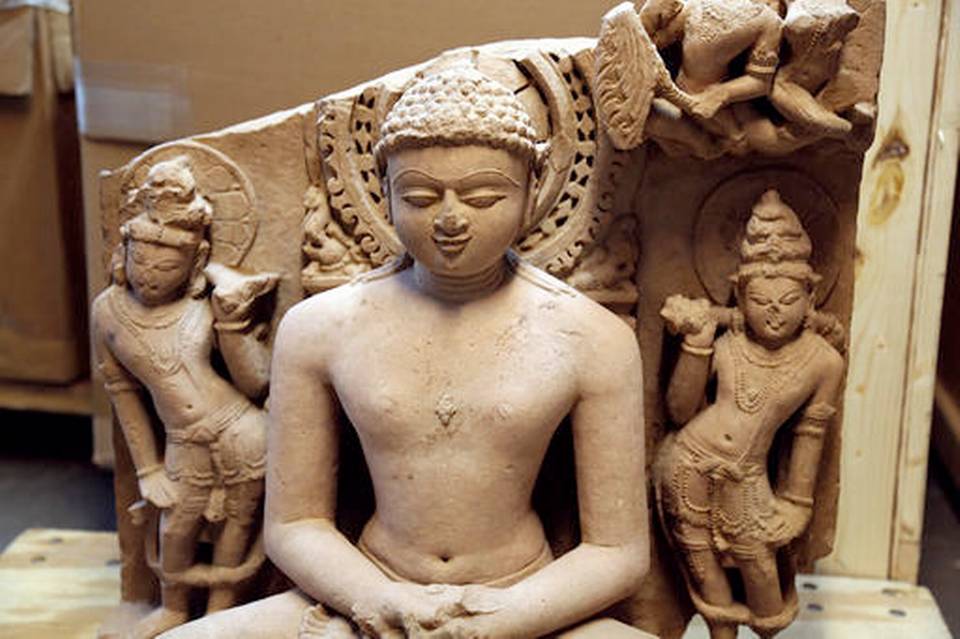
One statue called “Stele of Rishabhanata” depicts a stele carved with the first Jain Tirthankara and is valued at approximately USD 1,50,000.  It is believed to be from Rajasthan or Madhya Pradesh belonging to the 10th century AD.

A sandstone statue of Rishabhanata, from Rajasthan or Madhya Pradesh, India, in the 10th century A.D., flanked by a pair of attendants. It is valued at approximately $150,000
A sandstone statue of Rishabhanata, from Rajasthan or Madhya Pradesh, India, in the 10th century A.D., flanked by a pair of attendants. It is valued at approximately $150,000 [Credit: U.S. Immigration and Customs Enforcement]
The second artifact is a Buff Sandstone Panel depicting Revanta and His Entourage from India in the 8th Century AD, in a very rare representation of the equestrian deity and valued at approximately USD 300,000.

A sandstone panel depicting a very rare representation of the equestrian deity, Revanta, and his entourage, from India, in the 8th Century A.D. It is valued at approximately $300,000
A sandstone panel depicting a very rare representation of the equestrian deity, Revanta, and his entourage, from India, in the 8th Century A.D. It is valued at approximately $300,000 [Credit: U.S. Immigration and Customs Enforcement]
Christie’s said in a statement that it would never knowingly offer a stolen work of art and it was cooperating with authorities.

“Christie’s devotes considerable resources to investigating the provenance of all objects we offer for sale. This is one of the difficulties the art market faces in vetting antiquities, which is why Christie’s very much values building strong relationships with and between countries of origin, law enforcement, archeologists, and the collecting community,” the statement read.

According to a yearslong, ongoing investigation by federal agents and the Manhattan district attorney’s office, the Rishabhanata statue was sold in 2006 or 2007. The Revanta panel contained a piece that had been perfectly broken off to be sold by smugglers after the sale of the main sculpture.

The seizure sends an important message, said Angel M. Melendez, special agent in charge of the New York office of U.S. Immigration and Customs Enforcement’s Homeland Security Investigations.

First and foremost, it demonstrates that we are committed to protecting cultural heritage around the world, and second, it demonstrates that we are monitoring the market to protect prospective buyers as well,” Melendez said.

Investigators believe both came from a smuggler in India who’s awaiting trial on charges he looted rare antiquities worth tens of millions of dollars from seven countries. Federal officials said four museums and a collector have surrendered looted artifacts within the past year. Four others have been arrested in the scheme.

The consul general of India praised authorities for their work in tracking down the statues.

I would like to convey my deep sense of appreciation to HSI for the exceptional work done in locating and retrieving the sculptures brought into the United States by organized crime syndicates,” said Ambassador Riva Ganguly Das.

Source: India.com

British enlisted Indian children as young as 10 during World War-I

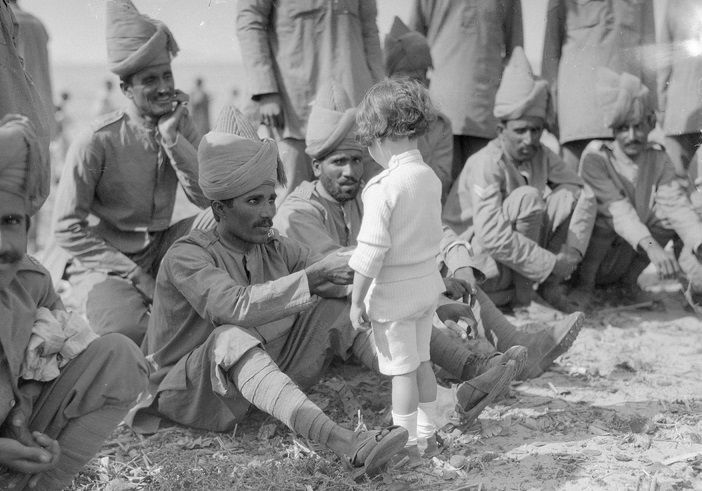
Britain’s World War-I army included Indian children as young as 10-years-old fighting against the Germans on the western front, according to a new book on the role of Indian soldiers in the Great War.

The youngsters were shipped over to France from the far reaches of the British Empire to carry out support roles, but were so close to the front line that many were wounded and admitted to hospital, according to ‘For King and Another Country: Indian Soldiers on the Western Front 1914-18’.

The account by writer and historian Shrabani Basu is based on official papers at the National Archives and British Library. Some of the Indian children, including a 10-year-old “bellows blower”, and two grooms, both 12, provided support to cavalry regiments, a ‘Sunday Times’ report said.

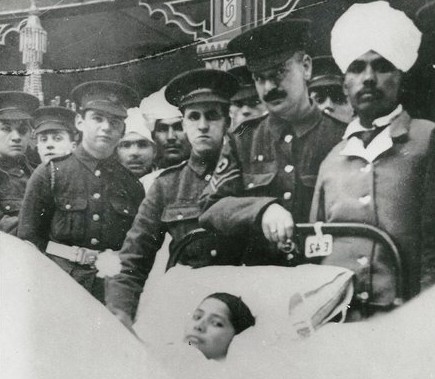
Pim, a Gurkha boy, was given an award for bravery in combat

One of the youngest boys involved in direct combat was a “brave little Gurkha” called Pim, 16, who was given an award for valour by Queen Mary while he was recuperating in hospital in Brighton. Basu believes many of the children came from poor families and that they would have lied about their age at recruitment offices in India, where they were encouraged to sign up for a monthly salary of 11 rupees.

In the case of a 10-year-old, it should have been pretty obvious that they were underage,” she told the newspaper.

This embarrassment was shared by some British officials.

In one dispatch to Lord Kitchener, secretary of state for war, Sir Walter Lawrence, a civil servant tasked with overseeing injured Indian troops, wrote: “It seems a great pity that children should have been allowed to come to Europe.”  About 1.5 million Indian soldiers fought for Britain in the First World War, with a handful being awarded the Victoria Cross bravery medal.

Basu’s book also reveals that British nurses were barred from treating Indian soldiers in war hospitals and were allowed only to supervise orderlies, leading to claims of discrimination.